The Australian dollar briefly hit a more than two-month high, buoyed by the US Treasury bond buyback program, as the employment data is about to reveal its true strength.
2026-08-20 08:41:00
On Thursday (August 20) during the Asian session, the Australian dollar traded in a narrow range against the US dollar, briefly touching a new high of 0.7128 since June 8, and is currently trading around 0.7125, almost unchanged for the day. Despite the hawkish tone of the Fed's July meeting minutes, news of the US Treasury expanding its long-term bond repurchase program suppressed US Treasury yields and dragged down the US dollar, allowing the Australian dollar to rise by about 0.5% against the US dollar yesterday. The market is focusing on Australian July employment data (expected to show 15,000 new jobs and an unemployment rate remaining stable at 4.4%), as well as US initial jobless claims and the preliminary S&P Global PMI. In addition, Fed Chairman Warsh will speak at the Jackson Hole symposium at the end of the month, potentially providing guidance on the interest rate path in the second half of the year. 
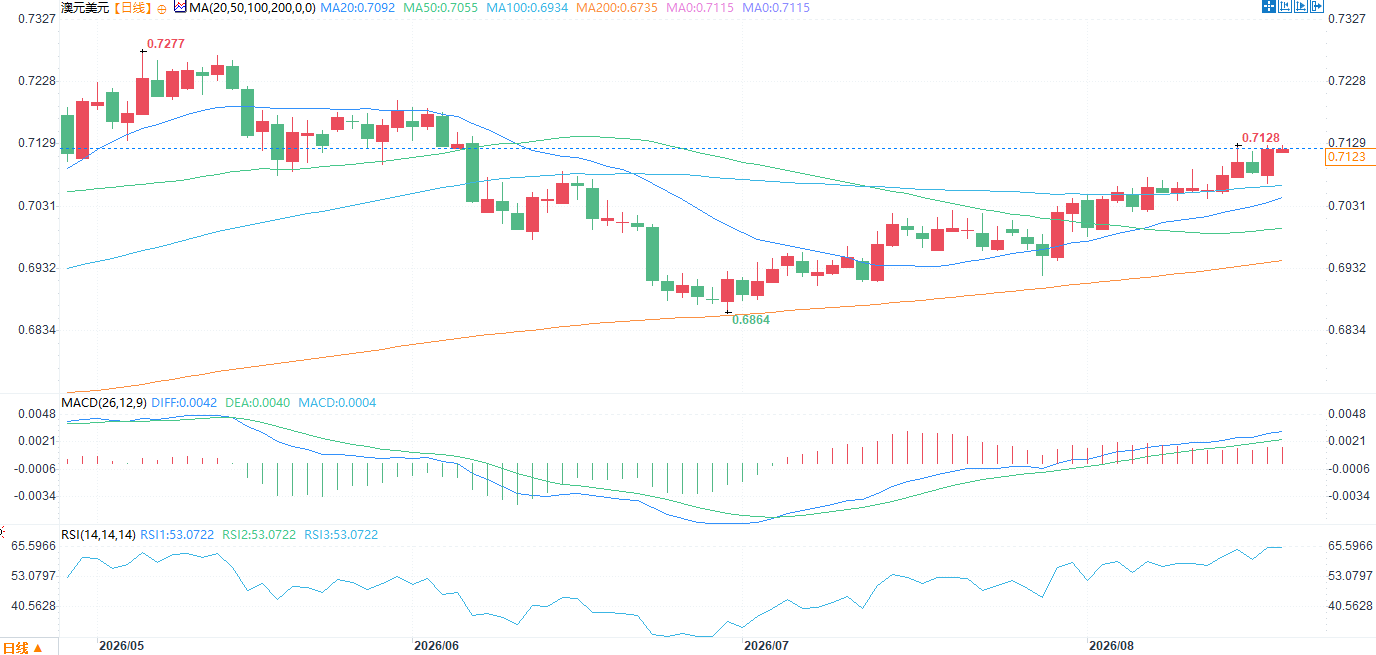 (Australian dollar to US dollar daily chart, source: FX678) At 8:37 AM Beijing time on August 20, the Australian dollar was trading at 0.7122/23 against the US dollar.
US Treasury repurchase program dominates market trends, putting downward pressure on the dollar.
The U.S. Treasury announced it would double its long-term Treasury bond repurchase program from $2 billion to at least $4 billion, triggering a decline in long-term yields and a broad weakening of the dollar. The program reflects the Treasury's concerns about high yields—since the outbreak of the U.S.-Iran conflict, U.S. Treasury yields have remained near their year-to-date highs, energy prices have remained high, and geopolitical tensions threaten nearly one-fifth of global oil supplies. The program will run from September 9 to November 4, during which the Treasury will double its purchases of long-term bonds to moderately influence the yield curve. The market interpreted this as a signal of pressure on U.S. fiscal conditions, putting pressure on the dollar and causing the Australian dollar to rise.Fed minutes: Hawkish bias, but already priced in by the market.
The minutes of the Fed's July meeting showed that dissenters believed inflation had a broad base and supported a "more restrictive policy." Many participants believed that if inflation failed to decline, policy tightening might become necessary. New Chairman Warsh inquired in the minutes whether the meeting frequency should be adjusted to six times a year, with two-month intervals between each meeting, to allow more time for data assessment, but the 2026 meeting schedule remained unchanged. Despite the hawkish tone of the minutes, the market reaction was muted—the minutes were already lagging behind recent weak economic data, and the futures market had reduced the probability of a September rate hike to about one-third. The market is more focused on the Jackson Hole symposium at the end of the month, where Warsh's speech will provide clearer guidance on the interest rate path in the second half of the year.This week's focus: Australian employment data and US PMI
In Australia, the market is focused on Thursday's July employment data – expected to show an increase of 15,000 jobs (previous figure 63,300), with the unemployment rate remaining stable at 4.4%. If the data meets expectations, it will reinforce the expectation that the Reserve Bank of Australia will keep interest rates unchanged, providing support for the Australian dollar; however, if employment growth significantly falls short of expectations, it could trigger a short-term pullback in the Australian dollar. In the US, Thursday will see the release of initial jobless claims and a speech by St. Louis Fed President Musalaim, while Friday will see the release of the preliminary S&P Global PMI. If the PMI data weakens further, it will continue to suppress expectations of a September rate hike, providing further upside potential for the Australian dollar against the US dollar. (Australian dollar to US dollar daily chart, source: FX678) At 8:37 AM Beijing time on August 20, the Australian dollar was trading at 0.7122/23 against the US dollar.
- Risk Warning and Disclaimer
- The market involves risk, and trading may not be suitable for all investors. This article is for reference only and does not constitute personal investment advice, nor does it take into account certain users’ specific investment objectives, financial situation, or other needs. Any investment decisions made based on this information are at your own risk.