Crude oil trading alert: Crude oil's rebound is weak, and it is expected to maintain a slight fluctuation in the short term.
2026-08-20 09:37:02
WTI crude oil remained range-bound in early Asian trading on Thursday, hovering around $84.50 per barrel, after a slight pullback in the previous session. Oil prices regained support primarily due to escalating tensions in the Middle East, limited progress in negotiations between the US and Iran, and rising concerns about further disruptions to the oil supply chain. Given the current complex inventory and demand factors, geopolitical risks have once again become a crucial variable determining the short-term direction of oil prices.  The market has recently been particularly focused on shipping conditions in the Strait of Hormuz. As a crucial global energy transport corridor, any sustained disruption to shipping through this region could rapidly increase the supply risk premium in the international crude oil market. US President Trump stated that crude oil shipments are still passing through this corridor, and that the possibility of continued negotiations has not been completely ruled out. This means that while the market does not currently see a complete supply disruption as certain, the risk has not disappeared. For the crude oil market, what truly affects prices is not just the number of ships currently able to pass through normally, but rather market expectations regarding future shipping security. If the relevant risks persist, shipping costs, insurance premiums, and transit times could all increase. Even if actual supply has not yet decreased significantly, traders may raise risk premiums in advance, thereby pushing crude oil prices to remain relatively high. Further complication of the regional situation has also increased market uncertainty. The UAE's announcement of suspending certain financial and economic transactions related to Iran has further reinforced market concerns about regional economic exchanges. Meanwhile, Gulf oil-producing countries are maintaining high export volumes through alternative shipping routes and more covert shipping methods, which has mitigated the actual supply shock to some extent. Therefore, the current crude oil market exhibits a distinct characteristic: a significant increase in risk premiums, but actual supply has not yet experienced a disruption that fully matches risk sentiment. If major Gulf producers can maintain stable exports, the upside potential for oil prices may be limited; conversely, if transportation facilities, tankers, or key energy infrastructure are further affected, the market could quickly shift from "risk trading" to "supply shortage trading." TD Securities believes that the current crude oil market environment remains fragile, with transportation security risks, escalating tensions, and stalled negotiations all potentially placing the energy market in a high-risk state. For Brent crude and refined products, the risk of supply disruptions may continue to maintain a high risk premium. This means that even if there is no significant imbalance between actual supply and demand in the crude oil market, prices may remain highly volatile due to risk expectations. US inventory data adds another constraint to oil price increases. The latest data from the US Energy Information Administration shows that US crude oil inventories increased by approximately 4.4 million barrels last week. This unexpected increase in inventories indicates relatively ample short-term supply and may also reflect changes in refinery demand or import patterns. Inventory growth typically implies increased supply and demand pressure in the spot market, thus becoming a key factor to watch during the current WTI price increase. However, the performance of US refined product inventories is not entirely pessimistic. Distillate fuel inventories fell by approximately 1.5 million barrels during the same period, reaching a one-month low, indicating that the refined product market still faces some destocking pressure. If refinery operating rates remain high and refined product demand continues to improve, it may further increase crude oil processing demand, thus partially offsetting the negative impact of increased crude oil inventories. From a global market perspective, the core contradiction in current oil prices remains the interplay between escalating geopolitical risks and relatively ample supply. If Middle East risks continue to escalate, the market may further increase the supply disruption premium, and WTI has the opportunity to challenge higher price levels. If these risks are controlled, and US crude oil inventories continue to accumulate, oil prices may return to a fundamentally driven adjustment pattern. In the future, close attention needs to be paid to whether shipping through the Strait of Hormuz remains stable, changes in US crude oil and refined product inventories, export conditions of Gulf oil-producing countries, and the progress of negotiations between the US and Iran. In particular, if there is a sustained disruption to crude oil transportation, even if actual inventories have not yet declined rapidly, the market may pre-trade for future supply gaps, thereby amplifying the magnitude of oil price increases. From a daily chart perspective, WTI has returned above $84, maintaining a generally bullish trend. After a period of consolidation, the price regained upward momentum, indicating that bulls still hold some control. The market should focus on the short-term resistance around $86.00. If oil prices can effectively break through and hold this area, the possibility of further moves towards $88.00 or even $90.00 will significantly increase. Initial support is seen around $84.00. If a pullback to this area finds support, the bullish structure remains intact. A further break below $84 could extend downward pressure to around $82.50, with the more important medium-term support level being the psychological level of $80. Overall, geopolitical risks provide fundamental support for the bullish technical structure, but profit-taking should be anticipated after the rapid rise in oil prices. From a 4-hour chart perspective, WTI maintains a short-term bullish bias, with bullish momentum recovering after the price regained above $85. The current area around $84.50 is a key observation zone. If the price can break through and hold above $86, the short-term uptrend may be further strengthened; if it fails to break through $86 repeatedly, a technical pullback may occur. During the pullback, $84 is a crucial level for judging the strength of the short-term bulls. Holding this area means the market may still be building momentum for further upward movement, while a break below $84 indicates that short-term momentum is weakening. Overall, the 4-hour chart still leans bullish, but whether oil prices can rise further will heavily depend on whether geopolitical risks continue to drive up risk premiums.
 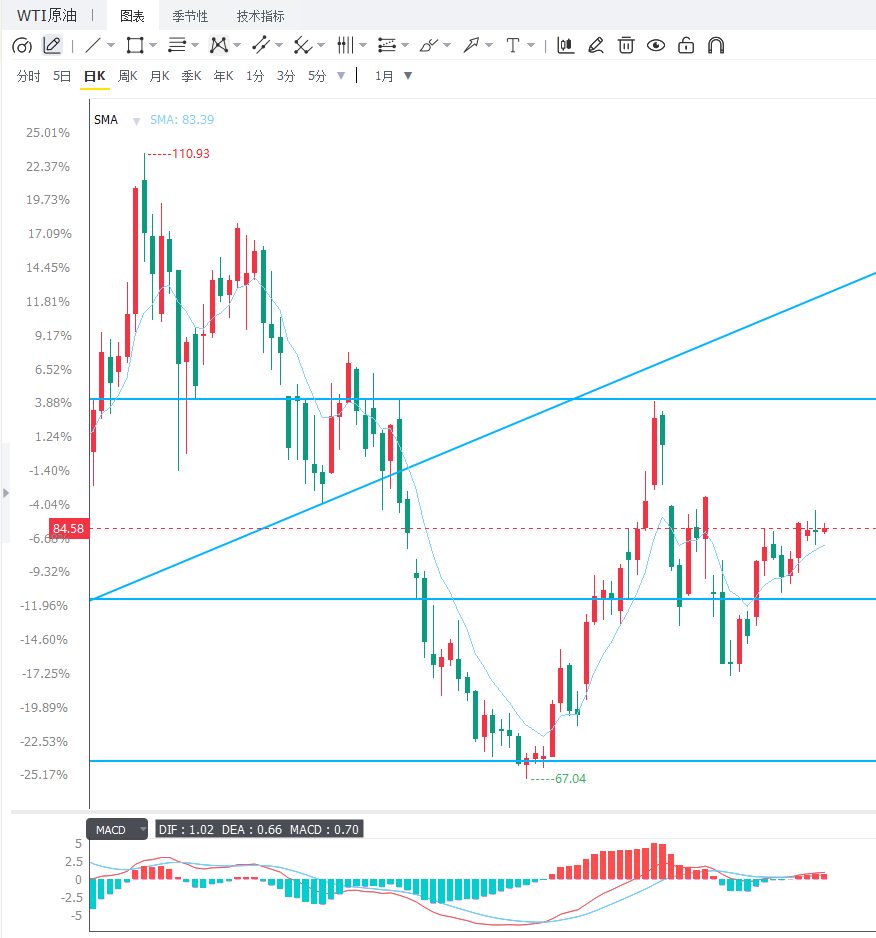 Editor's Summary: The core driver of the current WTI crude oil price increase is the escalating tensions in the Middle East and shipping risks in the Strait of Hormuz, while rising US crude oil inventories pose a significant fundamental constraint. As long as key shipping routes remain largely unobstructed, the price increase reflects more of an expansion of risk premiums than a widening of the actual supply gap. Therefore, WTI may maintain a high-level, slightly bullish trend in the short term, but a sustained rise requires confirmation from new supply-side shocks. If the geopolitical situation worsens further, the area above $86 could become the next breakout zone; if the situation eases and US inventories continue to increase, oil prices may fall back to the $82.50-$84 range. The current market presents both opportunities and risks; the focus should be on whether the supply chain shifts from a "risk state" to an "actual disruption."
The market has recently been particularly focused on shipping conditions in the Strait of Hormuz. As a crucial global energy transport corridor, any sustained disruption to shipping through this region could rapidly increase the supply risk premium in the international crude oil market. US President Trump stated that crude oil shipments are still passing through this corridor, and that the possibility of continued negotiations has not been completely ruled out. This means that while the market does not currently see a complete supply disruption as certain, the risk has not disappeared. For the crude oil market, what truly affects prices is not just the number of ships currently able to pass through normally, but rather market expectations regarding future shipping security. If the relevant risks persist, shipping costs, insurance premiums, and transit times could all increase. Even if actual supply has not yet decreased significantly, traders may raise risk premiums in advance, thereby pushing crude oil prices to remain relatively high. Further complication of the regional situation has also increased market uncertainty. The UAE's announcement of suspending certain financial and economic transactions related to Iran has further reinforced market concerns about regional economic exchanges. Meanwhile, Gulf oil-producing countries are maintaining high export volumes through alternative shipping routes and more covert shipping methods, which has mitigated the actual supply shock to some extent. Therefore, the current crude oil market exhibits a distinct characteristic: a significant increase in risk premiums, but actual supply has not yet experienced a disruption that fully matches risk sentiment. If major Gulf producers can maintain stable exports, the upside potential for oil prices may be limited; conversely, if transportation facilities, tankers, or key energy infrastructure are further affected, the market could quickly shift from "risk trading" to "supply shortage trading." TD Securities believes that the current crude oil market environment remains fragile, with transportation security risks, escalating tensions, and stalled negotiations all potentially placing the energy market in a high-risk state. For Brent crude and refined products, the risk of supply disruptions may continue to maintain a high risk premium. This means that even if there is no significant imbalance between actual supply and demand in the crude oil market, prices may remain highly volatile due to risk expectations. US inventory data adds another constraint to oil price increases. The latest data from the US Energy Information Administration shows that US crude oil inventories increased by approximately 4.4 million barrels last week. This unexpected increase in inventories indicates relatively ample short-term supply and may also reflect changes in refinery demand or import patterns. Inventory growth typically implies increased supply and demand pressure in the spot market, thus becoming a key factor to watch during the current WTI price increase. However, the performance of US refined product inventories is not entirely pessimistic. Distillate fuel inventories fell by approximately 1.5 million barrels during the same period, reaching a one-month low, indicating that the refined product market still faces some destocking pressure. If refinery operating rates remain high and refined product demand continues to improve, it may further increase crude oil processing demand, thus partially offsetting the negative impact of increased crude oil inventories. From a global market perspective, the core contradiction in current oil prices remains the interplay between escalating geopolitical risks and relatively ample supply. If Middle East risks continue to escalate, the market may further increase the supply disruption premium, and WTI has the opportunity to challenge higher price levels. If these risks are controlled, and US crude oil inventories continue to accumulate, oil prices may return to a fundamentally driven adjustment pattern. In the future, close attention needs to be paid to whether shipping through the Strait of Hormuz remains stable, changes in US crude oil and refined product inventories, export conditions of Gulf oil-producing countries, and the progress of negotiations between the US and Iran. In particular, if there is a sustained disruption to crude oil transportation, even if actual inventories have not yet declined rapidly, the market may pre-trade for future supply gaps, thereby amplifying the magnitude of oil price increases. From a daily chart perspective, WTI has returned above $84, maintaining a generally bullish trend. After a period of consolidation, the price regained upward momentum, indicating that bulls still hold some control. The market should focus on the short-term resistance around $86.00. If oil prices can effectively break through and hold this area, the possibility of further moves towards $88.00 or even $90.00 will significantly increase. Initial support is seen around $84.00. If a pullback to this area finds support, the bullish structure remains intact. A further break below $84 could extend downward pressure to around $82.50, with the more important medium-term support level being the psychological level of $80. Overall, geopolitical risks provide fundamental support for the bullish technical structure, but profit-taking should be anticipated after the rapid rise in oil prices. From a 4-hour chart perspective, WTI maintains a short-term bullish bias, with bullish momentum recovering after the price regained above $85. The current area around $84.50 is a key observation zone. If the price can break through and hold above $86, the short-term uptrend may be further strengthened; if it fails to break through $86 repeatedly, a technical pullback may occur. During the pullback, $84 is a crucial level for judging the strength of the short-term bulls. Holding this area means the market may still be building momentum for further upward movement, while a break below $84 indicates that short-term momentum is weakening. Overall, the 4-hour chart still leans bullish, but whether oil prices can rise further will heavily depend on whether geopolitical risks continue to drive up risk premiums. Editor's Summary: The core driver of the current WTI crude oil price increase is the escalating tensions in the Middle East and shipping risks in the Strait of Hormuz, while rising US crude oil inventories pose a significant fundamental constraint. As long as key shipping routes remain largely unobstructed, the price increase reflects more of an expansion of risk premiums than a widening of the actual supply gap. Therefore, WTI may maintain a high-level, slightly bullish trend in the short term, but a sustained rise requires confirmation from new supply-side shocks. If the geopolitical situation worsens further, the area above $86 could become the next breakout zone; if the situation eases and US inventories continue to increase, oil prices may fall back to the $82.50-$84 range. The current market presents both opportunities and risks; the focus should be on whether the supply chain shifts from a "risk state" to an "actual disruption."
- Risk Warning and Disclaimer
- The market involves risk, and trading may not be suitable for all investors. This article is for reference only and does not constitute personal investment advice, nor does it take into account certain users’ specific investment objectives, financial situation, or other needs. Any investment decisions made based on this information are at your own risk.