Why did the dollar remain unmoved despite the Fed minutes' hawkish tone?
2026-08-20 08:20:57
The US dollar index traded in a volatile range during Asian trading hours on Thursday (August 20), currently hovering around 98.80. On Wednesday, the dollar index closed down 0.86% below 98.80, its weakest closing level since mid-May, and at its intraday low. The core driver of the sell-off was not the Fed's July meeting minutes, but rather the US Treasury's announcement that it would at least double the size of its long-term Treasury repurchase operations from $2 billion to $4 billion, a news that triggered a broad weakening of the dollar during the London afternoon trading session. While the Fed minutes showed a hawkish bias—with many participants supporting an immediate rate hike and the hawkish camp being broader than the voting results—the market reacted mutedly, as the minutes were outdated compared to recent weak economic data. The dollar index closed at its intraday low, reflecting a repricing of the issuer (the US Treasury) rather than monetary policy (the Fed). 
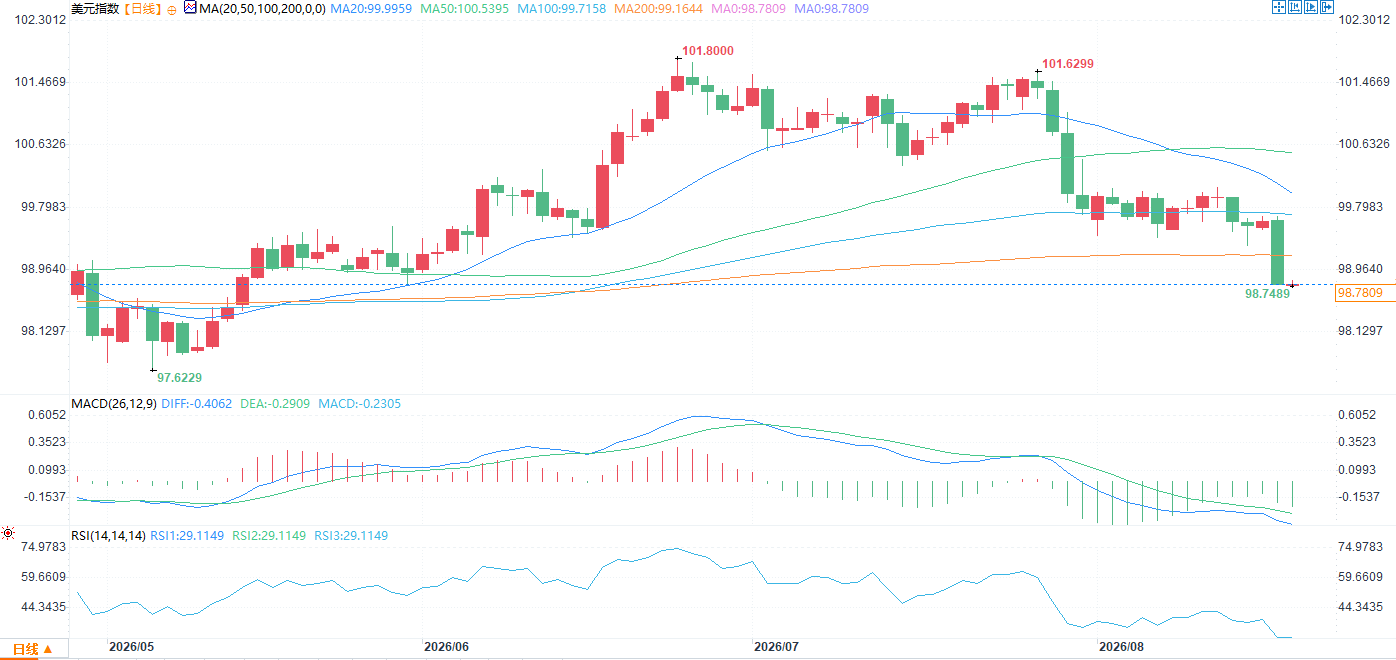 (US Dollar Index Daily Chart) At 8:07 AM Beijing time on August 20, the US Dollar Index was at 98.81.
The Ministry of Finance was the real driving force behind Wednesday's market movements.
The U.S. Treasury announced it would at least double the size of its liquidity-supported repurchase operations for long-term nominal coupon bonds, increasing the size of each operation from $2 billion to at least $4 billion for 10- to 20-year and 20- to 30-year maturities. This adjustment is effective from September 9 to November 4, with subsequent arrangements depending on the November refinancing plan. The timing of this announcement is quite delicate—just two weeks after the quarterly repurchase plan was announced, and on the eve of a $16 billion 20-year Treasury auction. Long-term yields reacted textbook to the announcement. The 30-year Treasury yield, which had broken through 5.33% on August 18, its highest level since June 2007, fell nearly 10 basis points in afternoon trading after the announcement, while the 10-year yield approached 4.65%. While the decline in long-term yields due to deflationary expectations has limited impact on exchange rates, the decline in yields caused by issuers being forced to bid in the market is a completely different matter—the foreign exchange market priced in this difference within minutes.The market is repricing the issuer by selling off indiscriminate coverage.
Wednesday's sell-off was remarkably indiscriminate—a signal worth watching. The Swiss franc appreciated nearly 1.8% against the US dollar, the New Zealand dollar rose about 1%, the Mexican peso reached a two-year high, gold approached $4,500 per ounce, and silver followed suit. A currency weakening simultaneously against funding currencies (Swiss franc), high-yield currencies (New Zealand dollar, peso), and precious metals (gold, silver) on the same afternoon—this isn't a repricing of interest rate differentials, but rather a repricing of the issuer.Fed minutes: Hawkish content, muted reaction
The minutes of the July 28-29 FOMC meeting, released at 2:00 AM Beijing time on Thursday, described a committee that was even more hawkish than the voting results suggested. Several participants supported an immediate rate hike (while only three actually voted against it), many believed that tightening might become necessary if inflation failed to decline, and some pointed out that acting early could prevent the committee from needing to take larger-scale measures later. This wording carried more weight than the voting data—the June minutes attributed the reasons for a rate hike to only a few participants, while the July minutes showed a significant rise in hawkish sentiment, yet the voting results remained unchanged. Two regional Fed presidents who did not have voting rights in July subsequently stated that they supported a rate hike, indicating that the hawkish camp was actually broader than the vote count suggested and was still expanding. However, the foreign exchange market treated the minutes as a non-event. The dollar index was already at its intraday low when the minutes were released and remained at that level. The futures market had compressed the probability of a September rate hike from about two-thirds after the previous meeting to about one-third, and nothing in the minutes reversed this trend. A committee that proactively shut down forward guidance is now vying for market attention with a debt management body that did not shut down forward guidance—and the latter apparently won Wednesday’s battle.The real test this week comes after the minutes.
Thursday's US economic calendar kicks off at 8:30 PM Beijing time with initial jobless claims (consensus 210,000, previous 209,000) and the Philadelphia Fed's August manufacturing survey (consensus 25, previous 41.4). This forecast implies a sharp drop of more than 16 points in the regional survey; if the data approaches that level, its impact on pricing in a September rate hike will be far greater than a meeting minutes from three weeks ago. At 9:45 PM Beijing time on Friday, the preliminary August S&P Global Manufacturing and Services PMIs will be released—manufacturing consensus 53.8 (previous 53.9), services consensus 54 (previous 54.6), and composite 54.5. Both are expected to soften slightly but not break key levels; this pattern is sufficient to maintain the expectation of no rate cut in September without pushing for a rate cut. The Jackson Hole symposium at the end of the month is the next window for the Fed to wrest control of the market narrative from the Treasury. (US Dollar Index Daily Chart) At 8:07 AM Beijing time on August 20, the US Dollar Index was at 98.81.
- Risk Warning and Disclaimer
- The market involves risk, and trading may not be suitable for all investors. This article is for reference only and does not constitute personal investment advice, nor does it take into account certain users’ specific investment objectives, financial situation, or other needs. Any investment decisions made based on this information are at your own risk.