The Fed's hawkish stance failed to stem the dollar's decline, and the Treasury's buyback program further exacerbated the situation, propelling the euro to its highest level since the end of May.
2026-08-20 10:28:59
On Thursday (August 20) during the Asian session, the euro fluctuated and adjusted against the US dollar after a sharp rise overnight, currently trading around 1.1672, still in the high range since the end of May. Although the minutes of the Fed's July meeting showed a hawkish bias—with several officials stating that interest rates should be raised as soon as possible if inflation does not cool down—the market reaction was muted. Weak economic data, coupled with news of the US Treasury expanding its long-term bond repurchase program, jointly suppressed the dollar's weakness, limiting the euro's downside. The probability of a Fed rate hike in September has fallen from 47% a month ago to about 33%, while the probability of an ECB rate hike in September remains as high as 90%-94%, and this policy divergence continues to provide structural support for the euro. 
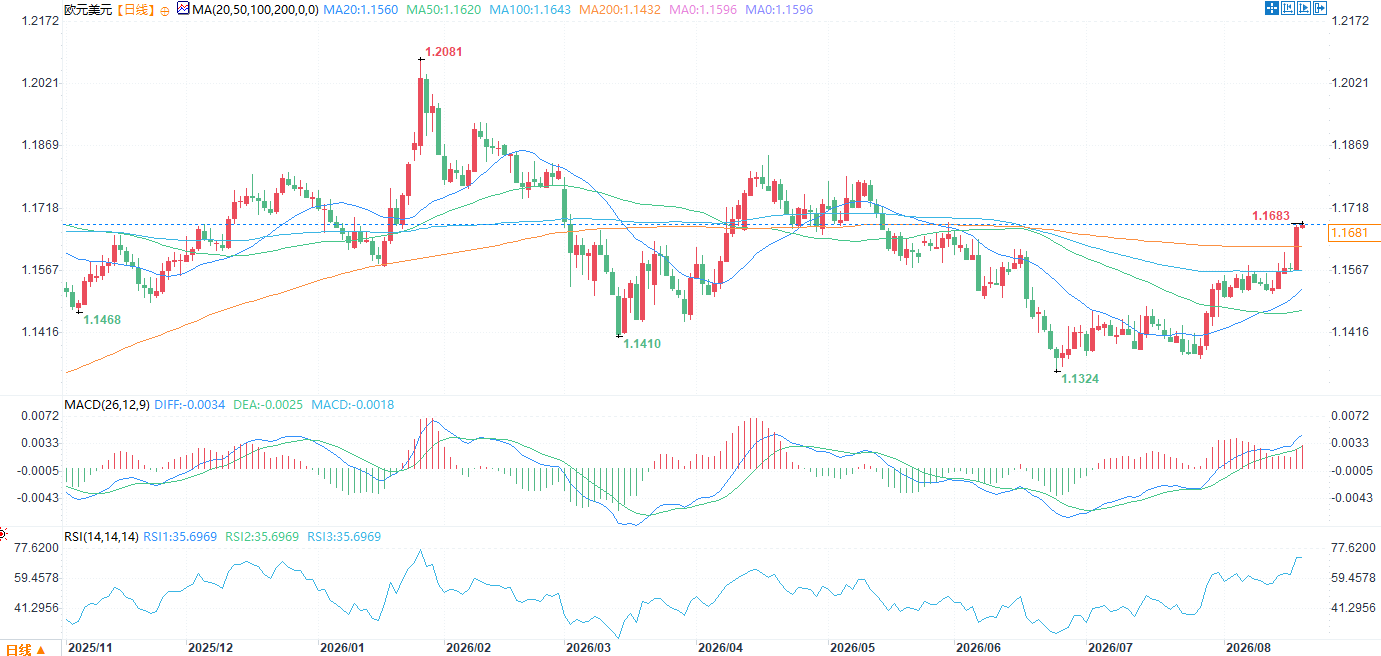 (Euro/USD daily chart, source: FX678) At 10:26 Beijing time on August 20, the euro was trading at 1.1675/76 against the US dollar.
The Fed minutes were hawkish, but the market is more focused on weak data.
The minutes of the Federal Reserve's July meeting revealed that officials stated at the last meeting that a rate hike would be needed soon unless there was further progress on inflation. The Fed kept the benchmark interest rate unchanged at 3.5%-3.75% at its July meeting, with dissenters arguing that action needed to bring inflation back to target as quickly as possible. Since the last policy meeting, data has mostly shown moderate monthly price increases, but key indicators suggest that inflation remains well above the Fed's 2% target. However, the market reacted mutedly to the hawkish minutes—the content of which lagged behind recent weak economic data, and the futures market has compressed the probability of a September rate hike to about 33%. The CME FedWatch tool shows that the market's probability of a 25 basis point rate hike in September has fallen from 47% the previous month to 32.7%. This trend limited the upside potential of the dollar and provided a floor for the euro.ECB rate hike expectations are solid, and policy divergence supports the euro.
On the euro side, market expectations for further interest rate hikes by the ECB remain solid. The ECB Watch tool shows that the market is pricing in a 90%-94% probability of a 25 basis point rate hike to 2.50% at the next meeting on September 9th. Analysts at Societe Generale point out that the Eurozone macroeconomic backdrop is reinforcing the recent trend in interest rate differentials – "improved growth expectations are supporting relative interest rate changes initiated by higher inflation," suggesting that the initial inflation-driven interest rate repricing is now being validated by a more robust growth outlook. This structural backdrop continues to support the euro.Institutional Views
In its August 19th research report, Mitsubishi UFJ Financial Group expressed caution regarding the euro's outlook against the US dollar, believing that current prices are overvalued and buying interest is clearly insufficient. Mitsubishi UFJ Financial Group stated that European energy risks are the core concern: natural gas inventories are at their lowest levels since 2011, winter stockpiling is lagging behind expectations, and competition from Asian LNG demand could push up energy costs; low water levels in the Rhine and Danube rivers also threaten industrial, power, and food production. If this situation persists, terms of trade could further deteriorate, dragging down the euro. ING Group, in its latest research report, predicts that the Federal Reserve will not raise interest rates and sets its EUR/USD target at 1.17 by the end of September and 1.18 by the end of the year. While the euro is not severely undervalued, it has begun to appear cheap, and the medium-term bullish logic remains, but a breakout requires confirmation from the Federal Reserve's policy signals.Summarize
The euro is currently consolidating against the dollar after a sharp overnight rise. The Fed minutes were hawkish, but the market reaction was muted. Weak economic data has reduced the probability of a September rate hike to about 33%, putting overall pressure on the dollar and providing support for the euro. Meanwhile, the probability of an ECB rate hike in September remains as high as 90%-94%, and this policy divergence continues to provide structural support for the euro. The market is now focused on ECB President Lagarde's speech and further developments in US economic data. (Euro/USD daily chart, source: FX678) At 10:26 Beijing time on August 20, the euro was trading at 1.1675/76 against the US dollar.
- Risk Warning and Disclaimer
- The market involves risk, and trading may not be suitable for all investors. This article is for reference only and does not constitute personal investment advice, nor does it take into account certain users’ specific investment objectives, financial situation, or other needs. Any investment decisions made based on this information are at your own risk.