Weakening US Treasury bonds coupled with increased repurchase operations supported a rise in gold prices.
2026-08-20 10:00:57
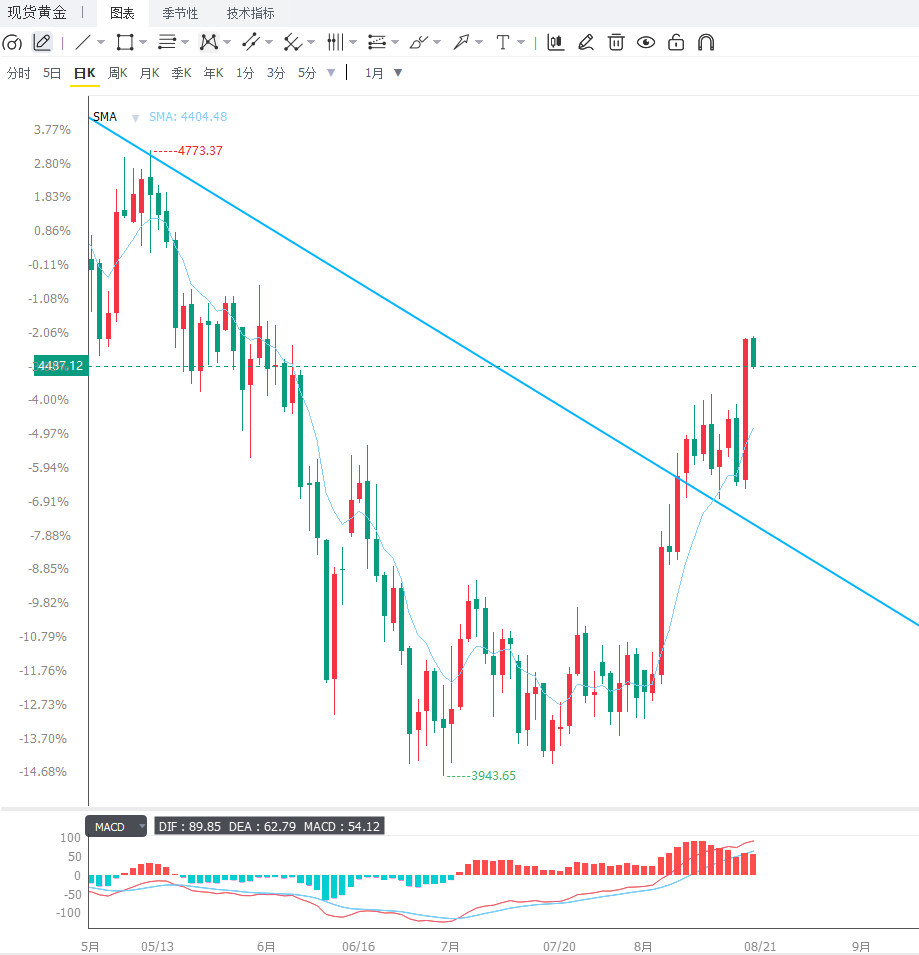
Spot gold extended its strength in early Asian trading on Thursday, rising to around $4,520 per ounce, its highest level since early June, before retreating slightly and currently trading around $4,480. The core driver of this rally was not solely safe-haven demand, but rather the combined effect of improved liquidity in the US bond market, a weaker dollar, and the market's repricing of future real interest rate trends. As gold approaches its recent highs, investors are reassessing the impact of US monetary policy, fiscal financing conditions, and energy price changes on the precious metals market.  The U.S. Treasury Department's recent expansion of its long-term Treasury repurchase operations has become a focal point in financial markets. The arrangements indicate that the maximum size of a single repurchase operation supporting liquidity for long-term nominal bonds will increase from at least $2 billion to at least $4 billion, effectively doubling the maximum scale of such operations. This move is expected to improve liquidity in the long-term Treasury market and alleviate pressure from multi-year high borrowing costs. From a gold pricing perspective, if long-term yields are further suppressed after liquidity in the U.S. Treasury market is supported, the opportunity cost of holding gold may decrease. Simultaneously, the recent weakening of the dollar has directly improved the environment for dollar-denominated gold price increases. The market is currently particularly focused on whether the Treasury Department's liquidity operations can sustainably improve bond market financing conditions and whether this will further impact real interest rate trends. If real interest rates decline sustainably, gold's investment appeal is expected to strengthen again. Market institutions' outlook for gold is also becoming more positive. TD Securities believes that the recent slowdown in gold investment inflows may only be a temporary phenomenon. With the US Treasury providing more liquidity support, coupled with the Federal Reserve's potentially more tolerant policy stance on energy price shocks, stagflation risks are regaining market attention, and gold inflows may recover quickly. The key to this logic lies in the dual impact of energy prices on inflation and economic growth. If energy costs remain high, overall inflation may be supported, but high energy prices will simultaneously suppress real purchasing power and corporate profit margins, thus increasing the likelihood of slower economic growth. When the market begins to trade the stagflation combination of "high inflation + low growth," the valuation pressure on traditional financial assets may increase, while gold's allocation value as a non-credit asset and safe-haven asset will be strengthened. However, Federal Reserve policy remains an unavoidable variable for the short-term trend of gold. The latest minutes of the July meeting show that many policymakers believe that if inflation fails to continue to fall back to the target level, there is still a possibility of renewed interest rate hikes. Last month, the Federal Reserve maintained the target range for the federal funds rate at 3.50% to 3.75%, and some officials believed that action needed to be taken as soon as possible to push inflation back to the target level. Theoretically, higher interest rate expectations and a stronger dollar should put downward pressure on gold, so the potential risk of a Fed rate hike has not disappeared. However, the market is not currently trading entirely according to the traditional logic of "high inflation = high interest rates = bearish for gold," but is paying more attention to the economic growth risks that energy shocks may cause. If rising energy prices ultimately lead to a significant slowdown in economic activity, and the Fed chooses to observe rather than tighten policy quickly, then the possibility of a decline in real interest rates will actually increase, which is an important reason why gold has recently regained attention. From a global market perspective, the US fiscal financing environment, the dollar's trend, energy prices, and the policies of major central banks are forming a new linkage. If the US long-term bond market receives more liquidity support, it may reduce concerns about liquidity tightness in the financial market, but it is also necessary to observe whether long-term yields can truly and sustainably decline. If bond yields remain high, the upside potential for gold may be limited; conversely, if yields and the dollar weaken in tandem, gold may receive further investment. Currently, investors also need to pay attention to subsequent developments in the energy market. If energy prices continue to rise, it will increase global inflationary pressures and potentially reinforce stagflation trading; however, if energy prices fall rapidly, inflation expectations cool, and the Federal Reserve regains greater policy maneuvering space, gold may be suppressed again by interest rate expectations. Therefore, the future trend of gold depends not only on US monetary policy but also on the changing balance between energy prices and economic growth. From a daily chart perspective, spot gold has regained its position above major medium-term moving averages and remains above the 20-period Bollinger Band middle line and the 100-day moving average, maintaining a complete upward structure. Currently, gold prices are approaching the upper Bollinger Band, indicating a significant increase in bullish momentum; however, the expanded short-term gains also mean a corresponding increase in the risk of a pullback. The Relative Strength Index (RSI) is currently around 67, approaching the overbought zone but not yet reaching extreme levels, therefore the technical outlook remains bullish, although the upside potential is beginning to be limited. The first resistance level to watch is the upper Bollinger Band around $4550. If the daily close is effectively above this level, gold prices are expected to open up further upside potential and challenge new historical highs. On the downside, the first support level to watch is the 100-day moving average around $4380. If this level is breached, a further pullback could target the middle Bollinger Band around $4225, with deeper support at the lower Bollinger Band around $3905. Looking at the 4-hour chart, the short-term trend for gold remains upward. After a rapid breakout from the previous consolidation range, the bulls have regained control. However, after a continuous short-term rise, the price is gradually approaching the resistance zone of $4520 to $4550, which may lead to increased profit-taking. Therefore, the possibility of high-level consolidation or even a technical pullback cannot be ruled out. If gold prices can hold above $4380 during a pullback and re-attack $4550, the short-term upward structure remains intact. If a breakout above $4550 is confirmed, the probability of further upward movement towards previous highs increases significantly. Conversely, if the price encounters resistance around $4,550 and falls below $4,380, the short-term uptrend may enter a correction phase. Overall, the current technical structure is bullish, but indicators running at high levels mean investors need to be wary of profit-taking after a rapid rise.
  Editor's Summary: The US Treasury's expansion of long-term Treasury repurchase programs has provided a new liquidity logic for the current gold price surge. Simultaneously, a weakening dollar, changing expectations for real interest rates, and concerns about stagflation stemming from the energy shock have collectively enhanced gold's attractiveness. While the Federal Reserve still retains the option of potential rate hikes, the market is currently more focused on the impact of the energy shock on economic growth and real interest rates. In the short term, $4550 is a key resistance level for gold to further expand its upward potential, while $4380 is a crucial support level for determining whether the bullish structure can continue. If the dollar and real interest rates continue to weaken, gold is expected to maintain its strength; however, if US yields rise significantly again, gold prices may still face pressure for a correction at higher levels.
The U.S. Treasury Department's recent expansion of its long-term Treasury repurchase operations has become a focal point in financial markets. The arrangements indicate that the maximum size of a single repurchase operation supporting liquidity for long-term nominal bonds will increase from at least $2 billion to at least $4 billion, effectively doubling the maximum scale of such operations. This move is expected to improve liquidity in the long-term Treasury market and alleviate pressure from multi-year high borrowing costs. From a gold pricing perspective, if long-term yields are further suppressed after liquidity in the U.S. Treasury market is supported, the opportunity cost of holding gold may decrease. Simultaneously, the recent weakening of the dollar has directly improved the environment for dollar-denominated gold price increases. The market is currently particularly focused on whether the Treasury Department's liquidity operations can sustainably improve bond market financing conditions and whether this will further impact real interest rate trends. If real interest rates decline sustainably, gold's investment appeal is expected to strengthen again. Market institutions' outlook for gold is also becoming more positive. TD Securities believes that the recent slowdown in gold investment inflows may only be a temporary phenomenon. With the US Treasury providing more liquidity support, coupled with the Federal Reserve's potentially more tolerant policy stance on energy price shocks, stagflation risks are regaining market attention, and gold inflows may recover quickly. The key to this logic lies in the dual impact of energy prices on inflation and economic growth. If energy costs remain high, overall inflation may be supported, but high energy prices will simultaneously suppress real purchasing power and corporate profit margins, thus increasing the likelihood of slower economic growth. When the market begins to trade the stagflation combination of "high inflation + low growth," the valuation pressure on traditional financial assets may increase, while gold's allocation value as a non-credit asset and safe-haven asset will be strengthened. However, Federal Reserve policy remains an unavoidable variable for the short-term trend of gold. The latest minutes of the July meeting show that many policymakers believe that if inflation fails to continue to fall back to the target level, there is still a possibility of renewed interest rate hikes. Last month, the Federal Reserve maintained the target range for the federal funds rate at 3.50% to 3.75%, and some officials believed that action needed to be taken as soon as possible to push inflation back to the target level. Theoretically, higher interest rate expectations and a stronger dollar should put downward pressure on gold, so the potential risk of a Fed rate hike has not disappeared. However, the market is not currently trading entirely according to the traditional logic of "high inflation = high interest rates = bearish for gold," but is paying more attention to the economic growth risks that energy shocks may cause. If rising energy prices ultimately lead to a significant slowdown in economic activity, and the Fed chooses to observe rather than tighten policy quickly, then the possibility of a decline in real interest rates will actually increase, which is an important reason why gold has recently regained attention. From a global market perspective, the US fiscal financing environment, the dollar's trend, energy prices, and the policies of major central banks are forming a new linkage. If the US long-term bond market receives more liquidity support, it may reduce concerns about liquidity tightness in the financial market, but it is also necessary to observe whether long-term yields can truly and sustainably decline. If bond yields remain high, the upside potential for gold may be limited; conversely, if yields and the dollar weaken in tandem, gold may receive further investment. Currently, investors also need to pay attention to subsequent developments in the energy market. If energy prices continue to rise, it will increase global inflationary pressures and potentially reinforce stagflation trading; however, if energy prices fall rapidly, inflation expectations cool, and the Federal Reserve regains greater policy maneuvering space, gold may be suppressed again by interest rate expectations. Therefore, the future trend of gold depends not only on US monetary policy but also on the changing balance between energy prices and economic growth. From a daily chart perspective, spot gold has regained its position above major medium-term moving averages and remains above the 20-period Bollinger Band middle line and the 100-day moving average, maintaining a complete upward structure. Currently, gold prices are approaching the upper Bollinger Band, indicating a significant increase in bullish momentum; however, the expanded short-term gains also mean a corresponding increase in the risk of a pullback. The Relative Strength Index (RSI) is currently around 67, approaching the overbought zone but not yet reaching extreme levels, therefore the technical outlook remains bullish, although the upside potential is beginning to be limited. The first resistance level to watch is the upper Bollinger Band around $4550. If the daily close is effectively above this level, gold prices are expected to open up further upside potential and challenge new historical highs. On the downside, the first support level to watch is the 100-day moving average around $4380. If this level is breached, a further pullback could target the middle Bollinger Band around $4225, with deeper support at the lower Bollinger Band around $3905. Looking at the 4-hour chart, the short-term trend for gold remains upward. After a rapid breakout from the previous consolidation range, the bulls have regained control. However, after a continuous short-term rise, the price is gradually approaching the resistance zone of $4520 to $4550, which may lead to increased profit-taking. Therefore, the possibility of high-level consolidation or even a technical pullback cannot be ruled out. If gold prices can hold above $4380 during a pullback and re-attack $4550, the short-term upward structure remains intact. If a breakout above $4550 is confirmed, the probability of further upward movement towards previous highs increases significantly. Conversely, if the price encounters resistance around $4,550 and falls below $4,380, the short-term uptrend may enter a correction phase. Overall, the current technical structure is bullish, but indicators running at high levels mean investors need to be wary of profit-taking after a rapid rise. Editor's Summary: The US Treasury's expansion of long-term Treasury repurchase programs has provided a new liquidity logic for the current gold price surge. Simultaneously, a weakening dollar, changing expectations for real interest rates, and concerns about stagflation stemming from the energy shock have collectively enhanced gold's attractiveness. While the Federal Reserve still retains the option of potential rate hikes, the market is currently more focused on the impact of the energy shock on economic growth and real interest rates. In the short term, $4550 is a key resistance level for gold to further expand its upward potential, while $4380 is a crucial support level for determining whether the bullish structure can continue. If the dollar and real interest rates continue to weaken, gold is expected to maintain its strength; however, if US yields rise significantly again, gold prices may still face pressure for a correction at higher levels.
- Risk Warning and Disclaimer
- The market involves risk, and trading may not be suitable for all investors. This article is for reference only and does not constitute personal investment advice, nor does it take into account certain users’ specific investment objectives, financial situation, or other needs. Any investment decisions made based on this information are at your own risk.