Japan's widening trade deficit coupled with rising energy costs may lead to continued adjustments in the USD/JPY exchange rate.
2026-08-20 14:58:58
The dollar strengthened against the yen in Asian trading on Thursday, trading around 158.50, after a slight pullback in the previous session. The yen has continued to face multiple pressures recently, including interest rate differentials between the US and Europe, fiscal pressures, and rising energy and imported commodity costs. While the dollar has been constrained by expectations of a cooling US interest rate, it has maintained some resilience, keeping the dollar/yen pair at higher levels.  Japan's latest trade data shows that the merchandise trade deficit widened to 634.5 billion yen in July, up from 409.9 billion yen in the previous month, marking the third consecutive month of deficit and the largest deficit since January this year. While the actual deficit was lower than the market expectation of 680 billion yen, import growth significantly outpaced export growth, indicating that the cost of domestic demand for overseas goods and energy remains high. Looking at the trade structure, Japan's exports in July increased by 23.2% year-on-year to 11.512 trillion yen, significantly higher than the market expectation of 19.9%, and the largest increase since October 2022. However, imports grew even faster, reaching 27.8% and reaching 12.146 trillion yen, also a high growth rate. Both exports and imports hit record highs, but the import growth rate exceeded that of exports, putting greater pressure on Japan's trade account. For the yen, a widening trade deficit typically means insufficient foreign exchange inflows from merchandise trade, thus weakening the yen's fundamental support. Especially in an environment of high energy prices, Japan is highly dependent on imported energy; rising oil prices will increase import costs for businesses and residents, expanding the energy import bill. If this trend continues, the yen may continue to face pressure from deteriorating terms of trade. On the other hand, the interest rate differential between Japan and the US remains a significant factor keeping the USD/JPY exchange rate high. Although market expectations for future Fed rate hikes have declined significantly, US interest rates remain significantly higher than Japanese rates, making carry trades still attractive. Given the Bank of Japan's relatively cautious pace of policy normalization, the yield advantage for investors continuing to hold dollar assets remains. However, the policy support for the dollar itself is weakening. The minutes of the Fed's July meeting showed that if inflation fails to continue to decline, some policymakers still prefer to raise rates as soon as possible, but recent relatively mild US inflation data has reduced market bets on short-term rate hikes. Current market pricing indicates a 32.7% probability of a rate hike at the Fed's next policy meeting, a significant decrease from about 47% a month ago. If US inflation and employment data continue to cool, the likelihood of the Fed raising rates again may further decrease, and the interest rate differential advantage between the US and Japan will gradually narrow. This will limit further gains for the USD/JPY and may create conditions for a subsequent yen rebound. Meanwhile, the Japanese market is closely monitoring the risk of potential foreign exchange intervention. Societe Generale believes the yen still has room for recovery in the medium term, but without a significant drop in oil prices to improve Japan's economic outlook, a sustained rebound in the yen may require a new round of foreign exchange market intervention. In other words, the USD/JPY pair is currently near its highs, and policy risk has become a significant variable limiting further upside. From a global risk appetite perspective, the risks associated with the Strait of Hormuz remain a focus of market attention. Although the US dollar typically exhibits safe-haven characteristics in geopolitical tensions, it has not yet experienced a strong unilateral rise, indicating that the market has not fully shifted to an extreme risk-averse mode. If global stock markets and risk assets experience a more significant correction, the yen, as a traditional safe-haven currency, may regain inflows. Therefore, the USD/JPY pair is currently in a state of intertwined forces: Japan's trade deficit and rising energy costs are suppressing the yen, while declining expectations of US interest rate hikes are limiting the dollar's rise, and potential foreign exchange intervention risks are creating a ceiling for the exchange rate. Subsequent movements will depend on the combined changes in the USD/JPY interest rate differential, oil prices, Japanese policy signals, and global risk appetite. From a daily chart perspective, the USD/JPY pair remains in a high-level consolidation zone, with the area around 158.50 being a key level to watch. The exchange rate rebounded after a previous correction, indicating that bulls have not completely exited the market, but there is strong psychological and policy resistance around the 160.00 level. The first resistance level to watch is around 159.00; a successful break above this level could lead to a further test of the 159.50-160.00 area. A break above and hold above 160.00 could prompt the market to reassess higher targets. However, the closer to the 160 level, the higher the risk of potential policy intervention. Initial support is seen around 158.00, followed by 156.80, with more significant medium-term support around 155.50. A break below 155.50 could shift the high-level consolidation structure towards a more pronounced correction. Looking at the 4-hour chart, USD/JPY is showing a short-term slightly bullish trend, with the price returning to around 158.50, but the upward momentum is not particularly strong. 159.00 is a crucial level for short-term bullish and bearish battles. If the price can effectively break through and hold above $159, it may continue to test the $159.50 to $160.00 area in the short term. If the price fails to rise and falls back below $158.00, it may trigger profit-taking, further seeking support around $156.80. Overall, the short-term trend is bullish, but policy risks around $160 mean that the upside potential is limited, and investors need to be wary of a rapid reversal.
 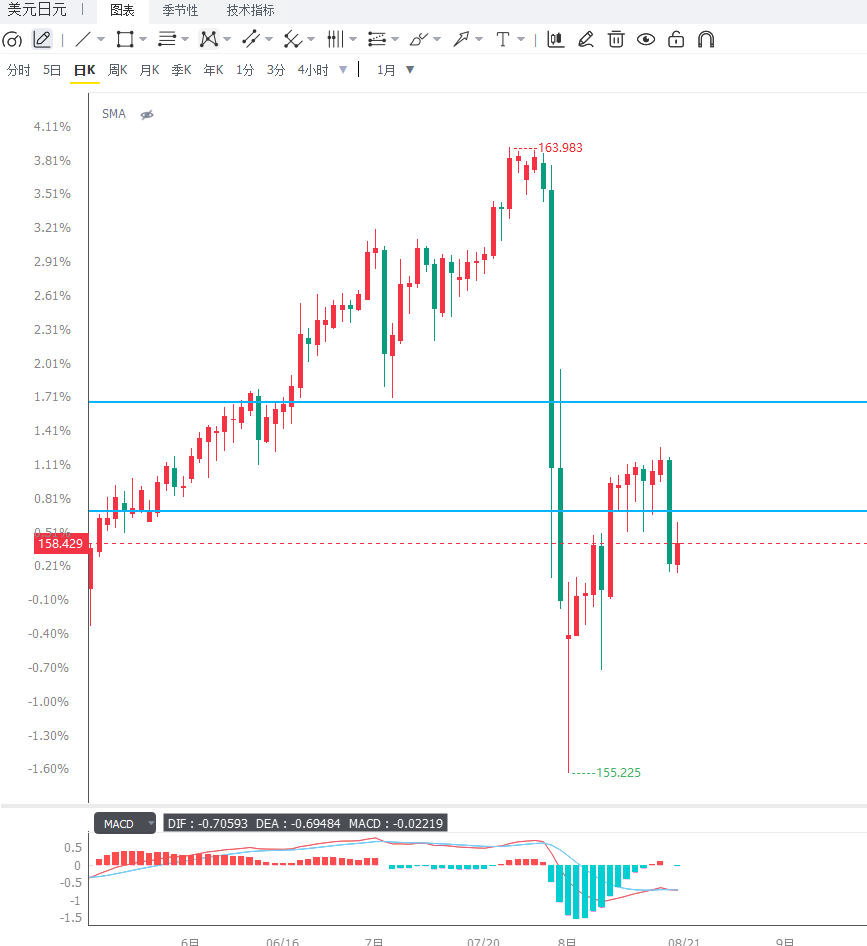 Editor's Summary: The USD/JPY pair is currently supported by the USD/JPY interest rate differential and Japan's widening trade deficit, but the dollar's own interest rate advantage is gradually weakening due to declining expectations of US rate hikes. **Japan's trade deficit widened to ¥634.5 billion in July, while imports increased by 27.8% year-on-year, indicating that energy and import costs remain significant sources of pressure on the yen.** However, oil price movements and potential foreign exchange intervention could be key catalysts for a yen rebound. In the short term, the 159.00-160.00 area is a key resistance zone, while 158.00 is the primary support level. If US data continues to cool, further upside potential for USD/JPY may be limited; if oil prices fall or expectations of Japanese policy intervention rise, the risk of a yen rebound will increase significantly.
Japan's latest trade data shows that the merchandise trade deficit widened to 634.5 billion yen in July, up from 409.9 billion yen in the previous month, marking the third consecutive month of deficit and the largest deficit since January this year. While the actual deficit was lower than the market expectation of 680 billion yen, import growth significantly outpaced export growth, indicating that the cost of domestic demand for overseas goods and energy remains high. Looking at the trade structure, Japan's exports in July increased by 23.2% year-on-year to 11.512 trillion yen, significantly higher than the market expectation of 19.9%, and the largest increase since October 2022. However, imports grew even faster, reaching 27.8% and reaching 12.146 trillion yen, also a high growth rate. Both exports and imports hit record highs, but the import growth rate exceeded that of exports, putting greater pressure on Japan's trade account. For the yen, a widening trade deficit typically means insufficient foreign exchange inflows from merchandise trade, thus weakening the yen's fundamental support. Especially in an environment of high energy prices, Japan is highly dependent on imported energy; rising oil prices will increase import costs for businesses and residents, expanding the energy import bill. If this trend continues, the yen may continue to face pressure from deteriorating terms of trade. On the other hand, the interest rate differential between Japan and the US remains a significant factor keeping the USD/JPY exchange rate high. Although market expectations for future Fed rate hikes have declined significantly, US interest rates remain significantly higher than Japanese rates, making carry trades still attractive. Given the Bank of Japan's relatively cautious pace of policy normalization, the yield advantage for investors continuing to hold dollar assets remains. However, the policy support for the dollar itself is weakening. The minutes of the Fed's July meeting showed that if inflation fails to continue to decline, some policymakers still prefer to raise rates as soon as possible, but recent relatively mild US inflation data has reduced market bets on short-term rate hikes. Current market pricing indicates a 32.7% probability of a rate hike at the Fed's next policy meeting, a significant decrease from about 47% a month ago. If US inflation and employment data continue to cool, the likelihood of the Fed raising rates again may further decrease, and the interest rate differential advantage between the US and Japan will gradually narrow. This will limit further gains for the USD/JPY and may create conditions for a subsequent yen rebound. Meanwhile, the Japanese market is closely monitoring the risk of potential foreign exchange intervention. Societe Generale believes the yen still has room for recovery in the medium term, but without a significant drop in oil prices to improve Japan's economic outlook, a sustained rebound in the yen may require a new round of foreign exchange market intervention. In other words, the USD/JPY pair is currently near its highs, and policy risk has become a significant variable limiting further upside. From a global risk appetite perspective, the risks associated with the Strait of Hormuz remain a focus of market attention. Although the US dollar typically exhibits safe-haven characteristics in geopolitical tensions, it has not yet experienced a strong unilateral rise, indicating that the market has not fully shifted to an extreme risk-averse mode. If global stock markets and risk assets experience a more significant correction, the yen, as a traditional safe-haven currency, may regain inflows. Therefore, the USD/JPY pair is currently in a state of intertwined forces: Japan's trade deficit and rising energy costs are suppressing the yen, while declining expectations of US interest rate hikes are limiting the dollar's rise, and potential foreign exchange intervention risks are creating a ceiling for the exchange rate. Subsequent movements will depend on the combined changes in the USD/JPY interest rate differential, oil prices, Japanese policy signals, and global risk appetite. From a daily chart perspective, the USD/JPY pair remains in a high-level consolidation zone, with the area around 158.50 being a key level to watch. The exchange rate rebounded after a previous correction, indicating that bulls have not completely exited the market, but there is strong psychological and policy resistance around the 160.00 level. The first resistance level to watch is around 159.00; a successful break above this level could lead to a further test of the 159.50-160.00 area. A break above and hold above 160.00 could prompt the market to reassess higher targets. However, the closer to the 160 level, the higher the risk of potential policy intervention. Initial support is seen around 158.00, followed by 156.80, with more significant medium-term support around 155.50. A break below 155.50 could shift the high-level consolidation structure towards a more pronounced correction. Looking at the 4-hour chart, USD/JPY is showing a short-term slightly bullish trend, with the price returning to around 158.50, but the upward momentum is not particularly strong. 159.00 is a crucial level for short-term bullish and bearish battles. If the price can effectively break through and hold above $159, it may continue to test the $159.50 to $160.00 area in the short term. If the price fails to rise and falls back below $158.00, it may trigger profit-taking, further seeking support around $156.80. Overall, the short-term trend is bullish, but policy risks around $160 mean that the upside potential is limited, and investors need to be wary of a rapid reversal. Editor's Summary: The USD/JPY pair is currently supported by the USD/JPY interest rate differential and Japan's widening trade deficit, but the dollar's own interest rate advantage is gradually weakening due to declining expectations of US rate hikes. **Japan's trade deficit widened to ¥634.5 billion in July, while imports increased by 27.8% year-on-year, indicating that energy and import costs remain significant sources of pressure on the yen.** However, oil price movements and potential foreign exchange intervention could be key catalysts for a yen rebound. In the short term, the 159.00-160.00 area is a key resistance zone, while 158.00 is the primary support level. If US data continues to cool, further upside potential for USD/JPY may be limited; if oil prices fall or expectations of Japanese policy intervention rise, the risk of a yen rebound will increase significantly.
- Risk Warning and Disclaimer
- The market involves risk, and trading may not be suitable for all investors. This article is for reference only and does not constitute personal investment advice, nor does it take into account certain users’ specific investment objectives, financial situation, or other needs. Any investment decisions made based on this information are at your own risk.