Silver hit a two-month high as US Treasury yields fell sharply and the dollar weakened.
2026-08-20 15:06:59
Spot silver continued its upward trend in Asian trading on Thursday, reaching a high of $67.33 per ounce, its highest level in two months. This surge in silver prices was primarily driven by declining yields on long-term US Treasury bonds and a weakening US dollar. As the US Treasury expanded its long-term Treasury repurchase operations, the market reassessed bond supply and demand and liquidity conditions, leading to a rapid decline in long-term yields and increasing the attractiveness of non-yielding precious metals.  The U.S. Treasury announced on Wednesday that it would expand the scale of its long-term government bond repurchase program, at least doubling the size of the operation. The market believes this measure will help improve liquidity in the long-term bond market and may alleviate pressure from rapidly rising long-term financing costs. Following the announcement, U.S. long-term Treasury yields fell significantly, and the precious metals market reacted quickly. Specifically, the 10-year Treasury yield is currently close to the previous trading day's low of around 4.64%, having fallen by more than 1.5% on Wednesday; the 30-year Treasury yield has also fallen by nearly 2% from Tuesday's closing level, currently near 5.18%. The rapid decline in long-term yields directly reduces the opportunity cost of holding non-yielding assets like silver, providing significant support for precious metal prices. The dollar's performance is also beneficial to silver. The dollar index is currently hovering near a seven-week low of around 98.77. A weaker dollar means that dollar-denominated silver is relatively cheaper for investors in other currencies, and also improves the conditions for international funds to allocate to precious metals. The simultaneous decline in the dollar and Treasury yields has become a significant driving force for silver's short-term breakthrough of key resistance. However, the Federal Reserve's policy remains a variable that needs to be monitored during the silver price increase. The minutes of the Federal Reserve's July meeting revealed that several policymakers believed further interest rate hikes might be necessary if inflation continued to exceed the policy target. Theoretically, higher interest rates imply higher real yields, increasing the attractiveness of holding income-generating assets and putting pressure on non-yielding assets like silver. However, current market trading logic hasn't fully shifted to a hawkish stance from the Fed. On one hand, recent US employment and inflation data have shown marginal cooling, reducing market bets on short-term rate hikes; on the other hand, the decline in yields resulting from expanded US Treasury repurchase agreements is directly improving financial conditions for precious metals. In this environment, silver is temporarily benefiting more from real interest rates and a weaker dollar, rather than being suppressed by potential rate hike signals in the meeting minutes. Compared to gold, silver also has more pronounced industrial attributes, making global economic growth expectations a significant factor influencing its medium-term price. If global manufacturing and industrial demand remains resilient, silver demand may receive additional support. Conversely, if high interest rates or persistently rising energy costs lead to a significant slowdown in global economic growth, declining industrial demand could limit silver's gains. This has resulted in a clear battle between bulls and bears in the current market. On the one hand, declining US Treasury yields and the dollar provide financial support for silver; on the other hand, the Federal Reserve still retains potential room for interest rate hikes, and there is uncertainty regarding global economic growth and industrial demand. After the rapid rise in silver prices, the risk of short-term profit-taking has also increased. The key focus going forward is whether US Treasury yields can continue to decline. If the 10-year and 30-year yields fall further, silver is expected to maintain its strength; if yields rebound rapidly while the dollar index regains its key position, silver may experience a technical correction at its high levels. Furthermore, speeches by Federal Reserve officials and future US inflation and employment data will also influence the market's repricing of interest rate paths. From a daily chart perspective, spot silver maintains a clear bullish trend, with prices consistently trading above the 20-period exponential moving average (EMA). Currently, the 20-period EMA is around $63.20, and the moving averages remain upward, indicating strong short-term support. The RSI is currently around 61.48, in positive territory but not yet clearly overbought, meaning there is still some upside potential, and the current rally has not shown any obvious signs of overheating. The first resistance level to watch is the psychological level of $70.00. A decisive break above this level would target the June 16 high near $71.19. Initial support is seen near the recent price pivot point around $67.10. A break below this level would bring the next key support level to the 20-period EMA near $63.20. Looking at the 4-hour chart, silver's recent upward slope has accelerated significantly, with the price moving away from its previous consolidation range and holding around $67, indicating short-term bullish dominance. $65.80 is currently a crucial short-term support/resistance level. If the price holds above this level after a pullback, the market may continue its push towards $70. A break above $70 with confirmed support would target $71.19. Conversely, a break below $65.80 could trigger profit-taking, potentially leading to a further pullback to around $65, or even testing the dynamic support at $63.20. Overall, the 4-hour chart remains bullish, but the rapid rise warrants caution against increased short-term volatility.
 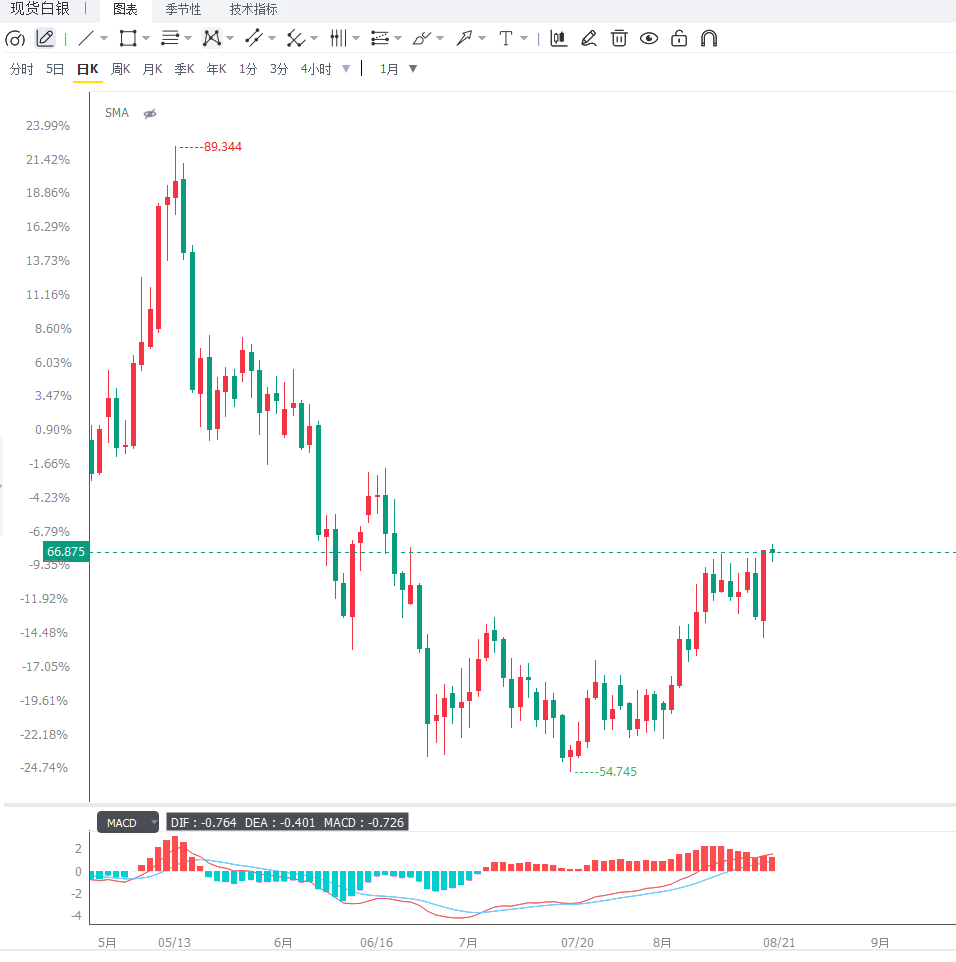 Editor's Summary: The core driver of this round of silver price increases is the rapid decline in US Treasury yields and the weakening of the US dollar. The 10-year US Treasury yield fell to around 4.64%, and the US dollar index dropped to around 98.77, providing important financial conditions for silver to break through $67. Although the Fed meeting minutes still leave room for potential interest rate hikes, the market is currently more focused on the decline in long-term yields and improved liquidity. In the short term, $70 is a key resistance level for further silver price increases, $65.80 is the first support level, and $63.20 is an important dynamic support level for judging the bullish trend. As long as US Treasury yields and the US dollar continue to weaken, silver still has room for further upward movement; if yields rebound, the risk of a pullback from high levels should be noted.
The U.S. Treasury announced on Wednesday that it would expand the scale of its long-term government bond repurchase program, at least doubling the size of the operation. The market believes this measure will help improve liquidity in the long-term bond market and may alleviate pressure from rapidly rising long-term financing costs. Following the announcement, U.S. long-term Treasury yields fell significantly, and the precious metals market reacted quickly. Specifically, the 10-year Treasury yield is currently close to the previous trading day's low of around 4.64%, having fallen by more than 1.5% on Wednesday; the 30-year Treasury yield has also fallen by nearly 2% from Tuesday's closing level, currently near 5.18%. The rapid decline in long-term yields directly reduces the opportunity cost of holding non-yielding assets like silver, providing significant support for precious metal prices. The dollar's performance is also beneficial to silver. The dollar index is currently hovering near a seven-week low of around 98.77. A weaker dollar means that dollar-denominated silver is relatively cheaper for investors in other currencies, and also improves the conditions for international funds to allocate to precious metals. The simultaneous decline in the dollar and Treasury yields has become a significant driving force for silver's short-term breakthrough of key resistance. However, the Federal Reserve's policy remains a variable that needs to be monitored during the silver price increase. The minutes of the Federal Reserve's July meeting revealed that several policymakers believed further interest rate hikes might be necessary if inflation continued to exceed the policy target. Theoretically, higher interest rates imply higher real yields, increasing the attractiveness of holding income-generating assets and putting pressure on non-yielding assets like silver. However, current market trading logic hasn't fully shifted to a hawkish stance from the Fed. On one hand, recent US employment and inflation data have shown marginal cooling, reducing market bets on short-term rate hikes; on the other hand, the decline in yields resulting from expanded US Treasury repurchase agreements is directly improving financial conditions for precious metals. In this environment, silver is temporarily benefiting more from real interest rates and a weaker dollar, rather than being suppressed by potential rate hike signals in the meeting minutes. Compared to gold, silver also has more pronounced industrial attributes, making global economic growth expectations a significant factor influencing its medium-term price. If global manufacturing and industrial demand remains resilient, silver demand may receive additional support. Conversely, if high interest rates or persistently rising energy costs lead to a significant slowdown in global economic growth, declining industrial demand could limit silver's gains. This has resulted in a clear battle between bulls and bears in the current market. On the one hand, declining US Treasury yields and the dollar provide financial support for silver; on the other hand, the Federal Reserve still retains potential room for interest rate hikes, and there is uncertainty regarding global economic growth and industrial demand. After the rapid rise in silver prices, the risk of short-term profit-taking has also increased. The key focus going forward is whether US Treasury yields can continue to decline. If the 10-year and 30-year yields fall further, silver is expected to maintain its strength; if yields rebound rapidly while the dollar index regains its key position, silver may experience a technical correction at its high levels. Furthermore, speeches by Federal Reserve officials and future US inflation and employment data will also influence the market's repricing of interest rate paths. From a daily chart perspective, spot silver maintains a clear bullish trend, with prices consistently trading above the 20-period exponential moving average (EMA). Currently, the 20-period EMA is around $63.20, and the moving averages remain upward, indicating strong short-term support. The RSI is currently around 61.48, in positive territory but not yet clearly overbought, meaning there is still some upside potential, and the current rally has not shown any obvious signs of overheating. The first resistance level to watch is the psychological level of $70.00. A decisive break above this level would target the June 16 high near $71.19. Initial support is seen near the recent price pivot point around $67.10. A break below this level would bring the next key support level to the 20-period EMA near $63.20. Looking at the 4-hour chart, silver's recent upward slope has accelerated significantly, with the price moving away from its previous consolidation range and holding around $67, indicating short-term bullish dominance. $65.80 is currently a crucial short-term support/resistance level. If the price holds above this level after a pullback, the market may continue its push towards $70. A break above $70 with confirmed support would target $71.19. Conversely, a break below $65.80 could trigger profit-taking, potentially leading to a further pullback to around $65, or even testing the dynamic support at $63.20. Overall, the 4-hour chart remains bullish, but the rapid rise warrants caution against increased short-term volatility. Editor's Summary: The core driver of this round of silver price increases is the rapid decline in US Treasury yields and the weakening of the US dollar. The 10-year US Treasury yield fell to around 4.64%, and the US dollar index dropped to around 98.77, providing important financial conditions for silver to break through $67. Although the Fed meeting minutes still leave room for potential interest rate hikes, the market is currently more focused on the decline in long-term yields and improved liquidity. In the short term, $70 is a key resistance level for further silver price increases, $65.80 is the first support level, and $63.20 is an important dynamic support level for judging the bullish trend. As long as US Treasury yields and the US dollar continue to weaken, silver still has room for further upward movement; if yields rebound, the risk of a pullback from high levels should be noted.
- Risk Warning and Disclaimer
- The market involves risk, and trading may not be suitable for all investors. This article is for reference only and does not constitute personal investment advice, nor does it take into account certain users’ specific investment objectives, financial situation, or other needs. Any investment decisions made based on this information are at your own risk.