The multi-dimensional confrontation between the US and Iran has fully unfolded, and WTI oil prices have continued to rise.
2026-08-20 15:35:01
On Thursday (August 20), during the Asian and European sessions, international oil prices continued their upward trend, with WTI crude oil trading at $85.1, up 0.89%. Currently, the US and Iran remain in a standoff, with each side playing its own cards. The US maintains its strategy of maritime blockade, using secret shipping lanes to smuggle crude oil, and increasing sanctions, while Iran controls shipping capacity in the Straits and maintains a military deterrent against its Gulf neighbors. Negotiations are seemingly stalled. 
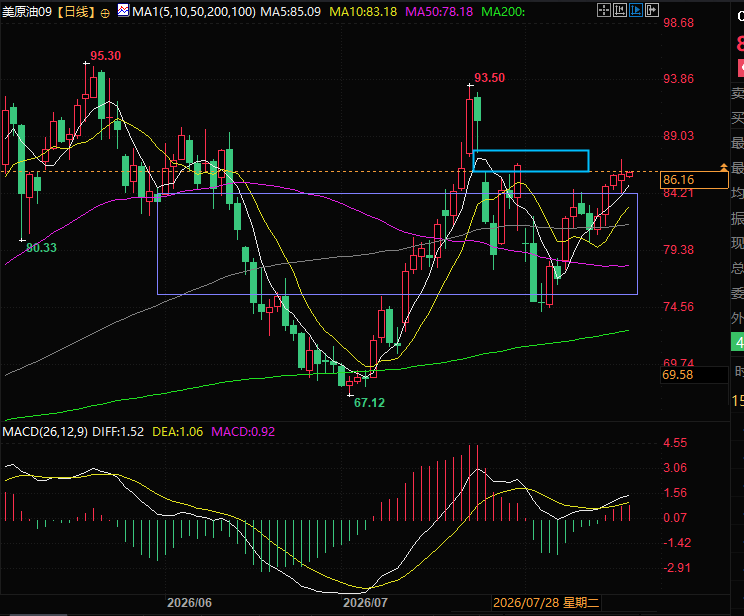 (WTI crude oil September contract daily chart, source: EasyForex) At 15:28 Beijing time, the WTI crude oil September contract is currently trading at $86.16 per barrel.
Economic Pressure: The United States Unleashes the Strongest Sanctions in History to Deter Third-Party Countries
Trump announced the most devastating economic sanctions against Iran in history, calling it the economic "Normandy landings." The US stated that Iran's naval and air forces, military industrial facilities, and currency had been attacked, bringing its domestic economy to the brink of collapse. The US also warned the world that any country providing support to Iran through currency swaps, fund transfers, ship registrations, shell companies, or other means would face severe economic retaliation, demanding an immediate halt to all aid-to-Iran activities.The Taiwan Strait game: US blockade and secret oil transport routes running in parallel.
On August 19th local time, the U.S. Central Command confirmed that the maritime blockade operation against Iran was still ongoing. The U.S. military had diverted 65 commercial vessels, rendering three ships unable to navigate normally, and had boarded and inspected two other vessels. Meanwhile, U.S. media outlet Axios revealed that the U.S. military had established a secret shipping route. This clandestine oil transport operation has been ongoing for several weeks, utilizing the southern shipping lanes off the coast of Oman, with 15-20 oil tankers passing through the straits daily over the past two weeks. The scale of oil transport has continued to rise, averaging nearly 10 million barrels per day, with peak periods reaching 15-20 million barrels per day from the Gulf. Although the scale of oil transport has not yet returned to pre-war levels, it has already provided substantial support for global crude oil supply; the full scale of the operation and its subsequent implementation details have not yet been officially disclosed.US position: Claiming the blockade was a great success, oil prices face two possible evolution paths.
US President Trump publicly stated that the US possesses extremely severe sanctions against Iran, and subsequent measures will be dynamically adjusted according to the situation. He predicted two possible outcomes: either a sharp drop in international oil prices, or the continuation of the current blockade and sanctions policies. Trump claimed that the US maritime blockade was 100% successful, the Strait of Hormuz remained open, and oil tanker shipping was not interrupted. The market's previous panic about oil prices soaring to $350 per barrel did not materialize; current oil prices are stable in the $84-85 range, and a large amount of oil is still being exported. He suggested that increased oil and gas production in Texas, Alaska, and Louisiana, coupled with the commissioning of new pipelines, has reduced the US's energy dependence on the Strait of Hormuz, diminishing the strategic importance of this waterway.Iran's countermeasures: Holding leverage in the Strait of Hormone, it sets preconditions for negotiations.
Iranian Parliament Speaker Ghalibaf outlined Iran's conditions: the United States must fully implement the 14-point memorandum of understanding, including lifting the maritime blockade, unfreezing frozen Iranian assets, and easing oil sanctions, before Iran will reopen the Strait of Hormuz. The conflicting accounts from the US and Iran regarding the actual navigation status of the strait suggest a continued risk of escalating regional conflict.Iran seeks multilateral hedging: BRICS framework to build financial connectivity corridor
Faced with comprehensive pressure from the United States' blockade, Iran is attempting to mitigate risks through multilateral cooperation. The governor of the Central Bank of Iran proposed establishing a financial connectivity corridor within the BRICS cooperation framework, calling on all parties to reduce their reliance on third-party currencies. This proposal aligns with the demands of emerging market and developing economies to reform the international monetary system and resist the risks of unilateral monetary hegemony, and is also expected to provide more independent and stable financial support for BRICS economic and trade cooperation.Iran's Revolutionary Guard warned of maintaining military radiation in the Gulf region.
A spokesperson for the Iranian Revolutionary Guard stated that the Houthi rebels in Yemen continue to enhance their capabilities and will use more destructive weapons should a new war break out. Iran itself is also making continuous progress in various weapons fields, producing more precise, destructive, and advanced models. If war breaks out again, its weapons will differ from the past in terms of warheads, accuracy, and range. He emphasized that Iran has never stopped its weapons development, and all possibilities are conceivable. The spokesperson pointed out that the Zionist regime has been fighting in Gaza for over two years without inflicting substantial damage on Hamas. Therefore, Saudi Arabia, whose military strength is far inferior to Israel's, is even less likely to be able to deal with the Houthis and Yemeni fighters. As seen in the past few days, every Saudi attack has been met with retaliation.Negotiations have stalled: the US is refusing dialogue, with the nuclear issue as the core red line.
Bilateral negotiations between the US and Iran are currently stalled. The US negotiating team has been instructed to suspend all talks until Iran makes substantial concessions. Trump has confirmed that there are no talks scheduled at this stage, only stating that dialogue might resume "perhaps at some point" in the future. The US has clearly drawn a core red line: it will absolutely not allow Iran to possess nuclear weapons.Market Outlook: Geopolitical risks and supply variables continue to weigh on crude oil prices.
The Strait of Hormuz remains the core focus of the US-Iran confrontation. While imposing sanctions and blockades, the US is simultaneously building secret shipping lanes to ensure the export of crude oil, aiming to stabilize global energy supplies. Iran uses the Strait as a bargaining chip, while leveraging the BRICS mechanism to offset external financial pressure. The crude oil market continues to bear the risk premium brought about by geopolitical conflict, while also being suppressed by the release of US domestic oil and gas production capacity. Any slight movement in the Strait of Hormuz will quickly be transmitted to the global energy market. Technically, the WTI crude oil September futures contract is still hovering around the previous downward gap, attempting an upward breakout. Resistance is near the gap, while support is at the upper edge of the trading range and near the 5-day moving average. (WTI crude oil September contract daily chart, source: EasyForex) At 15:28 Beijing time, the WTI crude oil September contract is currently trading at $86.16 per barrel.
- Risk Warning and Disclaimer
- The market involves risk, and trading may not be suitable for all investors. This article is for reference only and does not constitute personal investment advice, nor does it take into account certain users’ specific investment objectives, financial situation, or other needs. Any investment decisions made based on this information are at your own risk.