The US initiates implicit yield curve control (YCC), and the Treasury Department provides additional support to the Federal Reserve.
2026-08-20 17:10:59
Amid recent global financial market turmoil, the U.S. Treasury, under the direction of Treasury Secretary Scott Bessenter, announced a policy that sent shockwaves through the market: effectively doubling the size of its repurchase agreements for 10- to 30-year Treasury bonds, increasing the maximum repurchase amount from $2 billion to at least $4 billion per transaction, effective September. This move quickly triggered a frenzy in capital markets, with U.S. Treasury yields falling sharply, U.S. stocks and gold rebounding strongly, while the dollar suffered a sell-off. 
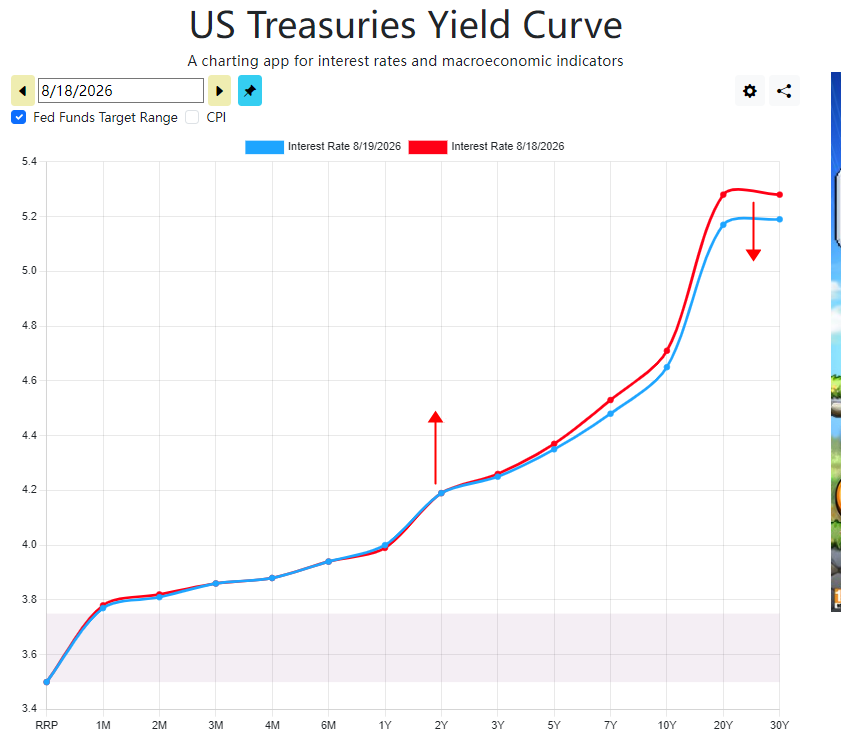 (Comparison of Treasury yield curves before and after intervention, source: Federal Reserve)
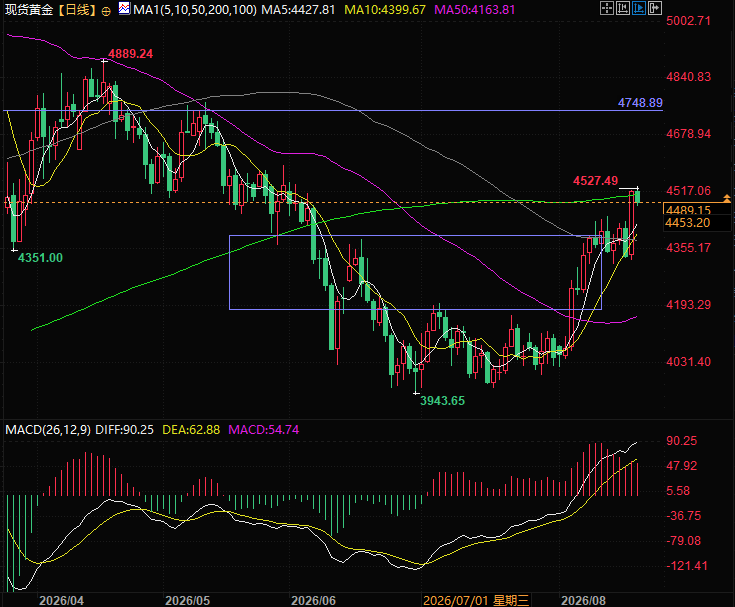 (Spot gold daily chart, source: FX678) At 17:00 Beijing time, spot gold is currently trading at $4488 per ounce.
What is "Bessent's pan-YCC operation", and what are the nature and boundaries of YCC?
Yield curve control (YCC) traditionally refers to a monetary policy where a central bank commits to "unlimited purchases of government bonds of a specific maturity," forcibly anchoring long-term interest rates to a target level (such as the Bank of Japan). The Ministry of Finance's recent operation is being called a "fiscal version" or "implicit" YCC: The core intent is the same: the Ministry of Finance uses a "buy long, issue short" (repurchase long-term bonds and issue short-term government bonds) swap mechanism to withdraw long-term bond holdings from the market, thereby forcibly offsetting the pressure of rapidly rising long-term interest rates, without essentially increasing the monetary base. The fundamental difference lies in the fact that true YCC relies on a central bank with the "power to issue currency," theoretically having no upper limit on funds; while the Ministry of Finance does not have a printing press, and its repurchases rely entirely on the fiscal budget and debt swap capabilities. Therefore, this is not traditional monetary easing, but rather an active Treasury operation led by the Ministry of Finance.Logical contradiction: Why would this move put significant pressure on the Federal Reserve to raise interest rates?
If the Federal Reserve is forced to restart interest rate hikes due to sticky inflation or strong data, the Treasury's "repurchase intervention" will face a devastating blow, potentially making future rate hikes extremely difficult: Short-term funding costs will soar: The Treasury needs funds to repurchase long-term bonds from issuing short-term Treasury bills (T-Bills). Fed rate hikes will directly raise short-term interest rates, causing a surge in the Treasury's cost of issuing short-term bonds, making debt swaps unsustainable. A severely inverted yield curve: Rate hikes will raise short-term yields, while the Treasury's forced suppression of long-term yields will lead to a deeply inverted yield curve, severely squeezing commercial bank interest rate spreads and triggering liquidity risks in the financial system. Forcing rate hikes will become difficult (a fiscal-led dilemma): After the Treasury "de facto shortens" its debt, the government needs to frequently roll over short-term bonds at the latest high interest rates. Once the Fed raises rates, the massive interest payments on US debt will directly overwhelm the fiscal budget. This is equivalent to the Treasury preemptively putting "shackles" on the Fed, forcing the central bank to compromise with fiscal difficulties when formulating monetary policy. (Comparison of Treasury yield curves before and after intervention, source: Federal Reserve)Size Comparison: Tactical "Small Pipes" and Actual Impact
From an objective data perspective, the Treasury's bond-buying quota is merely the tip of the iceberg compared to the massive US debt system. Currently, the total size of the US national debt is a staggering $32.2 trillion, of which the outstanding amount of 20- to 30-year long-term US Treasury bonds, which are the main bailers in this transaction, is approximately $5.5 trillion. Previous repurchase volume: The total repurchase volume for the entire year of 2024 was only $32 billion (operating for only 7 months), $78 billion in 2025, and approximately $50 billion so far in 2026. Original scale: The maximum repurchase amount per transaction was only $2 billion (the planned total from August to November was approximately $69 billion). Adjusted scale: The maximum repurchase amount per transaction has doubled to at least $4 billion (the planned total from September to November will increase to approximately $83 billion, representing an additional injection of approximately $14 billion). Compared to the peak of the Federal Reserve's QE, which reached as high as $120 billion per month, the Treasury's adjusted repurchase volume is only about 5%-7% of the Fed's past monthly QE scale. This tactical "small-pipe" injection of liquidity has a starkly different impact: In the short term, due to Treasury Secretary Bessant's astute choice to intervene in mid-August, when liquidity was weak and just before the auction, the policy's excellent psychological squeeze effect instantly disrupted one-sided short positions, forcing short sellers to close their positions and successfully suppressing long-term yields; However, in the medium to long term, relying solely on debt swaps of a few hundred billion dollars annually is simply insufficient to reverse the fundamental disadvantages such as the huge fiscal deficit and sticky inflation, and it is difficult to fundamentally curb the long-term upward trend of long-term interest rates.Four Key Signals Released by "Bessent Put"
Like the "Greenspan Option" of the past, market institutions now explicitly characterize the Treasury's proactive intervention as the "Bessant Option." This action sends four core signals to the global market: First, it sets a "caps on yields," indicating that the Trump administration cannot tolerate 10-year yields exceeding 4.75% and 30-year yields exceeding 5.25%-5.35%. Once the threshold jeopardizing mortgage lending and the economy is reached, the Treasury will intervene. Second, the Treasury has transformed into an "active market maker," abandoning the traditional "conventional, transparent, and predictable" bond issuance model. Treasury Secretary Bessant has demonstrated an aggressive tactical intervention style, actively using Treasury tools as tactical weapons to regulate market liquidity. Third, it declares war on "bond guardians," directly expressing its buying stance in the face of Wall Street short sellers attempting to punish high deficits by selling US Treasuries and forcing higher interest rates, warning the market against blindly shorting US Treasuries. The Treasury Department's preemptive "injection" of liquidity into the Federal Reserve ahead of the Jackson Hole central bank symposium is effectively forcing the Fed to adopt a more accommodative and accommodative monetary policy outlook in the future.Impact on gold prices
Following the Treasury's announcement of expanded repurchase operations, spot gold surged by over 2% and broke through the $4,500/ounce mark, becoming the most dazzling safe-haven asset in the market. The core transmission logic is as follows: Declining real interest rates eliminate the cost of holding gold: Gold does not generate interest, and its price is highly negatively correlated with the "real interest rate" (nominal interest rate minus inflation expectations). Treasury Secretary Bessant forcibly capped nominal yields, but debt swaps and high deficits have kept medium- to long-term inflation expectations stubbornly persistent, leading to a significant decline in real interest rates and a substantial reduction in the opportunity cost of holding gold. A weakening dollar attracts funds to risk-free assets: The Treasury's "issuing short-term debt to buy long-term debt" increased the supply of short-term dollar debt, suppressing the dollar's credit (the dollar index fell to a recent low). As the ultimate currency with neither sovereign default risk nor credit risk, gold naturally absorbed the safe-haven funds flowing out of dollar assets. The core logic: The market's rush to buy gold is essentially a hedge against the government's use of implicit swaps and administrative suppression to cover up the debt crisis. As long as the US fiscal deficit and debt crisis remain unresolved, gold will remain the best safe-haven asset against the devaluation of fiat currencies and policy distortions. (Spot gold daily chart, source: FX678) At 17:00 Beijing time, spot gold is currently trading at $4488 per ounce.
- Risk Warning and Disclaimer
- The market involves risk, and trading may not be suitable for all investors. This article is for reference only and does not constitute personal investment advice, nor does it take into account certain users’ specific investment objectives, financial situation, or other needs. Any investment decisions made based on this information are at your own risk.