The Eurozone Market Logic Shifts: How Do Capital Flows, Inflation, and Policy Forces Interact?
2026-08-20 18:16:59
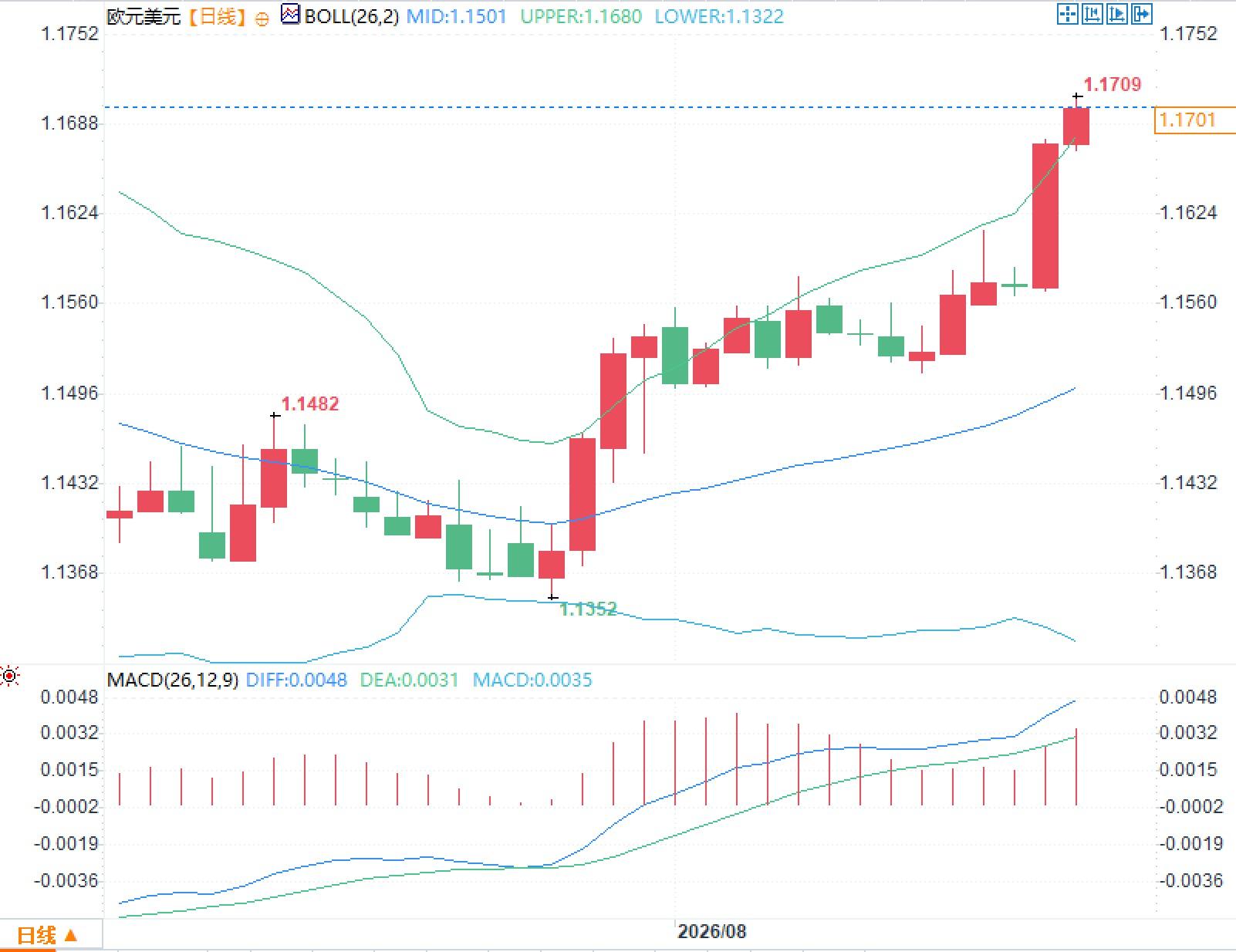
On Thursday, August 20th, the core trading logic surrounding the euro is shifting. The euro has maintained its strength against the US dollar recently, and market focus has gradually shifted from a single interest rate differential to the attractiveness of European assets, overseas capital flows, and changes in the inflation environment. Currently, the euro is trading around 1.1700 against the dollar, with the dollar's recent weakness providing external support. At the same time, European assets are attracting more international capital. Data from the European Central Bank and market analysis show that overseas investors purchased approximately €1.1 trillion in eurozone securities over the past 12 months, covering both bond and stock markets. This change in capital flows indicates that international allocation demand for euro assets is becoming a significant variable influencing the exchange rate. For a considerable period, the euro exchange rate was primarily influenced by differences in economic growth, central bank policy paths, and changes in the interest rate differential between Europe and the US. However, recently, market pricing logic has expanded, and the importance of capital flow factors has significantly increased.  From an asset allocation perspective, the continued increase in overseas investors' allocation to Eurozone securities reflects a global reassessment of the risk-return characteristics of European assets. The European bond market offers a relatively stable source of returns, and the valuations of some European corporate assets have also attracted international attention. This change does not necessarily indicate a comprehensive improvement in the European economic environment, but rather that the market is seeking a new asset rebalancing point. When global investors reduce their allocation to single markets, European assets may receive more funds for portfolio adjustments. From the perspective of exchange rate transmission mechanisms, foreign capital purchasing Eurozone stocks and bonds typically requires conversion into euros to complete asset allocation, thus creating a certain level of capital inflow support. Simultaneously, capital inflows also influence market assessments of long-term demand for the euro, expanding the impact of exchange rate factors from short-term interest rate expectations to medium- and long-term asset allocation. One of the key variables currently facing the European economy remains energy price fluctuations. Recent increases in natural gas prices due to supply disruptions have led the market to refocus on the transmission of energy costs to inflation. Rising energy prices not only affect household consumption costs but may also be transmitted to businesses through the industrial production chain. If production costs continue to rise, price pressures in the service and manufacturing sectors may fluctuate, limiting the European Central Bank's ability to quickly shift to easing policies. The latest German producer price data is a key focus for the market. Data shows that German producer prices rose 3.0% year-on-year in July, higher than the market expectation of 2.7%, marking the fastest annual growth rate since April 2023. Meanwhile, the month-on-month increase was 1.1%, indicating that price pressures on the industrial sector remain. However, the impact of producer price data on financial markets still needs to be assessed in conjunction with the overall economic background. Some institutions believe that although the data was higher than expected, its impact on overall policy expectations is relatively limited because it is not a major market indicator. Currently, the focus of the euro market is not on a single economic data point, but rather on the balance between inflation, growth, and monetary policy. If energy prices continue to drive inflationary pressures, the European Central Bank (ECB) may need to more cautiously assess the pace of interest rate policy adjustments. Market expectations for the ECB's future policy path will also affect the euro's performance through bond yields and currency valuations. The ECB currently faces the challenge that inflationary risks have not completely subsided, but the momentum of economic growth still needs to be observed. Excessive tightening of policy may affect economic activity, while premature easing may lead to a resurgence of price pressures. Therefore, future market analysis will focus on several areas: first, whether energy prices continue to be transmitted to the consumer side; second, whether core inflation continues its downward trend; and third, whether there are signs of improvement in European economic activity. From a technical analysis perspective, the euro/dollar exchange rate has recently been trading in the upper half of the Bollinger Bands, with the moving average structure gradually improving and the MACD indicator remaining in positive territory, reflecting a strengthening of short-term market momentum.
  In recent years, the core drivers of the global foreign exchange market have been constantly changing. Traditional carry trades relied on differences in central bank policies, while the current market is paying more attention to capital flows, fiscal stability, energy security, and asset valuations. A key reason for the recent focus on the euro is the resonance between capital inflows and policy expectations. On the one hand, overseas capital is increasing its allocation to Eurozone assets; on the other hand, inflationary pressures are keeping the European Central Bank's policies somewhat constrained. However, there are also potential risks. The European economy still faces uneven growth, energy price fluctuations may again affect corporate profit expectations, and changes in global risk appetite may also alter capital flows. Therefore, the future evolution of the euro market is not determined by a single factor, but rather by the combined effect of multiple variables. Capital inflows provide structural support, inflationary pressures affect policy space, and economic fundamentals determine whether this support can be sustained.
From an asset allocation perspective, the continued increase in overseas investors' allocation to Eurozone securities reflects a global reassessment of the risk-return characteristics of European assets. The European bond market offers a relatively stable source of returns, and the valuations of some European corporate assets have also attracted international attention. This change does not necessarily indicate a comprehensive improvement in the European economic environment, but rather that the market is seeking a new asset rebalancing point. When global investors reduce their allocation to single markets, European assets may receive more funds for portfolio adjustments. From the perspective of exchange rate transmission mechanisms, foreign capital purchasing Eurozone stocks and bonds typically requires conversion into euros to complete asset allocation, thus creating a certain level of capital inflow support. Simultaneously, capital inflows also influence market assessments of long-term demand for the euro, expanding the impact of exchange rate factors from short-term interest rate expectations to medium- and long-term asset allocation. One of the key variables currently facing the European economy remains energy price fluctuations. Recent increases in natural gas prices due to supply disruptions have led the market to refocus on the transmission of energy costs to inflation. Rising energy prices not only affect household consumption costs but may also be transmitted to businesses through the industrial production chain. If production costs continue to rise, price pressures in the service and manufacturing sectors may fluctuate, limiting the European Central Bank's ability to quickly shift to easing policies. The latest German producer price data is a key focus for the market. Data shows that German producer prices rose 3.0% year-on-year in July, higher than the market expectation of 2.7%, marking the fastest annual growth rate since April 2023. Meanwhile, the month-on-month increase was 1.1%, indicating that price pressures on the industrial sector remain. However, the impact of producer price data on financial markets still needs to be assessed in conjunction with the overall economic background. Some institutions believe that although the data was higher than expected, its impact on overall policy expectations is relatively limited because it is not a major market indicator. Currently, the focus of the euro market is not on a single economic data point, but rather on the balance between inflation, growth, and monetary policy. If energy prices continue to drive inflationary pressures, the European Central Bank (ECB) may need to more cautiously assess the pace of interest rate policy adjustments. Market expectations for the ECB's future policy path will also affect the euro's performance through bond yields and currency valuations. The ECB currently faces the challenge that inflationary risks have not completely subsided, but the momentum of economic growth still needs to be observed. Excessive tightening of policy may affect economic activity, while premature easing may lead to a resurgence of price pressures. Therefore, future market analysis will focus on several areas: first, whether energy prices continue to be transmitted to the consumer side; second, whether core inflation continues its downward trend; and third, whether there are signs of improvement in European economic activity. From a technical analysis perspective, the euro/dollar exchange rate has recently been trading in the upper half of the Bollinger Bands, with the moving average structure gradually improving and the MACD indicator remaining in positive territory, reflecting a strengthening of short-term market momentum. In recent years, the core drivers of the global foreign exchange market have been constantly changing. Traditional carry trades relied on differences in central bank policies, while the current market is paying more attention to capital flows, fiscal stability, energy security, and asset valuations. A key reason for the recent focus on the euro is the resonance between capital inflows and policy expectations. On the one hand, overseas capital is increasing its allocation to Eurozone assets; on the other hand, inflationary pressures are keeping the European Central Bank's policies somewhat constrained. However, there are also potential risks. The European economy still faces uneven growth, energy price fluctuations may again affect corporate profit expectations, and changes in global risk appetite may also alter capital flows. Therefore, the future evolution of the euro market is not determined by a single factor, but rather by the combined effect of multiple variables. Capital inflows provide structural support, inflationary pressures affect policy space, and economic fundamentals determine whether this support can be sustained.
- Risk Warning and Disclaimer
- The market involves risk, and trading may not be suitable for all investors. This article is for reference only and does not constitute personal investment advice, nor does it take into account certain users’ specific investment objectives, financial situation, or other needs. Any investment decisions made based on this information are at your own risk.