Institutions: US government launches implicit quantitative easing, fully opening up potential for a gold bull market.
2026-08-21 10:36:59
Recent key adjustments to US fiscal and monetary policies have provided strong support for the precious metals market with a continued easing stance. On the evening of August 19, 2026 (Beijing time), the US Treasury officially implemented an expansion of its long-term Treasury bond repurchase program, seen by the market as a form of implicit quantitative easing. Charlie Morris, Chief Investment Officer and Founder of ByteTree, clearly stated in his latest industry report that the combined effect of multiple easing measures in the US has thoroughly solidified the foundation for a gold bull market. The current price increase is just the beginning, with ample room for further upward movement. Debt imbalances, monetary easing, and global central bank gold purchases will continue to drive gold prices higher.
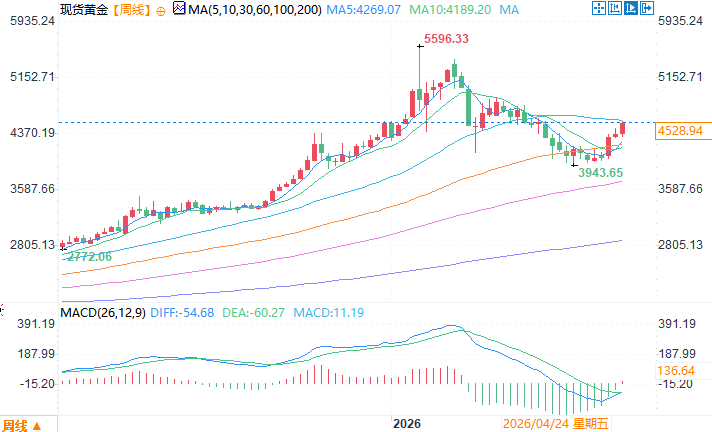 Spot gold weekly chart source: FX678. At 10:35 AM Beijing time on August 21, spot gold was trading at $4527.54 per ounce.
The US Treasury has initiated implicit easing, proactively lowering financing costs.
This policy adjustment was spearheaded by U.S. Treasury Secretary Scott Bessent, with the core measure being the doubling of the scale of long-term Treasury bond repurchases to specifically support long-term bond prices and lower the U.S. government's long-term financing costs. Morris stated that this operation is essentially equivalent to quantitative easing, a core means for the U.S. government to proactively intervene in the bond market and hedge against debt pressure. Prior to this, at the end of July, Bessent had already spent billions of dollars intervening in the foreign exchange market to stabilize the yen. This series of easing operations continuously released liquidity, becoming the direct trigger for the recent rebound in gold prices. In his report, he optimistically predicted the gold price trend, stating, "The overall trend for gold is improving, the market is experiencing a rapid recovery, and gold prices will soon be able to regain their footing above the 200-day moving average." Compared to traditional monetary policy, the Treasury's direct bond purchases have a more direct easing effect, and the continuous injection of liquidity provides solid support for gold's premium as a store of value.With US debt continuing to spiral out of control, gold's valuation has significant room for recovery.
The current US public debt has exceeded $40 trillion, and the rate of debt expansion continues to climb. Data shows that the average annual growth rate of US debt was 3.7% in the 1990s, rising to 7.8% before the pandemic, and further climbing to 8.6% after the pandemic, far exceeding the 6.5% nominal GDP growth rate. The rate of debt expansion has far outpaced economic growth, making the long-term fiscal imbalance unsustainable. Morris's analysis states that for a century, the total market value of global above-ground gold has been deeply correlated with the scale of outstanding US debt, while the annual growth rate of physical gold production is only 2%. The gap in debt expansion can only be filled by rising gold prices. Currently, the total market value of global gold is approximately $31 trillion, equivalent to 77% of the US debt. Historically, this ratio has exceeded 100% multiple times, indicating that gold prices still have room for valuation recovery. At the same time, the market value of gold is only 37% of the total market capitalization of the US stock market, far lower than the peak of 160% during the Great Depression and the inflation crisis of the 1970s, suggesting significant future growth potential.The loose monetary policy has hidden shortcomings, and the central bank's logic for purchasing gold continues to strengthen.
Industry insiders believe that the US's continuous bond-buying easing model has significant drawbacks. The market's long-term bond inventory is far less than that of short-term bonds. While short-term bond purchases can lower long-term yields, maintaining the easing effect requires continuous and escalating operations. In the current reflationary market environment, the negative impact of this model will continue to amplify. Coupled with the US facing $3 trillion in short-term debt refinancing pressure between 2027 and 2028, sustained low interest rates and ample liquidity will become an inevitable choice for the US. This is also the core reason why global central banks continue to increase their gold holdings. Morris stated that central banks are gradually reducing their reliance on US Treasury bonds, and gold, with its abundant supply, high liquidity, scarce supply, and long-term value preservation, is the optimal asset to replace US Treasury bonds. In the first quarter of this year, global central bank gold demand rebounded strongly, with only Turkey and Russia experiencing short-term net selling. Major Asian countries' trillion-dollar trade surpluses continue to flow into the gold market annually, and against the backdrop of geopolitical instability, gold has become a core global safe-haven asset.Summarize
In summary, the US Treasury's continued implementation of implicit quantitative easing policies, coupled with the out-of-control scale of US debt and the weakening of the US dollar's credibility, forms the core logic for a medium- to long-term bull market in gold. Currently, gold valuations remain relatively low, and with continued gold purchases by global central banks and ongoing geopolitical risks, the upward channel for gold prices has been fully opened under the combined effect of multiple positive factors, offering strong potential for continued upward movement and significant upside potential. Spot gold weekly chart source: FX678. At 10:35 AM Beijing time on August 21, spot gold was trading at $4527.54 per ounce.
- Risk Warning and Disclaimer
- The market involves risk, and trading may not be suitable for all investors. This article is for reference only and does not constitute personal investment advice, nor does it take into account certain users’ specific investment objectives, financial situation, or other needs. Any investment decisions made based on this information are at your own risk.