August 24th Financial Breakfast: Is the US Dollar's Credibility Undermined? Gold Prices Hold Steady at Three-Month High of $4600, Oil Prices Await US Economic Sanctions Against Iran
2026-08-24 07:22:59
On Monday (August 24, Beijing time) in early Asian trading, spot gold was trading around $4,607 per ounce. Last week, gold prices hit a three-month high after the US Treasury announced a possible further expansion of its Treasury bond repurchase program, raising concerns that this could weaken confidence in the dollar, causing it to weaken. Meanwhile, the market awaited specific measures from the US this week regarding economic sanctions against Iran. On August 23, Iran unveiled its "oil export countermeasures," stating that if the US waged an economic war, there would be no more oil exports from the Strait of Hormuz or even the Persian Gulf region. US crude oil is currently trading around $86.13 per barrel. 
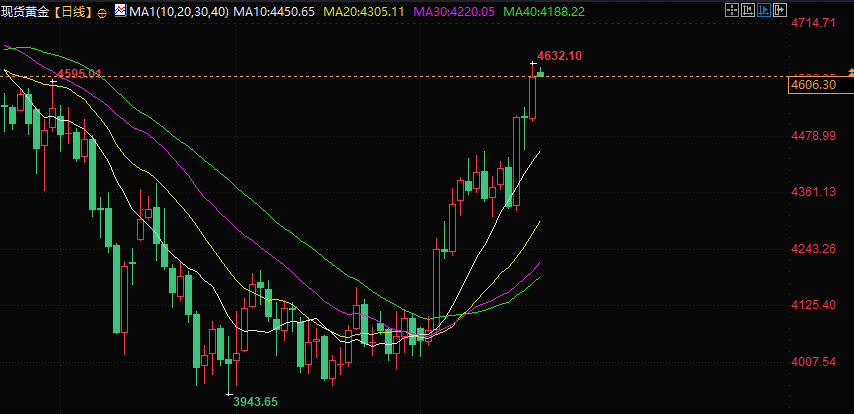 This rally was fueled by gold prices breaking through the closely watched 200-day moving average (around $4,513/oz), a key technical level viewed as a bullish signal by technical analysts. A weaker dollar also provided support, as market concerns arose that the US Treasury's plan to expand its bond buyback program could undermine confidence in the dollar. TD Securities strategists noted that if the momentum continues, the next target would be $4,700/oz, while a Goldman Sachs report stated that renewed global macroeconomic policy hedging demand boosted demand for gold call options, creating a mechanical price amplification effect. On the physical demand side, Indian retail buying was dampened by high prices, but Chinese demand remained stable; other precious metals also rose in tandem, with spot silver, platinum, and palladium increasing by 2.3%, 2.8%, and 0.8% respectively, marking gains for all precious metals last week.
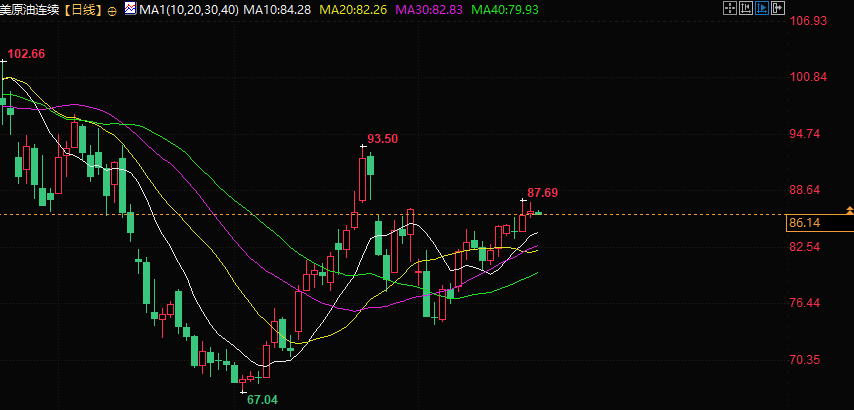 Again Capital partners stated that sanctions have been the primary means of pressuring Iran, while Iran has responded with "devastating" retaliation against any new threats. However, Empire FX analysts point out that given the severe restrictions on Iranian exports due to the US maritime blockade, the direct impact on supply may be limited. But with shipping volumes in the Strait of Hormuz remaining far below normal levels, increased maritime accidents and retaliatory actions could escalate tensions. Price Futures Group analysts believe the market is seeking alternative supplies from pipelines, US shale oil, and recovering Venezuelan and UAE sources. Furthermore, continued production cuts by major oil-producing countries are also supporting oil prices, and neither side has attempted to restart negotiations after the US-Iran peace agreement expired this week. Ship tracking data shows that only seven commodity carriers passed through the Strait of Hormuz last Thursday, half the number of the previous day.
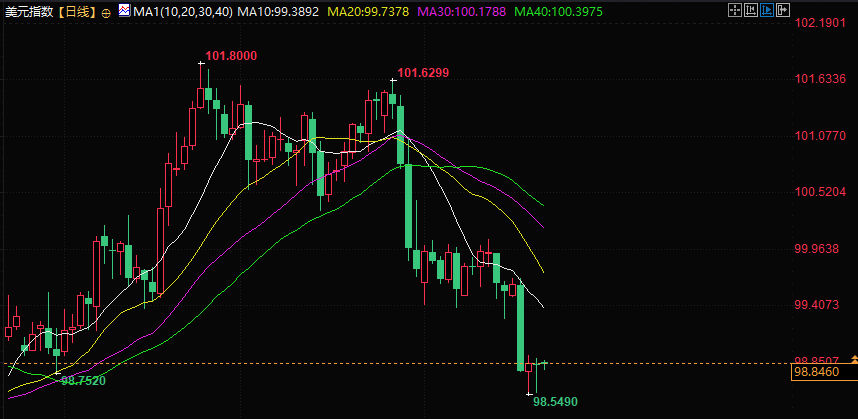 The euro touched a high of 1.1711 against the dollar, its highest since May 14, before closing at 1.1679. The pound also hit a high of 1.3675 against the dollar, its highest since February 11. The market's next test is Federal Reserve Chairman Warsh's speech at Jackson Hole this Friday. TD Securities believes the dollar's risks are skewed to the downside; if Warsh fails to address the issue of credibility in combating inflation, it could put further pressure on the dollar. Federal funds rate futures show a 40% probability of a rate hike in September and 72% in December. The yen rose slightly against the dollar to 159.01, supported by the acceleration of Japan's core inflation in July, but analysts say the yen may resume its decline unless the Bank of Japan tightens policy. The market is focused on its policy meeting on September 17-18.
stock market
U.S. stocks closed higher on Friday, with the Dow Jones Industrial Average, S&P 500, and Nasdaq Composite rising 0.98%, 0.43%, and 0.44%, respectively. However, all three indices recorded weekly declines, with the S&P 500 and Nasdaq ending three-week winning streaks and the Dow Jones falling for the second consecutive week. The market was primarily driven by bond yield volatility and uncertainty surrounding the Middle East situation. Investor concerns about a one-sided rise in yields eased somewhat after the U.S. Treasury announced a possible further expansion of its Treasury bond repurchase program. The materials sector led the gains, while utilities saw the largest declines. Oil prices rose for the sixth consecutive day due to supply risks from Iran, further exacerbating inflation concerns. In terms of individual stocks, Ross Stores rose 4.4% after raising its annual earnings forecast. Looking ahead to next week, market focus will shift to earnings reports from technology companies such as Nvidia, July PCE inflation data, and Federal Reserve Chairman Warsh's speech at the Jackson Hole Symposium.Gold Market
Spot gold rose nearly 2% on Friday, hitting a high of $4,632.10 per ounce, its highest level since May 15. It gained more than 5% last week, marking its third consecutive weekly gain. This rally was fueled by gold prices breaking through the closely watched 200-day moving average (around $4,513/oz), a key technical level viewed as a bullish signal by technical analysts. A weaker dollar also provided support, as market concerns arose that the US Treasury's plan to expand its bond buyback program could undermine confidence in the dollar. TD Securities strategists noted that if the momentum continues, the next target would be $4,700/oz, while a Goldman Sachs report stated that renewed global macroeconomic policy hedging demand boosted demand for gold call options, creating a mechanical price amplification effect. On the physical demand side, Indian retail buying was dampened by high prices, but Chinese demand remained stable; other precious metals also rose in tandem, with spot silver, platinum, and palladium increasing by 2.3%, 2.8%, and 0.8% respectively, marking gains for all precious metals last week.oil market
Oil prices rose on Friday as U.S. President Trump threatened economic sanctions against Iran's trading partners, raising market expectations of tighter supplies in the coming weeks. Brent crude rose 0.73% to $93.86 a barrel, while WTI crude rose 0.5% to $86.64, with both up 5.93% and 5.15% respectively last week. Again Capital partners stated that sanctions have been the primary means of pressuring Iran, while Iran has responded with "devastating" retaliation against any new threats. However, Empire FX analysts point out that given the severe restrictions on Iranian exports due to the US maritime blockade, the direct impact on supply may be limited. But with shipping volumes in the Strait of Hormuz remaining far below normal levels, increased maritime accidents and retaliatory actions could escalate tensions. Price Futures Group analysts believe the market is seeking alternative supplies from pipelines, US shale oil, and recovering Venezuelan and UAE sources. Furthermore, continued production cuts by major oil-producing countries are also supporting oil prices, and neither side has attempted to restart negotiations after the US-Iran peace agreement expired this week. Ship tracking data shows that only seven commodity carriers passed through the Strait of Hormuz last Thursday, half the number of the previous day.Foreign exchange market
The dollar index closed at 98.55 on Friday, and the dollar fell to a three-month low against the euro as markets grew increasingly concerned that the U.S. Treasury's plan to expand its buyback program for longer-term Treasury bonds could put further pressure on the dollar. Treasury Secretary Bessant indicated that the buyback program might be further increased, following the Treasury's unexpected pledge the previous day to at least double the buyback program to curb rising yields. However, analysts pointed out that this move failed to effectively lower U.S. Treasury yields and instead weakened the dollar. The chief strategist at Bannockburn Global Forex said, "The market is fighting back." The euro touched a high of 1.1711 against the dollar, its highest since May 14, before closing at 1.1679. The pound also hit a high of 1.3675 against the dollar, its highest since February 11. The market's next test is Federal Reserve Chairman Warsh's speech at Jackson Hole this Friday. TD Securities believes the dollar's risks are skewed to the downside; if Warsh fails to address the issue of credibility in combating inflation, it could put further pressure on the dollar. Federal funds rate futures show a 40% probability of a rate hike in September and 72% in December. The yen rose slightly against the dollar to 159.01, supported by the acceleration of Japan's core inflation in July, but analysts say the yen may resume its decline unless the Bank of Japan tightens policy. The market is focused on its policy meeting on September 17-18.International News
Following US President Trump's announcement of an "unprecedented" economic war against Iran , US Treasury Secretary Bessenter confirmed that the specific details of the "unprecedented economic isolation" measures against Iran would be officially announced on the 24th. Iran, on the 23rd, countered with its own "oil export" measures: if the US waged an economic war, there would be no more oil exports from the Strait of Hormuz or the Persian Gulf region. Currently, there are less than 24 hours left before the US announces the details of the sanctions. Public opinion generally believes this is a desperate move by the US given the current protracted conflict and fruitless negotiations between the two countries. Although specific measures have not yet been announced, some analysts believe this action may ultimately lead to a "lose-lose" situation. (CCTV News) Iranian Foreign Minister: Iran Has Never Feared US Sanctions On the 23rd local time, Iranian Foreign Minister Araqchi stated that Iran has never feared US sanctions. All their actions, whether blockades or military operations, have failed, and this new tactic will also fail. Trump's so-called "economic actions" are nothing more than a consistent bullying tactic of US policy. "In a sense, it's like a movie we've seen countless times; we know how to deal with it," Araghchi said. He added that whether the US engages in military action or reverts to old tactics, it shows they have no other choice. Faced with the Iranian people, the US has no option but to keep repeating the same plans. They should understand that there is no other way but to engage in respectful dialogue with the Iranian people and seek a solution based on justice and honor. (CCTV) Iranian President: The Country is in a State of Total War; US Misjudged Iran's Fall Before the War Iranian President Pezechzian stated that Iran is currently facing a "comprehensive economic, military, and security war." He emphasized that Washington mistakenly predicted before the war that Iran would quickly fall under US aggression and become like Venezuela, but the reality has surprised the world with Iran's "resistance, unity, and cohesion." Regarding Trump's announcement of "the harshest sanctions" against Iran, Pezechzian stated that Iran will stand firm and strive to cope with this "asymmetric war," resisting external pressure through a combination of internal mobilization and diplomatic means. Iran is currently using its control of the Strait of Hormuz as a strategic bargaining chip to maintain its military-industrial capacity during the six-month-long conflict, while emphasizing domestic resistance. Furthermore, Iran has included the development of renewable energy as part of its plan to alleviate energy imbalances and enhance its internal economic resilience. Iran's security chief stated that the Strait of Hormuz will remain closed until the US fulfills its commitments and warns neighboring countries against economic warfare. Rezaei, Secretary of Iran's Supreme National Security Council, stated that Iran will eliminate the economic pressure exerted by the US and take retaliatory measures against countries participating in the US "economic war" against Iran. He said the US has been "backed into a corner," facing either fulfilling its commitments or further deterioration of the situation. Iran has clearly warned all neighboring countries against launching an economic war against it, otherwise they will be considered hostile states and face Iranian retaliation. Rezaei emphasized that reopening the Strait of Hormuz is not currently being considered; the US must first fulfill its commitments to cease aggression and not interfere with regional maritime traffic. He revealed that Iran and Oman have reached a "paper agreement" on a commercial route through the strait, but the strait will reopen once the US fulfills its commitments. He pointed out that the Strait of Hormuz is "part of Iran's identity," and Iran will not relinquish its control over the strait. Rezaei stated that Iran's defense strategy and diplomatic behavior have undergone a fundamental transformation since the US-Israeli aggression. "Today's Iran is not the pre-war Iran," he said, adding that international perceptions of Iran have also changed. Iran will incorporate the lessons of war into its future military plans and adjust its diplomatic behavior to counter US breaches of commitment. The Supreme Leader's recent appointment of experienced commanders signifies a new operational approach in the next phase. Rezaei stated that Iran does not seek war but will continue to resist hostile actions. He warned the US against increasing its military presence in the Middle East, or Iran would retaliate. He also stated that Iran remains committed to diplomatic means, but the negotiation method has changed—Tehran will wait for the other side to fulfill its commitments, with goals including ending the wars in Iran, Lebanon, Gaza, and Yemen. He also pointed out that despite facing a naval blockade, Iran exported 70 million barrels of oil in the past month or two. Trump: US Military Intervention in Bond Market Possible US President Trump told the media on August 21 that he did not instruct Treasury Secretary Bessenter to intervene in the bond market this week. When asked what other intervention measures were available in the face of rising US long-term bond yields, Trump stated, "The ultimate intervention is the US military, which will be deployed if necessary." (CCTV International News) US-Canada trade negotiations break down; US imposes 50% tariffs on some Canadian goods starting Saturday US Trade Representative Greer stated that Canada has refused to finalize a bilateral trade agreement and continues to maintain retaliatory measures against the US, leading to a stalemate in negotiations. A senior official revealed that the US had offered Canada more favorable access to the US market, an agreement that could have significantly reduced tariffs and made Canada the country with the best trade terms with the US among all exporting countries. The official also pointed out that the US offered Canada generous facilitation arrangements for automobile exports, but Canada still chose not to accept them. According to statements from senior Trump administration officials, pursuant to Section 338 of the Tariff Act of 1930, the US will impose a 50% tariff on some Canadian imports, a measure that officially took effect at 12:01 AM Eastern Time on Saturday. Iran's parliamentary committee has approved a proposed toll scheme for passage through the Strait of Hormuz, but the mechanism faces legislative and international resistance. Iran's National Security and Foreign Policy Committee has approved Article 3 of a proposed law allowing Iran to charge fees to vessels permitted to pass through the Strait of Hormuz. This measure is part of a "strategic action plan to ensure the security and development of the Strait of Hormuz." Tehran stated that the tolls would cover maritime services, environmental services, fuel supplies, insurance, and security-related items, with payments made in Iranian rials or other designated currencies. Iran emphasized that the proposed legislation does not disregard international maritime rules; the draft law recognizes freedom of navigation under international law while stressing the sovereignty and security rights of littoral states along the strait, and cites the 1982 United Nations Convention on the Law of the Sea and Oman's position. The Strait of Hormuz has become one of the main points of contention in the US-Iran conflict, and Tehran hopes to expand its control over the conditions of use of the waterway. This toll scheme is a core measure to strengthen its management claims. Currently, commercial shipping through the Strait of Hormuz has declined significantly, with only a single-digit number of cargo ships passing through recently, compared to over 130 vessels per day before the war. While Iran has allowed some Iraqi oil tankers to pass, overall access remains selective. The proposal must be approved by the Iranian parliament and reviewed by the Guardian Council; in case of disagreement, the Supreme Interests Council may intervene. The US has previously rejected Iran's attempts to strengthen control over the Strait and maintained its blockade of Iranian ports. These conflicting policies create uncertainty for shipping companies regarding compliance options near the Strait. Any prolonged restrictions could trigger a chain reaction of global supply shortages, transportation costs, and insurance premiums. As Iran pushes forward with a formal toll system while the US continues to exert pressure, the Strait of Hormuz is simultaneously becoming a flashpoint for military conflict and a front line for economic competition. If the bill is ultimately approved, Iran will gain a formal legal framework for charging authorized vessels.Domestic News
A report shows that China's greening of the entire computing power chain has begun to show results. Currently, China's computing power is growing rapidly, computing equipment is upgrading towards higher energy efficiency, the green transformation of computing power carriers is progressing positively, and computing-electricity collaboration is moving from concept to practice. New models and new business forms such as computing power networks, word economy, and overseas expansion of computing power have become new growth poles. This is the latest news obtained by reporters on the 2026 Green Computing Power (Artificial Intelligence) Conference held in Hohhot, Inner Mongolia Autonomous Region on the 22nd. At the opening ceremony of the conference, Ao Li, Vice President of the China Academy of Information and Communications Technology, released the "Research Report on the Development of Green Computing Power (2026)". The report points out that in terms of the greening of computing equipment, China's computing equipment is accelerating its iterative upgrade towards higher energy efficiency. As of the end of June 2026, China's intelligent computing power scale reached 2185 EFLOPS. New technologies such as liquid cooling, high-speed optical interconnection, and new storage architecture have become essential conditions for the construction of high-density intelligent computing centers, supporting the coordinated development of the computing power industry in terms of scale, performance, and energy efficiency. The report points out that China's intensive layout and green transformation of computing power carriers are being promoted in a coordinated manner. By the end of 2025, China had over 13.73 million standard server racks in operation, and 42 intelligent computing clusters with tens of thousands of servers per day had been built. The intelligent computing power aggregated in the eight national hub nodes accounted for more than 80% of the national total. Significant progress has been made in improving green and low-carbon levels, with over 160 data centers nationwide rated as 4A-level or higher green data centers. Regarding the greening of computing power synergy, computing-electricity synergy has moved from concept to practice. The top-level policy system continues to improve, and computing-electricity synergy has been included in the 2026 Government Work Report. Currently, a number of benchmark projects for computing-electricity synergy have been completed, and breakthroughs in technological and market mechanism innovation continue. Integrated electricity-carbon computing scheduling technology promotes the flexible participation of computing load in grid peak shaving, and pilot projects for mechanisms such as direct green electricity connections have been implemented. In 2025, my country's electricity consumption for computing facilities reached 170 billion kilowatt-hours, an increase of approximately 30% year-on-year. Regarding the greening of computing-application synergy, computing networks, the word economy, and overseas expansion of computing power have become new growth drivers. A nationwide integrated computing network is rapidly taking shape. The rise of the meta-economy is driven by large-scale models. As of March 2026, China's daily meta-call volume surged from approximately 100 billion at the beginning of 2024 to approximately 140 trillion, an increase of over a thousandfold. (Xinhua News Agency) A global bond market sell-off is underway, with Panda bond issuance reaching a record high. Recently, yields on long-term government bonds in major global economies have continued to rise, increasing selling pressure in the bond market. However, China's bond market and exchange rate have remained relatively stable, and the issuance of Panda bonds has reached a record high for the same period. Data shows that as of August 21, 2026, the cumulative issuance of Panda bonds reached 209.975 billion yuan, an increase of over 73% year-on-year. Against the backdrop of sharp fluctuations in the global bond market, international institutions' increased investment in domestic RMB financing has attracted attention. Industry insiders explained, "We are in completely different economic and monetary cycles from overseas. Foreign capital accounts for only about 5%-8% of my country's bond market, while domestic capital holds absolute pricing power. Coupled with our monetary policy adhering to a self-reliant approach, overseas shocks cannot reverse the overall trend of the domestic bond market." Looking ahead, industry insiders believe that overseas bond yields are likely to remain highly volatile, highlighting the investment value of RMB bonds, and potentially leading to continued foreign investment in the medium to long term. However, it should be noted that rising US Treasury yields have raised the return threshold for global investment funds, which may somewhat disrupt the willingness of overseas institutions to increase their holdings of RMB bonds. Furthermore, the rapid rise in bond yields in developed countries may also constrain the valuation of domestic risky assets. (CCTV Finance)- Risk Warning and Disclaimer
- The market involves risk, and trading may not be suitable for all investors. This article is for reference only and does not constitute personal investment advice, nor does it take into account certain users’ specific investment objectives, financial situation, or other needs. Any investment decisions made based on this information are at your own risk.