The US imposed a 50% tariff on Canadian goods, fueling trade concerns and driving a rebound in the USD/CAD exchange rate after it had fallen sharply.
2026-08-24 14:27:00
The USD/CAD pair continued its volatile rebound in Asian trading on Monday, briefly approaching 1.3800, rising approximately 0.30% on the day and temporarily ending a three-day losing streak. The pair had previously hit a three-month low on Friday and has now regained some support due to the combined effects of deteriorating North American trade relations and falling oil prices. However, given the overall weakness of the US dollar, the current rebound in USD/CAD is more of a technical correction than a confirmed trend reversal. 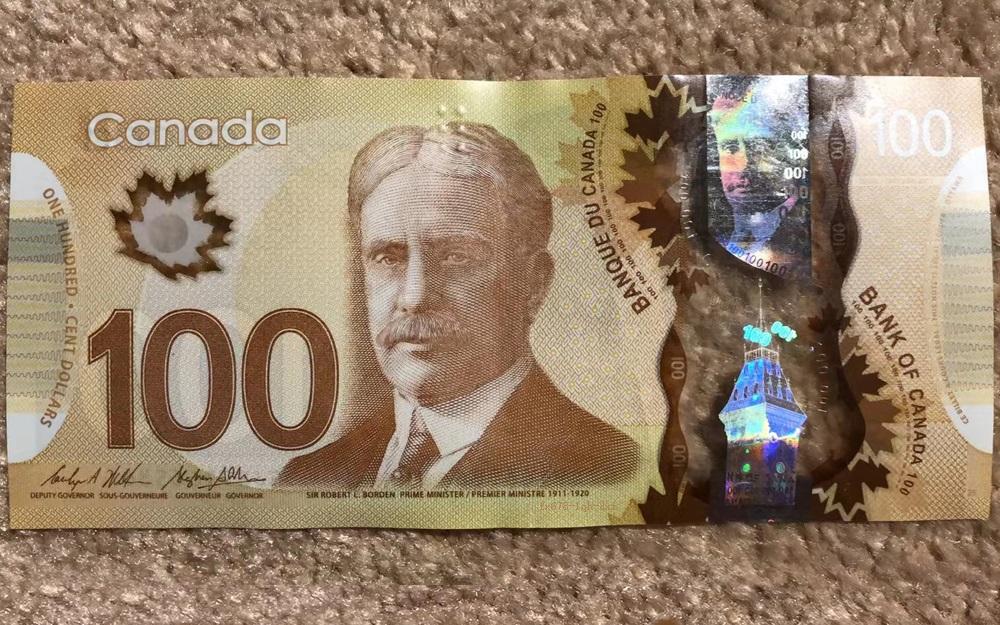 Following the breakdown of trade negotiations between the US and Canada last Friday, the US announced a 50% tariff on approximately $20 billion worth of Canadian goods. Canadian Prime Minister Mark Carney subsequently stated that Canada would implement retaliatory measures starting September 8th. This further escalation of tariffs has made North American trade concerns a significant variable in the currency market again. For Canada, whose economy is closely linked to the US market, escalating trade friction could put pressure on exports, business investment, and economic growth expectations. As a commodity currency and the currency of a highly open economy, the Canadian dollar is typically vulnerable to a deteriorating trade environment and declining economic growth expectations. Therefore, with the further escalation of tariffs between the US and Canada, funds tend to reduce their allocation to Canadian dollar assets in the short term, providing upward momentum for USD/CAD. However, the US dollar has not provided sufficient support for a sustained rise in USD/CAD. The US dollar index is currently near a three-month low, and market expectations for further interest rate hikes by the Federal Reserve have decreased. Meanwhile, the US Treasury announced an expansion of its long-term Treasury repurchase operations starting in September, leading to a temporary decline in US bond yields. The decline in long-term yields weakens the dollar's interest rate advantage, meaning that the upside potential for USD/CAD is significantly limited. From an interest rate pricing perspective, the market is currently reassessing US monetary policy. Recent US inflation data has shown signs of cooling, causing investors to reduce their bets on an immediate tightening by the Federal Reserve. If core inflation in the US continues to slow while the labor market further cools, the interest rate support for the US dollar may continue to decline. In this context, even if trade concerns put pressure on the Canadian dollar, USD/CAD may not be able to sustain a sustained one-sided rise. The oil market constitutes another important channel affecting the Canadian dollar. The Canadian economy is highly dependent on energy exports, and oil prices are usually strongly correlated with the performance of the Canadian dollar. Recently, WTI oil prices have retreated somewhat after a continuous rise, and profit-taking has put pressure on commodity currencies, thus helping USD/CAD gain short-term support. However, oil prices currently still have a high geopolitical risk premium. The US plans to announce a new round of economic restrictions against Iran, while Iran has warned that if economic pressure continues to escalate, oil exports from the Strait of Hormuz and the Persian Gulf region may be affected. Once these risks truly impact global oil transportation, oil prices may rise rapidly, and the Canadian dollar may regain support through commodity price channels, thereby limiting the rise of USD/CAD. Therefore, USD/CAD currently faces two opposing forces: on the one hand, rising concerns about US-Canada trade and a short-term decline in oil prices are putting pressure on the Canadian dollar; on the other hand, the US dollar itself is weak, while supply risks in the Middle East may drive up oil prices, thus providing support for the Canadian dollar. Whether the exchange rate can break free from its recent lows depends on whether trade policy or energy prices will dominate. From a fundamental perspective, the impact of the US imposing high tariffs on Canadian goods will not be immediately and fully reflected in the exchange rate. The market also needs to observe the specific scope of Canada's retaliatory measures and whether businesses begin to adjust their supply chains and investment plans. If the tariff measures are prolonged, Canada's economic growth expectations may be revised downwards, increasing the likelihood of the Bank of Canada adopting easing policies in the future, which would further weaken the Canadian dollar; conversely, if the two sides resume negotiations, the recent risk premium may quickly dissipate. From a daily technical perspective, USD/CAD remains in a generally bearish trend, with the price currently trading below the 200-day simple moving average at 1.3844, indicating that the medium-term bearish structure has not yet been broken. The 61.8% Fibonacci retracement level near 1.3815, along with the 200-day moving average, forms a dense resistance zone, which is crucial for the current bulls to reverse the trend. If the exchange rate can effectively break through and hold above 1.3844, further upside potential may open up, with resistance levels around 1.3897 and 1.3980; stronger resistance lies around 1.4081. From the 4-hour chart, USD/CAD is experiencing a low-level rebound, with short-term momentum improving somewhat, but it is still in a corrective phase within a weak trend. The area around 1.3800 is a short-term battleground between bulls and bears. If the exchange rate can break through 1.3815 and further hold above 1.3844, a short-term bottom may be gradually forming, and the price could test 1.3897. Conversely, if the rebound is blocked in the 1.3815-1.3844 area and the price falls back below 1.3700, the bears may regain the initiative, with further downside targets at 1.3698 and the previous low around 1.3549.
 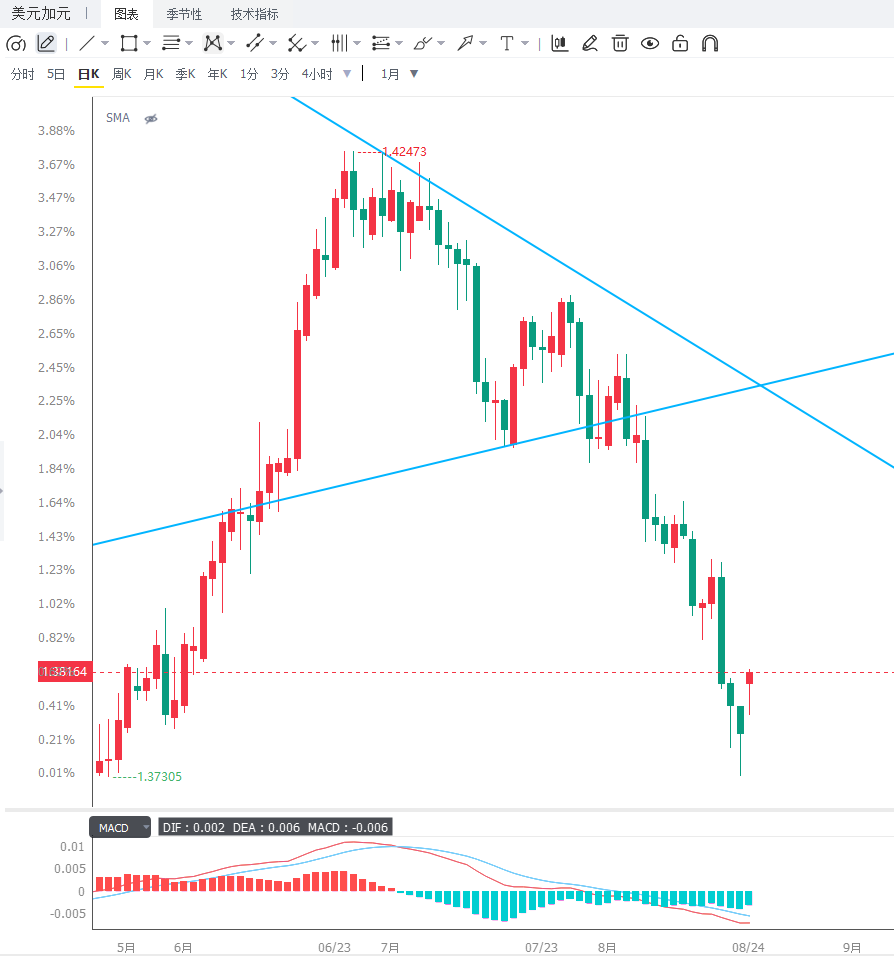 Editor's Summary : Overall, the US imposition of high tariffs on Canadian goods reignited trade concerns, acting as the main catalyst for the USD/CAD rebound on Monday. However, the weakness of the US dollar and the decline in US long-term yields limited the upside potential. In the short term, 1.3815-1.3844 constitutes a key resistance zone that will determine whether USD/CAD can transition from a rebound to a trend reversal. If trade tensions escalate further and Canadian economic expectations deteriorate, the exchange rate may gain sustained upward momentum; however, if Middle East risks drive oil prices higher, the Canadian dollar may receive support from commodity prices. Going forward, key factors to watch include North American tariff policies, crude oil prices, US Treasury yields, and expectations regarding the Bank of Canada's policy. USD/CAD may maintain a wide range of fluctuations in the short term, and a directional move will require further confirmation from fundamentals.
Following the breakdown of trade negotiations between the US and Canada last Friday, the US announced a 50% tariff on approximately $20 billion worth of Canadian goods. Canadian Prime Minister Mark Carney subsequently stated that Canada would implement retaliatory measures starting September 8th. This further escalation of tariffs has made North American trade concerns a significant variable in the currency market again. For Canada, whose economy is closely linked to the US market, escalating trade friction could put pressure on exports, business investment, and economic growth expectations. As a commodity currency and the currency of a highly open economy, the Canadian dollar is typically vulnerable to a deteriorating trade environment and declining economic growth expectations. Therefore, with the further escalation of tariffs between the US and Canada, funds tend to reduce their allocation to Canadian dollar assets in the short term, providing upward momentum for USD/CAD. However, the US dollar has not provided sufficient support for a sustained rise in USD/CAD. The US dollar index is currently near a three-month low, and market expectations for further interest rate hikes by the Federal Reserve have decreased. Meanwhile, the US Treasury announced an expansion of its long-term Treasury repurchase operations starting in September, leading to a temporary decline in US bond yields. The decline in long-term yields weakens the dollar's interest rate advantage, meaning that the upside potential for USD/CAD is significantly limited. From an interest rate pricing perspective, the market is currently reassessing US monetary policy. Recent US inflation data has shown signs of cooling, causing investors to reduce their bets on an immediate tightening by the Federal Reserve. If core inflation in the US continues to slow while the labor market further cools, the interest rate support for the US dollar may continue to decline. In this context, even if trade concerns put pressure on the Canadian dollar, USD/CAD may not be able to sustain a sustained one-sided rise. The oil market constitutes another important channel affecting the Canadian dollar. The Canadian economy is highly dependent on energy exports, and oil prices are usually strongly correlated with the performance of the Canadian dollar. Recently, WTI oil prices have retreated somewhat after a continuous rise, and profit-taking has put pressure on commodity currencies, thus helping USD/CAD gain short-term support. However, oil prices currently still have a high geopolitical risk premium. The US plans to announce a new round of economic restrictions against Iran, while Iran has warned that if economic pressure continues to escalate, oil exports from the Strait of Hormuz and the Persian Gulf region may be affected. Once these risks truly impact global oil transportation, oil prices may rise rapidly, and the Canadian dollar may regain support through commodity price channels, thereby limiting the rise of USD/CAD. Therefore, USD/CAD currently faces two opposing forces: on the one hand, rising concerns about US-Canada trade and a short-term decline in oil prices are putting pressure on the Canadian dollar; on the other hand, the US dollar itself is weak, while supply risks in the Middle East may drive up oil prices, thus providing support for the Canadian dollar. Whether the exchange rate can break free from its recent lows depends on whether trade policy or energy prices will dominate. From a fundamental perspective, the impact of the US imposing high tariffs on Canadian goods will not be immediately and fully reflected in the exchange rate. The market also needs to observe the specific scope of Canada's retaliatory measures and whether businesses begin to adjust their supply chains and investment plans. If the tariff measures are prolonged, Canada's economic growth expectations may be revised downwards, increasing the likelihood of the Bank of Canada adopting easing policies in the future, which would further weaken the Canadian dollar; conversely, if the two sides resume negotiations, the recent risk premium may quickly dissipate. From a daily technical perspective, USD/CAD remains in a generally bearish trend, with the price currently trading below the 200-day simple moving average at 1.3844, indicating that the medium-term bearish structure has not yet been broken. The 61.8% Fibonacci retracement level near 1.3815, along with the 200-day moving average, forms a dense resistance zone, which is crucial for the current bulls to reverse the trend. If the exchange rate can effectively break through and hold above 1.3844, further upside potential may open up, with resistance levels around 1.3897 and 1.3980; stronger resistance lies around 1.4081. From the 4-hour chart, USD/CAD is experiencing a low-level rebound, with short-term momentum improving somewhat, but it is still in a corrective phase within a weak trend. The area around 1.3800 is a short-term battleground between bulls and bears. If the exchange rate can break through 1.3815 and further hold above 1.3844, a short-term bottom may be gradually forming, and the price could test 1.3897. Conversely, if the rebound is blocked in the 1.3815-1.3844 area and the price falls back below 1.3700, the bears may regain the initiative, with further downside targets at 1.3698 and the previous low around 1.3549. Editor's Summary : Overall, the US imposition of high tariffs on Canadian goods reignited trade concerns, acting as the main catalyst for the USD/CAD rebound on Monday. However, the weakness of the US dollar and the decline in US long-term yields limited the upside potential. In the short term, 1.3815-1.3844 constitutes a key resistance zone that will determine whether USD/CAD can transition from a rebound to a trend reversal. If trade tensions escalate further and Canadian economic expectations deteriorate, the exchange rate may gain sustained upward momentum; however, if Middle East risks drive oil prices higher, the Canadian dollar may receive support from commodity prices. Going forward, key factors to watch include North American tariff policies, crude oil prices, US Treasury yields, and expectations regarding the Bank of Canada's policy. USD/CAD may maintain a wide range of fluctuations in the short term, and a directional move will require further confirmation from fundamentals.
- Risk Warning and Disclaimer
- The market involves risk, and trading may not be suitable for all investors. This article is for reference only and does not constitute personal investment advice, nor does it take into account certain users’ specific investment objectives, financial situation, or other needs. Any investment decisions made based on this information are at your own risk.