Japan's inflation accelerated for the second consecutive month, coupled with a weakening dollar, causing the USD/JPY exchange rate to remain volatile.
2026-08-24 14:33:02
The USD/JPY pair continued its decline in Asian trading on Monday, falling back to around 158.80 after some intraday volatility, marking its second consecutive day of losses. The main driver of the yen's strength was continued positive Japanese inflation data, while the weakness of the US dollar further amplified the downward pressure on the USD/JPY. The market is currently raising expectations for a normalization of the Bank of Japan's policy, causing some easing in the previously dominant USD/JPY carry trade.  Latest Japanese inflation data shows that price pressures accelerated for the second consecutive month, with inflation continuing to exceed the Bank of Japan's (BOJ) 2% target. For the BOJ, persistent price increases mean that the previously ultra-loose policy environment is gradually becoming unnecessary, providing a stronger basis for further adjustments to policy rates. The market has therefore begun to raise expectations for a rate hike at the BOJ's September meeting, with some swap pricing already reflecting a policy adjustment space of about 20 basis points. Recent statements by BOJ Governor Kazuo Ueda regarding policy normalization have further strengthened the market's judgment that the rate hike cycle will continue. If wage growth, service prices, and core inflation continue to be resilient, the BOJ may need to gradually raise policy rates to prevent inflation expectations from further derailing. For the foreign exchange market, this means that the yen's interest rate disadvantage is gradually narrowing, and the logic that USD/JPY previously relied on the USD/JPY interest rate differential to maintain its high level is being challenged. From a funding pricing perspective, the impact of Japanese inflation data has already begun to manifest. Market strategists pointed out that the latest price data slightly increased confidence in the BOJ's tightening policy next month, with the yen rising about 0.4% against the dollar on that day. While the increase was not significant, its significance lies in the market's gradual incorporation of the normalization of Japanese monetary policy into exchange rate pricing, rather than continuing to view the yen as merely a low-yield funding currency. Changes on the dollar side also pushed USD/JPY down. The US Treasury announced an expansion of its long-term Treasury repurchase program, attempting to alleviate pressure from rapidly rising long-term Treasury yields. Treasury Secretary Scott Bessant stated that the repurchase program could exceed $4 billion per transaction. This policy action led to a temporary decline in US long-term yields, weakening the dollar's interest rate advantage to some extent. One of the key supports for the dollar's previous high levels was the relatively high US interest rates and bond yields. If the Treasury continues to stabilize long-term yields through repurchase agreements and other means, while the market simultaneously lowers its expectations for further tightening by the Federal Reserve, the dollar may face double pressure. For USD/JPY, this change resonates with expectations of a Japanese interest rate hike, making it easier for the exchange rate to find a new equilibrium level in the short term. However, the dollar is not at risk of completely losing support. Significant uncertainty remains in the Middle East; if tensions between the US and Iran escalate further, risk aversion in global financial markets could rise significantly. As one of the world's major safe-haven currencies, the US dollar typically attracts inflows when risk events escalate rapidly, which may limit its decline and simultaneously curb further appreciation of the Japanese yen. The yen itself also possesses safe-haven characteristics, so the impact of the Middle East situation on USD/JPY is not one-way. If market concerns are primarily focused on energy supply and global economic growth, the yen may be supported by safe-haven inflows; however, if the market focuses more on the liquidity of US financial assets and the demand for US dollar cash, the dollar may strengthen again. Therefore, the future trend of USD/JPY still depends on which safe-haven asset will dominate due to risk events. From a fundamental perspective, the biggest change in USD/JPY currently lies in the rebalancing of policy expectations. For some time, the significant interest rate differential between the US and Japan has driven continuous allocation of funds to US dollar assets, but with Japanese inflation continuing to exceed its target and the Bank of Japan signaling further normalization, the US-Japan interest rate differential may gradually narrow. If this trend continues, even if the US economy remains resilient, USD/JPY may face medium-term valuation pressure. From a daily technical perspective, USD/JPY is currently in a bearish state, with the price trading below the 9-period and 50-period exponential moving averages, and short-term rebounds are being suppressed by these moving averages. The 9-period EMA is around 159.03, which is the first resistance level; the 50-period EMA is around 160.13, which is a more important medium-term resistance area. The 14-day RSI is around 42.67, below the 50 midline, but has not yet entered the oversold zone, indicating that there is still some room for the bears to fall, and the current decline has not shown any obvious technical overreaction. From the 4-hour chart, USD/JPY also maintains a weak and oscillating structure, with short-term rebound highs gradually being suppressed. The area around 159.00 is a key area for the current shift between bullish and bearish sentiment. If the exchange rate fails to regain a foothold above 159.03, it may continue to test new demand areas in the short term; if the price breaks through 159.03 again and further rises above 159.50, the short-term bearish momentum may weaken, and the next resistance level to watch is the 50-period EMA around 160.13. Since there is currently a lack of clear near-term technical support levels, investors should pay close attention to the buying support near previous lows and psychological levels.
 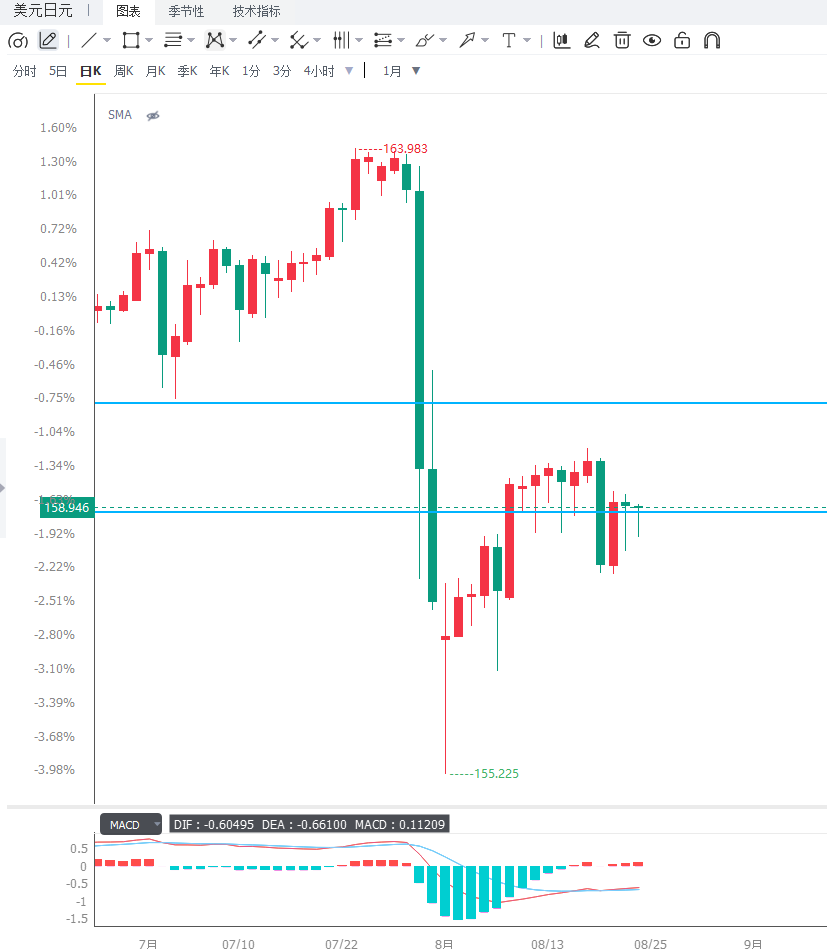 Editor's Summary : Overall, rising inflation in Japan has strengthened expectations of a September rate hike by the Bank of Japan, while US fiscal policy's suppression of long-term yields has weakened the dollar's interest rate advantage. These two forces have jointly pushed USD/JPY down to around 158.80. In the short term, 159.03 is a crucial level for a potential rebound. If the exchange rate continues to be resisted in this area, the downside risk remains high; if it breaks through 159.03 again, it may recover towards 160.13. Going forward, the market should focus on Japanese inflation, wage growth, policy signals from the Bank of Japan, and changes in US long-term yields. If Japanese policy normalization continues and the dollar's fiscal and interest rate advantages further decline, USD/JPY may still have room for further decline in the medium term. However, geopolitical risks leading to safe-haven dollar demand may be the biggest contrarian variable in the short term.
Latest Japanese inflation data shows that price pressures accelerated for the second consecutive month, with inflation continuing to exceed the Bank of Japan's (BOJ) 2% target. For the BOJ, persistent price increases mean that the previously ultra-loose policy environment is gradually becoming unnecessary, providing a stronger basis for further adjustments to policy rates. The market has therefore begun to raise expectations for a rate hike at the BOJ's September meeting, with some swap pricing already reflecting a policy adjustment space of about 20 basis points. Recent statements by BOJ Governor Kazuo Ueda regarding policy normalization have further strengthened the market's judgment that the rate hike cycle will continue. If wage growth, service prices, and core inflation continue to be resilient, the BOJ may need to gradually raise policy rates to prevent inflation expectations from further derailing. For the foreign exchange market, this means that the yen's interest rate disadvantage is gradually narrowing, and the logic that USD/JPY previously relied on the USD/JPY interest rate differential to maintain its high level is being challenged. From a funding pricing perspective, the impact of Japanese inflation data has already begun to manifest. Market strategists pointed out that the latest price data slightly increased confidence in the BOJ's tightening policy next month, with the yen rising about 0.4% against the dollar on that day. While the increase was not significant, its significance lies in the market's gradual incorporation of the normalization of Japanese monetary policy into exchange rate pricing, rather than continuing to view the yen as merely a low-yield funding currency. Changes on the dollar side also pushed USD/JPY down. The US Treasury announced an expansion of its long-term Treasury repurchase program, attempting to alleviate pressure from rapidly rising long-term Treasury yields. Treasury Secretary Scott Bessant stated that the repurchase program could exceed $4 billion per transaction. This policy action led to a temporary decline in US long-term yields, weakening the dollar's interest rate advantage to some extent. One of the key supports for the dollar's previous high levels was the relatively high US interest rates and bond yields. If the Treasury continues to stabilize long-term yields through repurchase agreements and other means, while the market simultaneously lowers its expectations for further tightening by the Federal Reserve, the dollar may face double pressure. For USD/JPY, this change resonates with expectations of a Japanese interest rate hike, making it easier for the exchange rate to find a new equilibrium level in the short term. However, the dollar is not at risk of completely losing support. Significant uncertainty remains in the Middle East; if tensions between the US and Iran escalate further, risk aversion in global financial markets could rise significantly. As one of the world's major safe-haven currencies, the US dollar typically attracts inflows when risk events escalate rapidly, which may limit its decline and simultaneously curb further appreciation of the Japanese yen. The yen itself also possesses safe-haven characteristics, so the impact of the Middle East situation on USD/JPY is not one-way. If market concerns are primarily focused on energy supply and global economic growth, the yen may be supported by safe-haven inflows; however, if the market focuses more on the liquidity of US financial assets and the demand for US dollar cash, the dollar may strengthen again. Therefore, the future trend of USD/JPY still depends on which safe-haven asset will dominate due to risk events. From a fundamental perspective, the biggest change in USD/JPY currently lies in the rebalancing of policy expectations. For some time, the significant interest rate differential between the US and Japan has driven continuous allocation of funds to US dollar assets, but with Japanese inflation continuing to exceed its target and the Bank of Japan signaling further normalization, the US-Japan interest rate differential may gradually narrow. If this trend continues, even if the US economy remains resilient, USD/JPY may face medium-term valuation pressure. From a daily technical perspective, USD/JPY is currently in a bearish state, with the price trading below the 9-period and 50-period exponential moving averages, and short-term rebounds are being suppressed by these moving averages. The 9-period EMA is around 159.03, which is the first resistance level; the 50-period EMA is around 160.13, which is a more important medium-term resistance area. The 14-day RSI is around 42.67, below the 50 midline, but has not yet entered the oversold zone, indicating that there is still some room for the bears to fall, and the current decline has not shown any obvious technical overreaction. From the 4-hour chart, USD/JPY also maintains a weak and oscillating structure, with short-term rebound highs gradually being suppressed. The area around 159.00 is a key area for the current shift between bullish and bearish sentiment. If the exchange rate fails to regain a foothold above 159.03, it may continue to test new demand areas in the short term; if the price breaks through 159.03 again and further rises above 159.50, the short-term bearish momentum may weaken, and the next resistance level to watch is the 50-period EMA around 160.13. Since there is currently a lack of clear near-term technical support levels, investors should pay close attention to the buying support near previous lows and psychological levels. Editor's Summary : Overall, rising inflation in Japan has strengthened expectations of a September rate hike by the Bank of Japan, while US fiscal policy's suppression of long-term yields has weakened the dollar's interest rate advantage. These two forces have jointly pushed USD/JPY down to around 158.80. In the short term, 159.03 is a crucial level for a potential rebound. If the exchange rate continues to be resisted in this area, the downside risk remains high; if it breaks through 159.03 again, it may recover towards 160.13. Going forward, the market should focus on Japanese inflation, wage growth, policy signals from the Bank of Japan, and changes in US long-term yields. If Japanese policy normalization continues and the dollar's fiscal and interest rate advantages further decline, USD/JPY may still have room for further decline in the medium term. However, geopolitical risks leading to safe-haven dollar demand may be the biggest contrarian variable in the short term.
- Risk Warning and Disclaimer
- The market involves risk, and trading may not be suitable for all investors. This article is for reference only and does not constitute personal investment advice, nor does it take into account certain users’ specific investment objectives, financial situation, or other needs. Any investment decisions made based on this information are at your own risk.