The US Treasury's expansion of long-term Treasury bond buybacks has suppressed yields, causing the dollar index to continue its decline; however, caution is advised regarding a potential acceleration of this downward trend.
2026-08-24 14:39:00
The US dollar index continued to be under pressure in Asian trading on Monday, trading around 98.80, near a three-month low. The core reason for the recent continued weakness of the dollar is not simply weak economic data, but rather a new pricing contradiction emerging between US fiscal policy, long-term Treasury yields, and monetary policy expectations. The US Treasury's attempt to stabilize the bond market by expanding long-term Treasury repurchase agreements has unexpectedly exacerbated market concerns about the fiscal situation and policy intervention, thus putting additional pressure on the dollar.  U.S. Treasury Secretary Scott Bessant previously stated that the Treasury Department would expand its long-term Treasury bond repurchase program to approximately $4 billion per transaction, hoping to alleviate upward pressure on 30-year Treasury yields by increasing demand for long-term bonds. The previously persistently high long-term yields had become a significant risk variable in the U.S. financial market. The Treasury Department's proactive intervention in the long-term bond market was intended to improve liquidity and stabilize the financing environment, but the market has not priced it in entirely according to policymakers' expectations. From a foreign exchange market perspective, if long-term Treasury yields are restricted from rising due to policy intervention, the dollar's traditional interest rate advantage may be weakened. For the dollar, which relies on higher U.S. interest rates, artificially suppressing the long end of the yield curve may mean that the dollar cannot fully obtain an interest rate premium. Market strategist Mark Chandler believes that the Treasury Department's measures to suppress U.S. yields have not significantly changed the long-term yield trend, but have had a negative impact on the dollar, indicating that the market is reassessing the policy's effectiveness. More importantly, the market is beginning to focus on the long-term implications of U.S. fiscal policy. If the government continues to stabilize long-term financing costs through bond repurchases and other means, while fiscal deficits and debt supply pressures remain, investors may demand a higher risk premium. In other words, suppressing long-term yields may not necessarily enhance the dollar's attractiveness; instead, it could make the dollar more sensitive to issues of US fiscal sustainability. Recent US inflation data further complicates policy decisions. Latest data shows signs of easing price pressures in the US, but some Federal Reserve officials still believe more evidence is needed to confirm that inflation is stabilizing near the 2% policy target. The market currently expects a 41% probability of a rate hike at the Fed's next meeting, down from about 47% a month ago. The declining rate hike expectations mean the dollar lacks new interest rate drivers in the short term. However, dollar bears cannot ignore the hawkish voices still present within the Fed. Fed official Alberto Musaleem recently stated that current policy rates are in a "neutral to slightly accommodative" range, while noting that underlying inflation is likely to remain in the range of about 2.5% to 3%. He emphasized that if inflation fails to decline further, taking more forward-looking policy action now could help avoid the need for more aggressive tightening measures in the future. This statement indicates that the Fed has not completely ruled out the possibility of further policy tightening. While the market has generally reduced its bets on an immediate rate hike, the dollar still has a basis for a phased rebound as long as core US inflation remains resilient. Therefore, the current weakness of the dollar is more a result of the combined effects of fiscal concerns, yield policy, and monetary policy expectations, rather than a clear shift towards easing in US monetary policy. Meanwhile, geopolitical risks remain a crucial variable for the dollar's short-term trajectory. The US government plans to announce a new round of economic restrictions against Iran, and the market is watching to see if these measures will further expand their impact on the financial and energy sectors. If the situation in the Middle East continues to escalate, funds may increase their allocation to traditional safe-haven assets such as the dollar, thus limiting further dollar declines. Therefore, the dollar currently faces a clear dual force. On the one hand, US fiscal policy intervention in long-term yields, coupled with market expectations of cooling US inflation and declining interest rate hikes, are putting pressure on the dollar; on the other hand, escalating geopolitical risks and warnings about inflation from hawkish Fed officials are providing potential support for the dollar. Whether the dollar can rebound in the future depends on which of these two forces dominates. From a daily technical perspective, the dollar index maintains a clear weak trend, with prices consistently trading below the 100-day moving average and the Bollinger Band middle line, indicating that the bears still hold the initiative. The index is currently approaching the lower Bollinger Band at around 98.50, while the 14-period RSI is around 30, nearing oversold territory. This suggests that while downward momentum still dominates for the US dollar, the probability of a technical rebound after a continued rapid decline in the short term is increasing. The first resistance level to watch is the 100-day moving average around 99.70, followed by the middle Bollinger Band around 99.75, forming a relatively dense resistance area. A further break above this level is needed to potentially test the 101.00 area. Looking at the 4-hour chart, the US dollar index remains in a downward oscillating structure, with rebound highs consistently facing resistance, and short-term moving averages generally bearish. The area around 98.50 is a crucial battleground between bulls and bears in the short term. A decisive break below this level could see the US dollar index seek support further towards 98.00 or even 97.50; conversely, if significant support appears around 98.50 and the index retests 99.50, the short-term bearish momentum may be corrected. As the RSI is approaching the oversold zone, a technical rebound should be watched out for during further declines in the US dollar. However, the weak structure on the daily chart is unlikely to change until the price regains its footing above 99.70-99.75.
 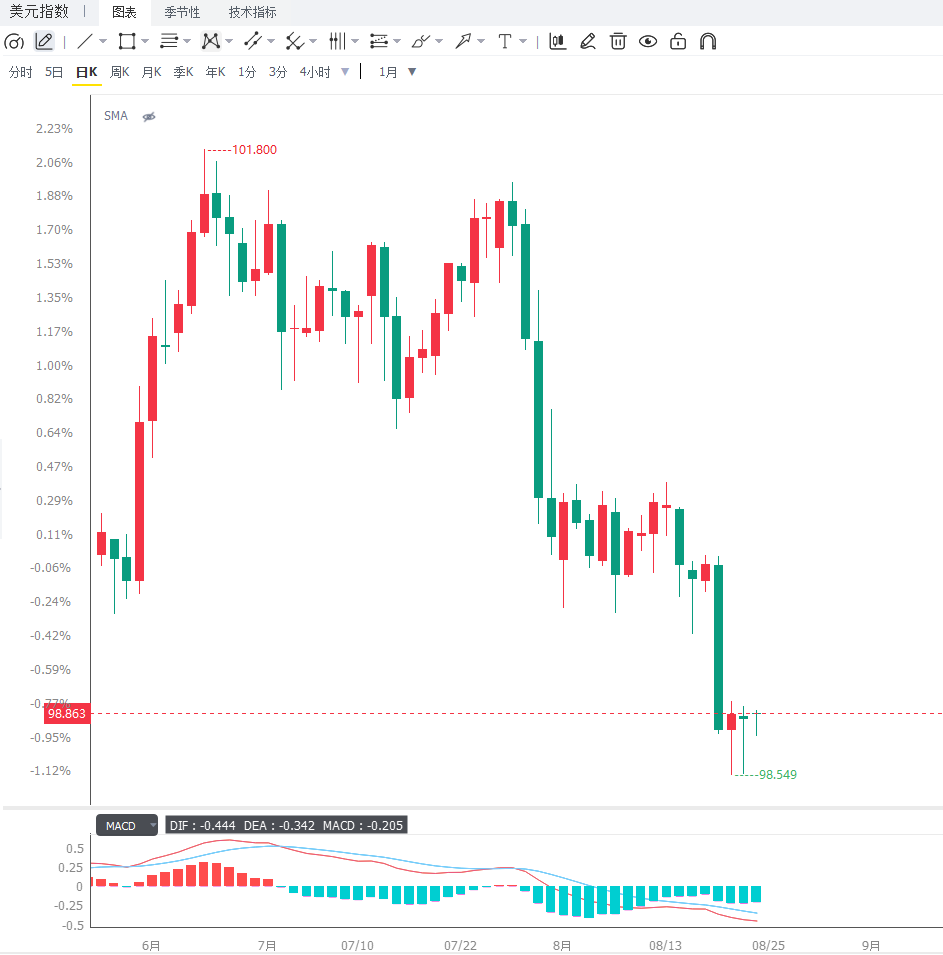 Editor's Summary : Overall, while the US Treasury's expansion of long-term Treasury repurchase agreements aimed to stabilize the bond market, it weakened the existing yield support for the US dollar to some extent and intensified market concerns about US fiscal policy. The US dollar remains weak in the short term, but the RSI is approaching oversold territory. Coupled with Middle East geopolitical risks and hawkish rhetoric from the Federal Reserve, this means that while the dollar may continue to decline, there is also a strong risk of a rebound. Technically, 98.50 is currently a key support level; a break below this level could open up further downside potential. If it recovers above 99.70-99.75, the signal for a short-term bottom will gradually strengthen. Going forward, the market should focus on US fiscal policy, US Treasury yields, core inflation, and the Federal Reserve's policy statements. The US dollar may continue to fluctuate weakly in the short term, but volatility will increase significantly.
U.S. Treasury Secretary Scott Bessant previously stated that the Treasury Department would expand its long-term Treasury bond repurchase program to approximately $4 billion per transaction, hoping to alleviate upward pressure on 30-year Treasury yields by increasing demand for long-term bonds. The previously persistently high long-term yields had become a significant risk variable in the U.S. financial market. The Treasury Department's proactive intervention in the long-term bond market was intended to improve liquidity and stabilize the financing environment, but the market has not priced it in entirely according to policymakers' expectations. From a foreign exchange market perspective, if long-term Treasury yields are restricted from rising due to policy intervention, the dollar's traditional interest rate advantage may be weakened. For the dollar, which relies on higher U.S. interest rates, artificially suppressing the long end of the yield curve may mean that the dollar cannot fully obtain an interest rate premium. Market strategist Mark Chandler believes that the Treasury Department's measures to suppress U.S. yields have not significantly changed the long-term yield trend, but have had a negative impact on the dollar, indicating that the market is reassessing the policy's effectiveness. More importantly, the market is beginning to focus on the long-term implications of U.S. fiscal policy. If the government continues to stabilize long-term financing costs through bond repurchases and other means, while fiscal deficits and debt supply pressures remain, investors may demand a higher risk premium. In other words, suppressing long-term yields may not necessarily enhance the dollar's attractiveness; instead, it could make the dollar more sensitive to issues of US fiscal sustainability. Recent US inflation data further complicates policy decisions. Latest data shows signs of easing price pressures in the US, but some Federal Reserve officials still believe more evidence is needed to confirm that inflation is stabilizing near the 2% policy target. The market currently expects a 41% probability of a rate hike at the Fed's next meeting, down from about 47% a month ago. The declining rate hike expectations mean the dollar lacks new interest rate drivers in the short term. However, dollar bears cannot ignore the hawkish voices still present within the Fed. Fed official Alberto Musaleem recently stated that current policy rates are in a "neutral to slightly accommodative" range, while noting that underlying inflation is likely to remain in the range of about 2.5% to 3%. He emphasized that if inflation fails to decline further, taking more forward-looking policy action now could help avoid the need for more aggressive tightening measures in the future. This statement indicates that the Fed has not completely ruled out the possibility of further policy tightening. While the market has generally reduced its bets on an immediate rate hike, the dollar still has a basis for a phased rebound as long as core US inflation remains resilient. Therefore, the current weakness of the dollar is more a result of the combined effects of fiscal concerns, yield policy, and monetary policy expectations, rather than a clear shift towards easing in US monetary policy. Meanwhile, geopolitical risks remain a crucial variable for the dollar's short-term trajectory. The US government plans to announce a new round of economic restrictions against Iran, and the market is watching to see if these measures will further expand their impact on the financial and energy sectors. If the situation in the Middle East continues to escalate, funds may increase their allocation to traditional safe-haven assets such as the dollar, thus limiting further dollar declines. Therefore, the dollar currently faces a clear dual force. On the one hand, US fiscal policy intervention in long-term yields, coupled with market expectations of cooling US inflation and declining interest rate hikes, are putting pressure on the dollar; on the other hand, escalating geopolitical risks and warnings about inflation from hawkish Fed officials are providing potential support for the dollar. Whether the dollar can rebound in the future depends on which of these two forces dominates. From a daily technical perspective, the dollar index maintains a clear weak trend, with prices consistently trading below the 100-day moving average and the Bollinger Band middle line, indicating that the bears still hold the initiative. The index is currently approaching the lower Bollinger Band at around 98.50, while the 14-period RSI is around 30, nearing oversold territory. This suggests that while downward momentum still dominates for the US dollar, the probability of a technical rebound after a continued rapid decline in the short term is increasing. The first resistance level to watch is the 100-day moving average around 99.70, followed by the middle Bollinger Band around 99.75, forming a relatively dense resistance area. A further break above this level is needed to potentially test the 101.00 area. Looking at the 4-hour chart, the US dollar index remains in a downward oscillating structure, with rebound highs consistently facing resistance, and short-term moving averages generally bearish. The area around 98.50 is a crucial battleground between bulls and bears in the short term. A decisive break below this level could see the US dollar index seek support further towards 98.00 or even 97.50; conversely, if significant support appears around 98.50 and the index retests 99.50, the short-term bearish momentum may be corrected. As the RSI is approaching the oversold zone, a technical rebound should be watched out for during further declines in the US dollar. However, the weak structure on the daily chart is unlikely to change until the price regains its footing above 99.70-99.75. Editor's Summary : Overall, while the US Treasury's expansion of long-term Treasury repurchase agreements aimed to stabilize the bond market, it weakened the existing yield support for the US dollar to some extent and intensified market concerns about US fiscal policy. The US dollar remains weak in the short term, but the RSI is approaching oversold territory. Coupled with Middle East geopolitical risks and hawkish rhetoric from the Federal Reserve, this means that while the dollar may continue to decline, there is also a strong risk of a rebound. Technically, 98.50 is currently a key support level; a break below this level could open up further downside potential. If it recovers above 99.70-99.75, the signal for a short-term bottom will gradually strengthen. Going forward, the market should focus on US fiscal policy, US Treasury yields, core inflation, and the Federal Reserve's policy statements. The US dollar may continue to fluctuate weakly in the short term, but volatility will increase significantly.
- Risk Warning and Disclaimer
- The market involves risk, and trading may not be suitable for all investors. This article is for reference only and does not constitute personal investment advice, nor does it take into account certain users’ specific investment objectives, financial situation, or other needs. Any investment decisions made based on this information are at your own risk.