The US's "economic isolation" measures have dampened risk appetite; can the Reserve Bank of Australia's minutes be a "savior" for the Australian dollar?
2026-08-25 08:21:01
The Australian dollar traded in a narrow range against the US dollar during Asian trading hours on Tuesday (August 25), currently hovering around 0.7150, virtually unchanged for the day. Global risk appetite was dampened by the US Treasury's sanctions against Iranian-related entities. US Treasury Secretary Bessenter initiated actions to sever Iran's ties with the global economy, with sanctions covering five sectors: digital assets, technology, gold, aviation, and shipping. Markets are focused on the Reserve Bank of Australia's August meeting minutes released on Tuesday and a speech by domestic markets director Jacobs for further clues about the interest rate outlook. Australian inflation data released on Wednesday is expected to show a 0.8% month-on-month increase in July CPI, with the year-on-year increase falling to 3.2% from 3.8%. In the US, economic data will gradually accelerate this week, including core PCE and Federal Reserve Chairman Warsh's speech in Jackson Hole. 
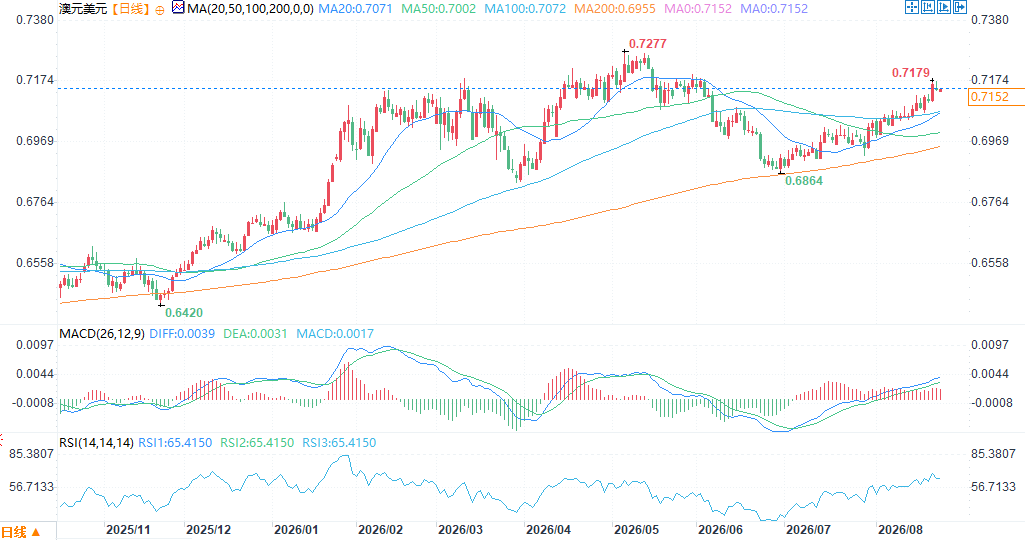 (Australian dollar to US dollar daily chart, source: EasyForex) At 8:14 AM Beijing time on August 25, the Australian dollar to US dollar exchange rate was 0.7154/55.
The US launches "economic isolation operation" to completely sever Iran's global economic ties.
Global risk appetite was significantly dampened by the U.S. Treasury Department's new round of sanctions against Iranian entities. On August 24, U.S. Treasury Secretary Scott Bessenter officially announced the launch of a large-scale sanctions operation codenamed "Operation Economic Outcast," aimed at completely severing Iran's ties with the global economy. This operation expands secondary sanctions to five key areas: digital assets, technology, gold, aviation, and shipping. Bessenter pointed out that these areas are vital "lifelines" for Iran to maintain its economy, circumvent sanctions, and obtain oil revenues. The U.S. Treasury Department's Office of Foreign Assets Control simultaneously imposed sanctions on more than 60 entities, individuals, and vessels worldwide, accused of assisting Iran in acquiring nuclear and missile technology, conducting cyber operations, and generating illicit oil revenues. Bessenter emphasized that the U.S. has given world leaders a clear deadline to immediately sever economic ties with Iran. Failure to act within the stipulated time will risk excluding these countries or entities from the dollar system. He also warned that any institution facilitating money laundering for Iran will be severely punished. The market generally believes that this move has exacerbated geopolitical uncertainty and may continue to suppress global risk appetite in the short term.The Reserve Bank of Australia's meeting minutes and inflation data are the focus.
The market is focused on the Reserve Bank of Australia's (RBA) August meeting minutes released on Tuesday and the speech by domestic markets director Jacobs. The August meeting kept the cash rate unchanged at 4.35% for the second consecutive time, but Governor Bullock confirmed that both a rate hike and maintaining the current rate were discussed at the meeting. Money market pricing indicates only a 14% probability of a rate hike in September, and an 86% probability of keeping the rate unchanged. Australian inflation data will be released on Wednesday—economists expect July CPI to rise 0.8% month-on-month, and fall to 3.2% year-on-year from 3.8%, with a revised average CPI forecast of a 0.1 percentage point decline to 3.5%. If inflation data is higher than expected, it could reignite market bets on an RBA rate hike, providing support for the Australian dollar; conversely, if the data shows a continued decline in inflation, it will solidify expectations of maintaining the current rate.US economic data and Jackson Hole speech
In the US, economic data releases will gradually accelerate this week. Starting Tuesday, a series of growth, inflation, and employment data will be released, including the Fed's preferred inflation gauge—the core PCE price index. Furthermore, the market is closely watching Fed Chairman Warsh's speech at the Jackson Hole Economic Symposium on August 28th, which could provide key guidance for the short-term direction of the US dollar. If Warsh releases a hawkish signal, the dollar may gain upward momentum, putting pressure on the Australian dollar; if the tone is dovish, the dollar may weaken further, providing support for the Australian dollar.Summarize
US Treasury Secretary Bessenter initiated actions to sever Iran's ties with the global economy, with sanctions covering digital assets, technology, gold, aviation, and shipping. Markets are focused on the Reserve Bank of Australia's August meeting minutes and Jacobs' speech, with only a 14% probability of a September rate hike. Australian inflation data on Wednesday will influence interest rate expectations. The US will release core PCE data and hold a Warsh-Jackson Hole speech this week, potentially determining the short-term direction of the US dollar. The Australian dollar is likely to fluctuate within the 0.7100-0.7200 range in the short term, awaiting a new catalyst. (Australian dollar to US dollar daily chart, source: EasyForex) At 8:14 AM Beijing time on August 25, the Australian dollar to US dollar exchange rate was 0.7154/55.
- Risk Warning and Disclaimer
- The market involves risk, and trading may not be suitable for all investors. This article is for reference only and does not constitute personal investment advice, nor does it take into account certain users’ specific investment objectives, financial situation, or other needs. Any investment decisions made based on this information are at your own risk.