Former Bank of Japan board member: The risk of holding rates steady outweighs the risk of raising rates; the yen's short-term trend depends on the September meeting.
2026-08-25 08:21:02
On Tuesday (August 25) during Asian trading hours, the USD/JPY pair edged higher, currently trading around 159. While hawkish comments from a former Bank of Japan board member provided short-term support for the yen, the exchange rate continued to fluctuate around the 159 level, with the market still weighing the expectations of interest rate hikes against the reality of interest rate differentials. Former Bank of Japan Policy Board member Seiji Adachi stated that the Bank of Japan might raise interest rates in September, and possibly again as early as January next year, warning that holding rates steady could trigger a new round of yen selling and faster import-driven inflation. The market has already priced in an approximately 80% probability of a September rate hike, and Adachi pointed out that the Bank of Japan is "backed into a corner," with the risk of holding rates steady outweighing the risk of a rate hike. US Treasury Secretary Bessenter's public support for the Bank of Japan's actions added a political dimension to the rate hike, making it more difficult for the Takaichi Sanae government, which supports stimulus policies, to oppose it. 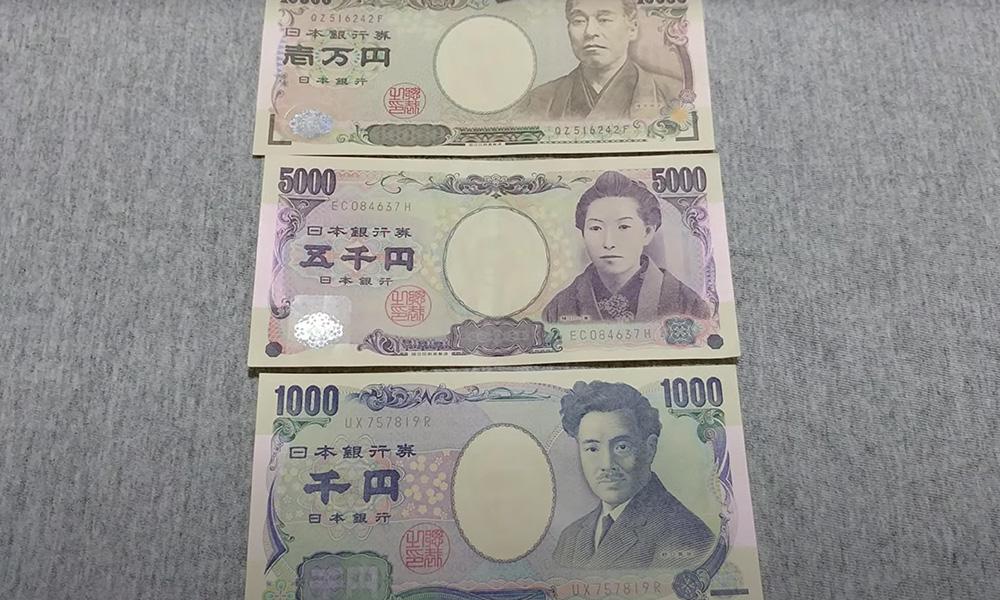
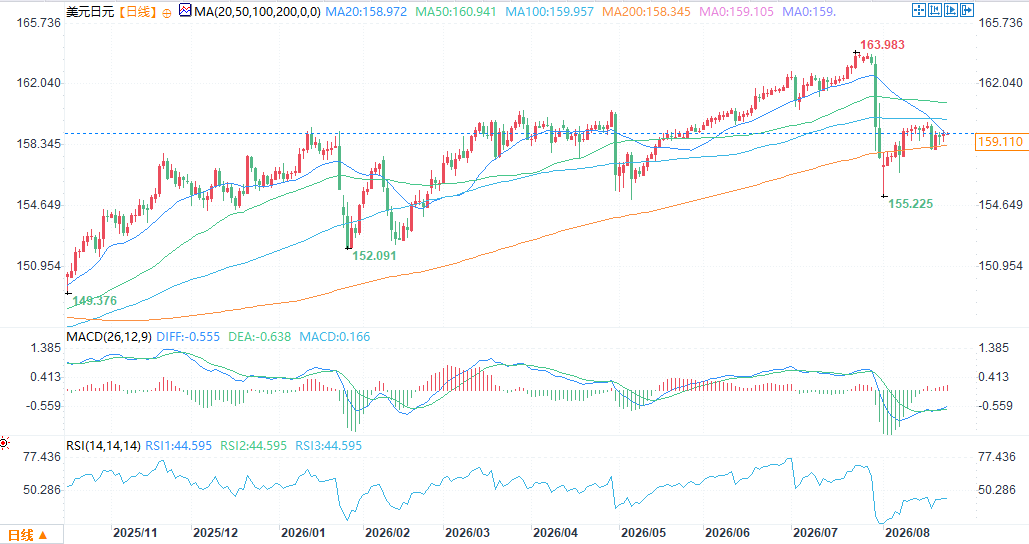 (USD/JPY daily chart, source: FX678) At 8:13 AM Beijing time on August 25, the USD/JPY exchange rate was 159.09/10.
Seiji Adachi: A September rate hike by the Bank of Japan is "almost a certainty".
Former Bank of Japan (BOJ) Policy Board member Seiji Adachi stated that the BOJ may raise interest rates in September, with a possible second rate hike as early as January next year. Traders are pricing in an approximately 80% probability of a September rate hike. The current exchange rate is trading around 159, still close to the psychologically important level of 160 even after joint intervention by the US and Japan. Adachi warned that holding rates steady could trigger a new round of yen selling and faster import-driven inflation. "The BOJ is in a bind. The market has almost completely priced in a rate hike. If the BOJ doesn't raise rates, the yen could weaken significantly again."Bessant's "public pressure" creates political space for raising interest rates.
Seiji Adachi points out that US Treasury Secretary Bessant publicly stated that policy actions should follow monetary intervention and hoped that Bank of Japan Governor Kazuo Ueda would raise interest rates. This statement provided Ueda with a useful opening, making it more difficult for the Takaichi Sanae government, which supports stimulus policies, to oppose interest rate hikes. "Bessant has repeatedly stated that the Bank of Japan is the next institution that needs to act. Under these circumstances, the government cannot tell the Bank of Japan to 'stop'." This political dimension further reduces the Japanese government's room for maneuver in opposing interest rate hikes. The tightening cycle may far exceed market expectations, and the final interest rate may be close to 2.75%. Adachi expects the Bank of Japan's tightening cycle to far exceed the previously expected final interest rate of 1.25%-1.5%. Using a simple Taylor rule, he estimates that the interest rate may eventually need to rise to around 2.75%, and the policy rate may reach 2% or slightly higher by the end of next year—far higher than the median economist forecast of about 1.5%. He expects that after the September rate hike, the next rate hike will most likely be in January rather than December (that would seem too fast). Overnight index swaps indicate a September rate hike to 1.25%, followed by a 25 basis point hike in January. This dynamic helps the Bank of Japan gradually guide expectations before taking action, reducing the burden of communication.Weak consumer spending is the main risk, but inflationary momentum remains.
Japan's core inflation accelerated for the second consecutive month to 1.8% in July, which, according to Seiji Adachi, has led many private sector economists to believe that costs driven by the Middle East conflict are beginning to pass on to Japanese prices, given Japan's heavy reliance on imported energy and food. He predicts inflation could accelerate to over 2.5%. The main risk to the outlook is weak consumer spending—down 0.1% year-on-year in the April-June quarter, despite a one-off boost from upfront demand ahead of regulatory changes. "Consumer spending lacks momentum. A key watch is whether the Bank of Japan can continue its aggressive rate hikes if consumer spending remains weak due to the shocks of higher inflation and higher interest rates."USD/JPY: The 160 level remains a major hurdle.
Seiji Adachi's remarks have injected new confidence into yen bulls. The USD/JPY pair traded around 159 in Asian trading on Tuesday, remaining at the upper end of the trading range since the joint intervention at the end of July, just a step away from the psychological level of 160. The market has priced in nearly 80% of the probability of a September rate hike, meaning that if the Bank of Japan acts as expected, USD/JPY may fall back towards 158; however, if it holds steady, the exchange rate could quickly break through 160, triggering a new round of official intervention. However, the yen's rebound faces multiple constraints. First, the USD/JPY interest rate differential remains the fundamental factor suppressing the yen—even if the Bank of Japan raises interest rates to 1.25%, there will still be a gap of more than 200 basis points compared to the Federal Reserve's policy rate of 3.5%-3.75%. Second, although Adachi has given a long-term interest rate target of 2.75%, this would take 12-18 months or even longer to achieve, making it difficult to reverse the interest rate differential structure in the short term. Third, the market's "intervention fear" around the 160 level is both a factor supporting the yen—traders are hesitant to short above that level—and also means the yen is unlikely to experience a breakout appreciation unless the Bank of Japan demonstrates a tightening resolve far exceeding market expectations. In the short term, USD/JPY may continue to fluctuate within the 158-160 range. Fed Chairman Warsh's speech at the Jackson Hole conference will be a key variable in breaking this range—if Warsh is hawkish, USD/JPY may retest 160; if he is dovish, the exchange rate may fall back towards 158. Seiji Adachi's rate hike expectations provide medium-term support for the yen, but a break above the 160 level still requires a stronger catalyst.Summarize
Seiji Adachi stated that a September rate hike is "almost a certainty" and predicts another rate hike as early as January. The market has already priced in an 80% probability of a September rate hike, and the risk of holding rates steady outweighs the risk of a rate hike. Bessant publicly expressed support for the Bank of Japan's actions, creating political space for a rate hike. Adachi expects the tightening cycle to far exceed previously anticipated terminal interest rates, with Taylor rule calculations showing that rates will eventually need to rise to around 2.75%. Japan's core inflation accelerated for the second consecutive month to 1.8% in July, but weak consumer spending is a major risk that could limit the pace of aggressive rate hikes by the central bank. (USD/JPY daily chart, source: FX678) At 8:13 AM Beijing time on August 25, the USD/JPY exchange rate was 159.09/10.
- Risk Warning and Disclaimer
- The market involves risk, and trading may not be suitable for all investors. This article is for reference only and does not constitute personal investment advice, nor does it take into account certain users’ specific investment objectives, financial situation, or other needs. Any investment decisions made based on this information are at your own risk.