Deteriorating fiscal conditions are putting pressure on the yen, while geopolitical risks are supporting the dollar. Who can break the deadlock?
2026-08-25 10:13:01
On Tuesday (August 25) during the Asian session, the USD/JPY pair fluctuated higher, currently trading around 159.20, awaiting a new catalyst to drive the next directional move. Japan's fiscal situation continues to deteriorate due to soaring long-term interest rates, a massive debt burden, and pressure from an expansionary budget. Coupled with the still significant USD/JPY interest rate differential, carry trades continue to suppress the yen, offsetting most of the effects of the joint US-Japan intervention at the end of July. US Treasury Secretary Bessenter announced on Monday the initiation of actions to sever Iran's ties with the global economy, providing safe-haven buying support for the dollar due to geopolitical risks. However, the continued cooling of expectations for a Fed rate hike and concerns about fiscal sustainability stemming from the failure of US Treasury repurchase agreements have limited the dollar's upside potential. The market is now focused on Wednesday's US PCE data and Friday's speech by Fed Chairman Warsh in Jackson Hole. 
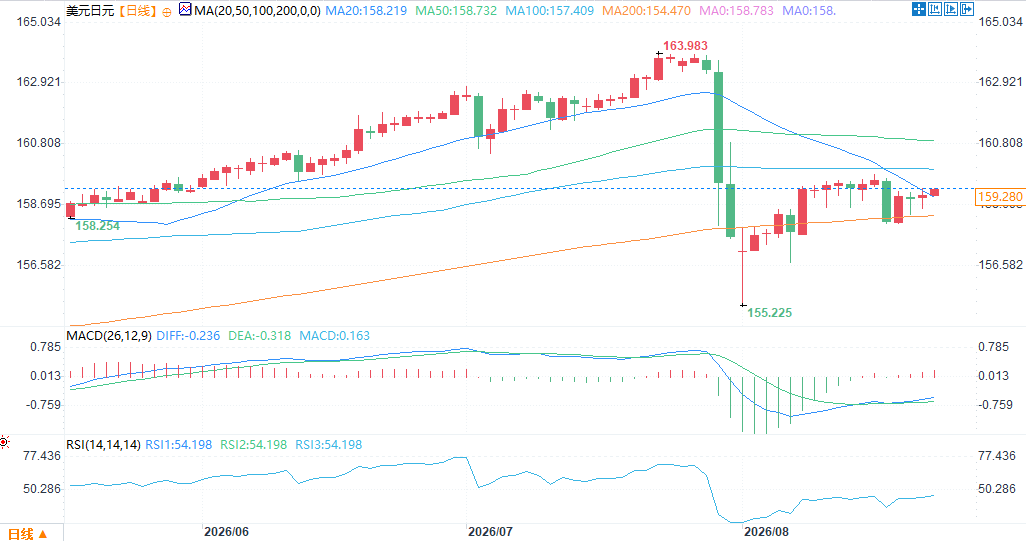 (USD/JPY daily chart, source: EasyForex) At 10:10 Beijing time on August 25, the USD/JPY exchange rate was 159.28/29.
Yen under pressure: Deteriorating fiscal conditions and continued pressure from carry trades
The USD/JPY pair has been trending higher, currently trading above 159.00, while the yen remains generally weak. The core drag is Japan's deteriorating fiscal situation: soaring long-term interest rates have increased government borrowing costs, coupled with a massive debt burden and expansionary budget pressures, significantly increasing market concerns about the sustainability of Japan's public finances. Meanwhile, the USD/JPY interest rate differential remains significantly high, with carry trade funds continuing to flow into high-yield dollar assets, further suppressing yen demand. These structural factors have largely offset the effects of the joint US-Japan intervention at the end of July, and the support after the intervention quickly weakened, thus providing sustained support for the USD/JPY pair. In the short term, unless there is a substantial improvement in Japan's fiscal pressure and interest rate differential, the yen is likely to continue to be under pressure, and the upside risk for the exchange rate remains skewed towards the dollar.Geopolitical factors provide safe-haven buying opportunities for the US dollar.
U.S. Treasury Secretary Bessant announced on Monday the initiation of an "economic exile" operation to sever Iran's economic ties with the global economy, explicitly warning that any country doing business with Iran would face the risk of U.S. sanctions. This move quickly escalated geopolitical tensions. Iran's Supreme National Security Council Secretary Rezaei immediately warned that if the economic war continued, oil exports from the Strait of Hormuz and the entire Persian Gulf would be halted, significantly increasing the risk of energy supply disruptions. The geopolitical risk premium thus persisted, providing significant safe-haven buying support for the U.S. dollar. At the same time, energy price volatility could push up global inflationary pressures, keeping market expectations of at least one Federal Reserve rate hike before the end of the year on the table, further strengthening the relative attractiveness of the dollar. In an environment of rising uncertainty, the dollar's status as a traditional safe-haven currency has once again become prominent, putting downward pressure on other currencies.Dollar upside limited: Cooling interest rate hike expectations and fiscal concerns
Despite geopolitical factors and a weaker yen providing support for the dollar, traders remain cautious about aggressively bullish positions. Expectations of a Fed rate hike continue to cool, and market pricing in further tightening has subsided. Meanwhile, the failed US Treasury buyback program has raised concerns about the sustainability of US fiscal policy, limiting the dollar's upside potential. Investors are closely watching key data and speeches to come: Wednesday's US PCE price index will provide the latest inflation reading, and Friday's speech by Fed Chairman Warsh in Jackson Hole may release policy signals. These events will provide crucial guidance for the dollar's short-term direction. If inflation data is moderate or Warsh's rhetoric is dovish, the dollar's upward momentum may be further limited; conversely, stronger data may provide a temporary boost, but overall upside will remain constrained by both fiscal and policy expectations.Summarize
The yen was pressured by deteriorating Japanese finances and the continued interest rate differential between the US and Japan, offsetting the effects of the joint intervention at the end of July. The US's "economic isolation" of Iran provided safe-haven buying for the dollar, but easing expectations of a Fed rate hike and fiscal concerns stemming from the failure of US Treasury repurchase agreements limited the dollar's upside. The market is focused on Wednesday's PCE data and Friday's Jackson Hole speech; before then, the exchange rate is expected to fluctuate within the 158.00-160.00 range. (USD/JPY daily chart, source: EasyForex) At 10:10 Beijing time on August 25, the USD/JPY exchange rate was 159.28/29.
- Risk Warning and Disclaimer
- The market involves risk, and trading may not be suitable for all investors. This article is for reference only and does not constitute personal investment advice, nor does it take into account certain users’ specific investment objectives, financial situation, or other needs. Any investment decisions made based on this information are at your own risk.