Japanese fiscal pressures have fueled expectations of a weaker yen, with the USD/JPY pair hovering above 159, awaiting signals from the PCE and the Federal Reserve.
2026-08-25 10:35:01
The USD/JPY pair remained range-bound in Asian trading on Tuesday, trading mostly above the 159.00 level, as the market awaited new macroeconomic catalysts. From the current fundamental perspective, USD/JPY remains relatively strong, but given its proximity to a key psychological level and significant uncertainties surrounding US inflation, fiscal policy, and Japanese interest rate policy, neither bulls nor bears currently possess the strength to drive a sustained one-sided trend. The yen has been under continuous pressure recently, largely due to changes in the Japanese government bond market. Long-term Japanese interest rates are at multi-year highs. While theoretically higher yields on Japanese government bonds could increase the attractiveness of yen-denominated assets, if the rising yields reflect concerns about fiscal sustainability rather than a rapid tightening of monetary policy by the Bank of Japan, its support for the yen may be limited. The Japanese Ministry of Finance recently considered raising the assumed interest rate used to calculate debt repayment costs in the next fiscal year's budget to 3.8%, the highest level in nearly 30 years, reflecting that rising long-term interest rates are significantly increasing fiscal financing pressure. Previously, the yield on 10-year Japanese government bonds had risen to approximately 2.945%, a multi-decade high.  Japan's massive government debt, fiscal spending pressures, and rising long-term financing costs are creating mutually reinforcing market concerns. If the Japanese government continues its relatively expansionary fiscal policy, and the Bank of Japan's interest rate hikes fail to keep pace with long-term interest rate changes, the yen may continue to be affected by both interest rate differentials and capital flows. Meanwhile, the interest rate differential between Japan and other major economies remains significant, meaning that arbitrage trades involving low-cost yen financing and investment in high-yield assets remain attractive. Although previous currency policy interventions briefly altered market sentiment, if the interest rate advantage does not fundamentally change, yen rebounds are likely to encounter selling pressure. Recent changes in the Japanese bond market also indicate a strengthening correlation between Japanese and US long-term yields, with global bond market volatility increasingly impacting the yen exchange rate. In the US, rising oil prices and energy supply risks remain important variables affecting the dollar. Persistently strong energy prices could transmit to inflation through transportation, production, and consumption, reducing the Federal Reserve's room for a rapid shift to easing policies. The minutes of the July Fed meeting showed that several officials believed that if inflation continues to exceed the target, further interest rate increases may be necessary; this makes it difficult for the market to completely rule out the possibility of a renewed tightening of monetary policy in the US. However, the dollar's rise is also constrained by the US fiscal situation. Recently, US long-term Treasury yields have risen significantly, and the market is paying closer attention to the fiscal deficit, debt size, and term premium. The US Treasury's expansion of long-term Treasury repurchase operations is taking place against this backdrop. While Treasury intervention in the bond market may improve liquidity to some extent, if the market believes the core reason behind the rise in long-term yields is fiscal risk rather than a temporary liquidity imbalance, then the dollar may struggle to maintain strong support. Therefore, USD/JPY is currently being acted upon by two forces simultaneously: on the one hand, Japanese fiscal pressure, the low-interest-rate environment, and carry trades provide upward momentum for the exchange rate; on the other hand, concerns about fiscal sustainability triggered by rising US long-term yields may limit further dollar strength. The area around 159.00 has thus become an important zone for the market to reassess the relative value of the dollar and yen. Geopolitical risks have also increased market attention to the dollar's safe-haven attributes. The US recently expanded sanctions against entities doing business with Iran, and related energy supply risks may further push up oil prices. Once a new supply shock occurs in the energy market, global inflation expectations may rise again, and market judgments on the Fed's future interest rate policy will change accordingly. For USD/JPY, the impact of this change depends on the magnitude of the rise in US yields and the allocation direction of safe-haven funds to the US dollar and Japanese yen; therefore, there is no simple one-way relationship. The real factors determining the market direction this week remain US macroeconomic data and Federal Reserve policy signals. The July Personal Consumption Expenditures Price Index (PCE) will be released on Wednesday. The market currently expects the core PCE monthly rate to rise by about 0.2%, with the year-on-year growth rate likely to remain at around 3.2%. If the data is higher than expected, the US interest rate market may re-price future rate hikes, thus pushing USD/JPY to test higher resistance levels; if inflation is significantly lower than expected, it may depress US yields and weaken the short-term bullish momentum of USD/JPY. On Friday, Federal Reserve Chairman Kevin Warsh will deliver a keynote speech at the Jackson Hole Economic Policy Symposium. The official Fed schedule shows that Warsh will deliver the keynote speech on August 28. The market is currently particularly focused on whether he will release a clearer policy signal regarding persistently above-target inflation. Due to the recent rise in the yield on the 30-year US Treasury bond to its highest level since 2007, the market's sensitivity to Warsh's speech has significantly increased. From a daily chart perspective, USD/JPY remains in a high-level consolidation pattern with a slight upward bias, with the 159.00 level acting as a crucial short-term support/resistance level. If the price can decisively break through the resistance around 159.60, the next target could be around 160.60, with further gains potentially leading to the 162.10 area. Conversely, if the price falls back below 159.00, the short-term bullish advantage will weaken, with the first support level to watch being the 158.70-158.50 area. A break below this area would likely see support around 157.30. Overall, the daily market momentum remains bullish, but after a prolonged period of high-level consolidation, the validity of a breakout will be more important than simply hitting resistance. From a 4-hour chart perspective, USD/JPY is currently trading above the 100-period simple moving average, maintaining a mildly bullish short-term structure. The 100-period moving average around 158.67 and the 38.2% Fibonacci retracement level around 158.56 form a significant support zone. If the exchange rate holds this level, the bulls still have a chance to test 159.59 again. 159.59 is the most crucial resistance level on the current 4-hour chart; a break above this level would target 160.62. If the exchange rate fails to break higher and falls below 158.56, the short-term consolidation may extend further, with the 23.6% Fibonacci retracement level around 157.28 becoming deeper support. If momentum indicators such as the MACD expand upwards again, it will be conducive to a breakout; conversely, if a clear bearish divergence appears at the highs, a technical pullback in USD/JPY should be anticipated.
 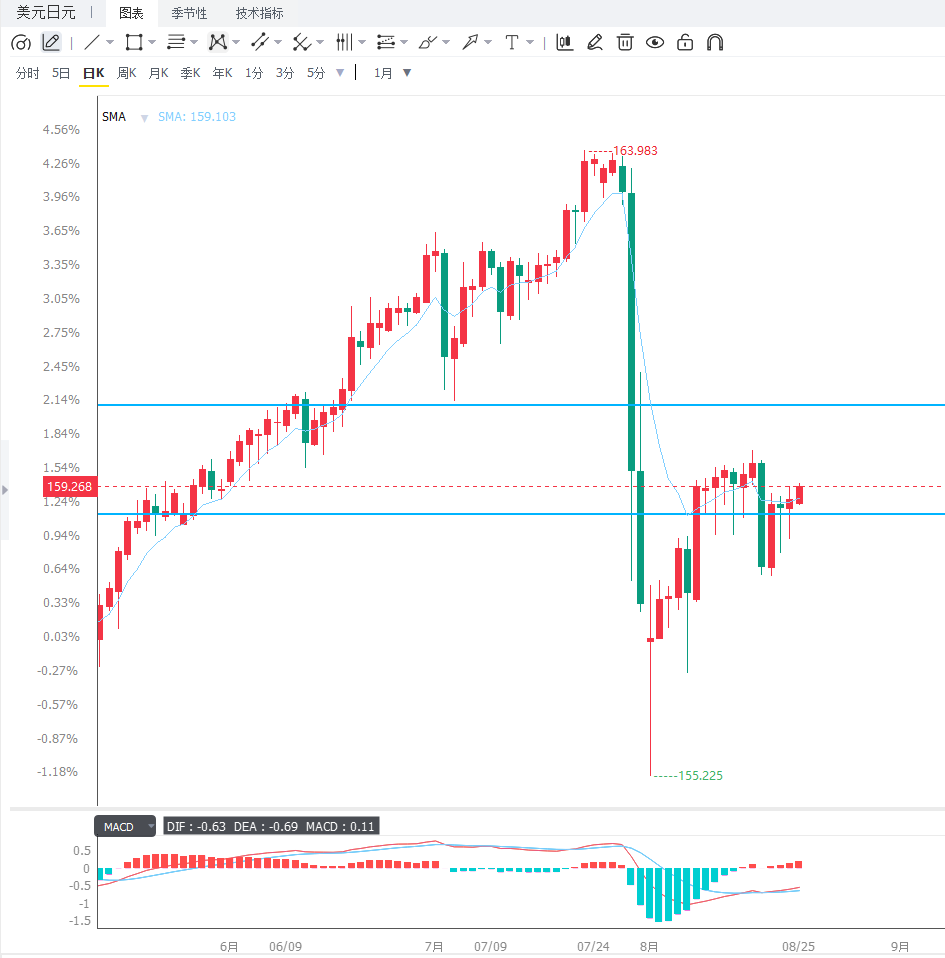 Editor's Summary: The core contradiction in the current USD/JPY exchange rate lies in the continued weakening of the yen due to Japanese fiscal pressure and a low-interest-rate environment, while sticky US inflation limits the Federal Reserve's room for a rapid shift to easing. This combination keeps the exchange rate relatively strong. However, the fiscal risks reflected in excessively high long-term US yields could also become a significant constraint on further dollar appreciation. In the short term, 159.60 is a key confirmation level for a bullish breakout, with 160.60 being the next key target; 158.50-158.70 is a crucial support zone for determining the completeness of the upward structure. If PCE is higher than expected and Warsh releases hawkish signals, USD/JPY may further challenge the 160 level; if US inflation cools and yields fall, the exchange rate may correct back towards the 158.50 or even 157.30 area. Therefore, the current market is not suitable for simply following a single direction. Investors need to closely observe the correlation between US inflation, long-term Treasury yields, and Japanese fiscal and monetary policies. As long as the US-Japan interest rate differential remains high, the medium-term upward trend of the USD/JPY exchange rate has not been completely destroyed, but the policy sensitivity in the 159-160 range is clearly increasing.
Japan's massive government debt, fiscal spending pressures, and rising long-term financing costs are creating mutually reinforcing market concerns. If the Japanese government continues its relatively expansionary fiscal policy, and the Bank of Japan's interest rate hikes fail to keep pace with long-term interest rate changes, the yen may continue to be affected by both interest rate differentials and capital flows. Meanwhile, the interest rate differential between Japan and other major economies remains significant, meaning that arbitrage trades involving low-cost yen financing and investment in high-yield assets remain attractive. Although previous currency policy interventions briefly altered market sentiment, if the interest rate advantage does not fundamentally change, yen rebounds are likely to encounter selling pressure. Recent changes in the Japanese bond market also indicate a strengthening correlation between Japanese and US long-term yields, with global bond market volatility increasingly impacting the yen exchange rate. In the US, rising oil prices and energy supply risks remain important variables affecting the dollar. Persistently strong energy prices could transmit to inflation through transportation, production, and consumption, reducing the Federal Reserve's room for a rapid shift to easing policies. The minutes of the July Fed meeting showed that several officials believed that if inflation continues to exceed the target, further interest rate increases may be necessary; this makes it difficult for the market to completely rule out the possibility of a renewed tightening of monetary policy in the US. However, the dollar's rise is also constrained by the US fiscal situation. Recently, US long-term Treasury yields have risen significantly, and the market is paying closer attention to the fiscal deficit, debt size, and term premium. The US Treasury's expansion of long-term Treasury repurchase operations is taking place against this backdrop. While Treasury intervention in the bond market may improve liquidity to some extent, if the market believes the core reason behind the rise in long-term yields is fiscal risk rather than a temporary liquidity imbalance, then the dollar may struggle to maintain strong support. Therefore, USD/JPY is currently being acted upon by two forces simultaneously: on the one hand, Japanese fiscal pressure, the low-interest-rate environment, and carry trades provide upward momentum for the exchange rate; on the other hand, concerns about fiscal sustainability triggered by rising US long-term yields may limit further dollar strength. The area around 159.00 has thus become an important zone for the market to reassess the relative value of the dollar and yen. Geopolitical risks have also increased market attention to the dollar's safe-haven attributes. The US recently expanded sanctions against entities doing business with Iran, and related energy supply risks may further push up oil prices. Once a new supply shock occurs in the energy market, global inflation expectations may rise again, and market judgments on the Fed's future interest rate policy will change accordingly. For USD/JPY, the impact of this change depends on the magnitude of the rise in US yields and the allocation direction of safe-haven funds to the US dollar and Japanese yen; therefore, there is no simple one-way relationship. The real factors determining the market direction this week remain US macroeconomic data and Federal Reserve policy signals. The July Personal Consumption Expenditures Price Index (PCE) will be released on Wednesday. The market currently expects the core PCE monthly rate to rise by about 0.2%, with the year-on-year growth rate likely to remain at around 3.2%. If the data is higher than expected, the US interest rate market may re-price future rate hikes, thus pushing USD/JPY to test higher resistance levels; if inflation is significantly lower than expected, it may depress US yields and weaken the short-term bullish momentum of USD/JPY. On Friday, Federal Reserve Chairman Kevin Warsh will deliver a keynote speech at the Jackson Hole Economic Policy Symposium. The official Fed schedule shows that Warsh will deliver the keynote speech on August 28. The market is currently particularly focused on whether he will release a clearer policy signal regarding persistently above-target inflation. Due to the recent rise in the yield on the 30-year US Treasury bond to its highest level since 2007, the market's sensitivity to Warsh's speech has significantly increased. From a daily chart perspective, USD/JPY remains in a high-level consolidation pattern with a slight upward bias, with the 159.00 level acting as a crucial short-term support/resistance level. If the price can decisively break through the resistance around 159.60, the next target could be around 160.60, with further gains potentially leading to the 162.10 area. Conversely, if the price falls back below 159.00, the short-term bullish advantage will weaken, with the first support level to watch being the 158.70-158.50 area. A break below this area would likely see support around 157.30. Overall, the daily market momentum remains bullish, but after a prolonged period of high-level consolidation, the validity of a breakout will be more important than simply hitting resistance. From a 4-hour chart perspective, USD/JPY is currently trading above the 100-period simple moving average, maintaining a mildly bullish short-term structure. The 100-period moving average around 158.67 and the 38.2% Fibonacci retracement level around 158.56 form a significant support zone. If the exchange rate holds this level, the bulls still have a chance to test 159.59 again. 159.59 is the most crucial resistance level on the current 4-hour chart; a break above this level would target 160.62. If the exchange rate fails to break higher and falls below 158.56, the short-term consolidation may extend further, with the 23.6% Fibonacci retracement level around 157.28 becoming deeper support. If momentum indicators such as the MACD expand upwards again, it will be conducive to a breakout; conversely, if a clear bearish divergence appears at the highs, a technical pullback in USD/JPY should be anticipated. Editor's Summary: The core contradiction in the current USD/JPY exchange rate lies in the continued weakening of the yen due to Japanese fiscal pressure and a low-interest-rate environment, while sticky US inflation limits the Federal Reserve's room for a rapid shift to easing. This combination keeps the exchange rate relatively strong. However, the fiscal risks reflected in excessively high long-term US yields could also become a significant constraint on further dollar appreciation. In the short term, 159.60 is a key confirmation level for a bullish breakout, with 160.60 being the next key target; 158.50-158.70 is a crucial support zone for determining the completeness of the upward structure. If PCE is higher than expected and Warsh releases hawkish signals, USD/JPY may further challenge the 160 level; if US inflation cools and yields fall, the exchange rate may correct back towards the 158.50 or even 157.30 area. Therefore, the current market is not suitable for simply following a single direction. Investors need to closely observe the correlation between US inflation, long-term Treasury yields, and Japanese fiscal and monetary policies. As long as the US-Japan interest rate differential remains high, the medium-term upward trend of the USD/JPY exchange rate has not been completely destroyed, but the policy sensitivity in the 159-160 range is clearly increasing.
- Risk Warning and Disclaimer
- The market involves risk, and trading may not be suitable for all investors. This article is for reference only and does not constitute personal investment advice, nor does it take into account certain users’ specific investment objectives, financial situation, or other needs. Any investment decisions made based on this information are at your own risk.