Demand for the safe-haven dollar limited the pound's gains, with GBP/USD trading sideways at high levels awaiting a signal from the Federal Reserve.
2026-08-25 14:31:01
The British pound continued its sideways movement against the US dollar in Asian trading on Tuesday, fluctuating around 1.3630, lacking a clear direction for the second consecutive trading day. Previously, the dollar's rebound from its mid-May lows had put some upward pressure on GBP/USD, but the pound did not show a significant follow-through decline, indicating that the current bearish momentum in the market remains limited. Ahead of a series of macroeconomic events, investors are more inclined to wait for new policy and inflation signals.  The recent rebound in the US dollar is primarily driven by safe-haven demand. Following the US expansion of secondary sanctions on Iranian-related economic activities, market concerns about energy supply and regional risks have resurfaced. US Treasury Secretary Bessant stated that the US will continue to push for restrictions on Iranian economic networks and warned that entities conducting business with Iran could face sanctions. Meanwhile, regional energy supply risks remain, and oil prices remain high. The impact of rising energy prices on the pound and the dollar is not entirely symmetrical. On the one hand, higher oil prices may reignite US inflation expectations, reducing market expectations for rapid easing by the Federal Reserve, thus supporting the dollar. On the other hand, the UK also faces imported inflation pressures, which may limit the Bank of England's room for further easing. Therefore, rising energy prices cannot be simply interpreted as negative for the pound; its ultimate impact depends on the relative changes in monetary policy expectations in the US and the UK. US July inflation data was relatively moderate, strengthening market expectations that the Federal Reserve will maintain interest rates at its September meeting. However, the market still believes there is a greater than 75% probability of at least one more rate hike by the end of the year, mainly due to continued energy price volatility and inflation stickiness. This means that while the dollar currently lacks strong upward momentum in interest rates, it has not yet lost the support of policy expectations. In the UK, market focus is primarily on the balance between economic growth and inflation. If UK economic activity continues to be resilient, and rising energy prices further push up inflation, the Bank of England's room for future interest rate cuts may be limited, thus supporting the pound. However, if economic growth slows significantly and monetary policy expectations shift back towards easing, the pound may face new pressure. Looking at fund flows, investors are not currently significantly increasing their long dollar positions, instead adopting a wait-and-see approach. The dollar has rebounded after a prolonged period of adjustment, but without new interest rate catalysts, the rebound may be more of a short covering and position rebalancing than a new trend. This week's US PCE data will be a crucial directional catalyst for GBP/USD. The market will focus on whether core inflation continues to remain moderate. If PCE is higher than expected, it could push up US Treasury yields and increase dollar demand, putting further downward pressure on GBP/USD; if PCE is lower than expected, it could strengthen expectations of future Fed easing policies, limiting the dollar's rebound potential, and the pound may retest recent highs. Furthermore, Fed Chairman Kevin Warsh's speech at the Jackson Hole symposium is also worth noting. If the exchange rate emphasizes inflation risks and releases hawkish signals, the US dollar may strengthen further; if it focuses more on employment and economic growth risks, it may weaken market expectations for further interest rate hikes, providing upside potential for GBP/USD. From a daily technical perspective, GBP/USD currently maintains a relatively positive medium-term structure, with the exchange rate above the 200-day simple moving average at 1.3431. However, short-term bulls need to first break through the 1.3660-1.3665 supply zone to confirm renewed upward momentum. A successful break above 1.3665 could see the exchange rate further test the 1.3700 and 1.3750 areas; a failed breakout would likely continue the high-level consolidation pattern. On the downside, the 1.3500 area provides short-term psychological support, while the 200-day moving average at 1.3431 is a more significant structural support. If the exchange rate breaks below 1.3431 and forms a sustained daily close confirming this, the current bullish structure will weaken significantly, potentially opening up deeper technical correction potential. From a 4-hour chart perspective, GBP/USD is currently in a high-level consolidation phase, with short-term moving averages gradually converging, indicating that the market is awaiting a new directional catalyst. If the exchange rate holds above the 1.3580-1.3600 area and breaks above 1.3665 again, the bulls may regain control in the short term; if it falls below 1.3580, it may retrace towards the 1.3500 area. If the MACD expands upward again, it will be conducive to a breakout; if momentum continues to weaken at high levels, a technical pullback after a failed attempt to break higher should be anticipated.
 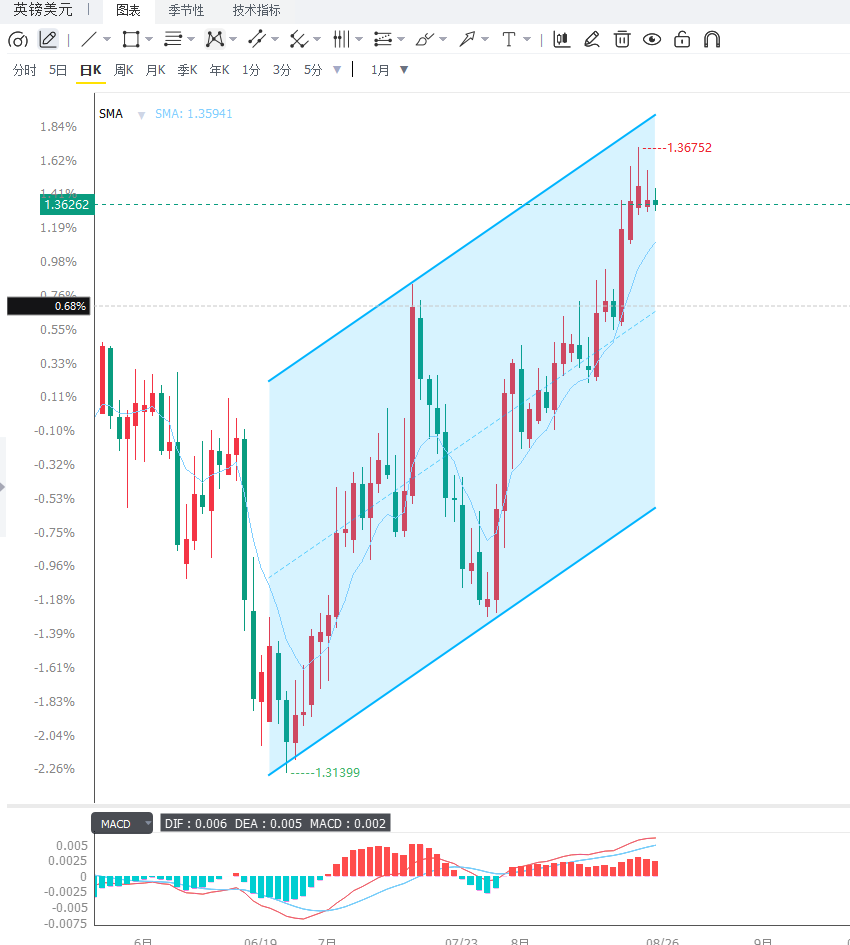 The GBP/USD pair is currently in a phase of tug-of-war between a rebounding US dollar and internal support factors for the British pound. While a temporary slowdown in US inflation has limited the dollar's upside, energy prices, geopolitical risks, and expectations of potential Fed rate hikes continue to support it. Meanwhile, the pound has not experienced significant selling pressure, indicating that market expectations of further easing of UK monetary policy have not yet exerted strong downward pressure. In the short term, 1.3660-1.3665 is a key area for a bullish breakout, 1.3580-1.3600 is a significant support zone on the 4-hour chart, and 1.3431 remains a crucial defense line on the daily chart. PCE data and policy signals from the Jackson Hole symposium will determine whether GBP/USD can break out of its current consolidation pattern. If US inflation continues to cool and further weakens the dollar, the pound may retest above 1.3665; conversely, if PCE exceeds expectations or the Fed releases a more hawkish policy signal, GBP/USD may seek support again near 1.3500 or even 1.3431. Currently, the market is more suited to focusing on confirmation of direction after a breakout of key technical levels, rather than chasing trends in the middle of the range.
The recent rebound in the US dollar is primarily driven by safe-haven demand. Following the US expansion of secondary sanctions on Iranian-related economic activities, market concerns about energy supply and regional risks have resurfaced. US Treasury Secretary Bessant stated that the US will continue to push for restrictions on Iranian economic networks and warned that entities conducting business with Iran could face sanctions. Meanwhile, regional energy supply risks remain, and oil prices remain high. The impact of rising energy prices on the pound and the dollar is not entirely symmetrical. On the one hand, higher oil prices may reignite US inflation expectations, reducing market expectations for rapid easing by the Federal Reserve, thus supporting the dollar. On the other hand, the UK also faces imported inflation pressures, which may limit the Bank of England's room for further easing. Therefore, rising energy prices cannot be simply interpreted as negative for the pound; its ultimate impact depends on the relative changes in monetary policy expectations in the US and the UK. US July inflation data was relatively moderate, strengthening market expectations that the Federal Reserve will maintain interest rates at its September meeting. However, the market still believes there is a greater than 75% probability of at least one more rate hike by the end of the year, mainly due to continued energy price volatility and inflation stickiness. This means that while the dollar currently lacks strong upward momentum in interest rates, it has not yet lost the support of policy expectations. In the UK, market focus is primarily on the balance between economic growth and inflation. If UK economic activity continues to be resilient, and rising energy prices further push up inflation, the Bank of England's room for future interest rate cuts may be limited, thus supporting the pound. However, if economic growth slows significantly and monetary policy expectations shift back towards easing, the pound may face new pressure. Looking at fund flows, investors are not currently significantly increasing their long dollar positions, instead adopting a wait-and-see approach. The dollar has rebounded after a prolonged period of adjustment, but without new interest rate catalysts, the rebound may be more of a short covering and position rebalancing than a new trend. This week's US PCE data will be a crucial directional catalyst for GBP/USD. The market will focus on whether core inflation continues to remain moderate. If PCE is higher than expected, it could push up US Treasury yields and increase dollar demand, putting further downward pressure on GBP/USD; if PCE is lower than expected, it could strengthen expectations of future Fed easing policies, limiting the dollar's rebound potential, and the pound may retest recent highs. Furthermore, Fed Chairman Kevin Warsh's speech at the Jackson Hole symposium is also worth noting. If the exchange rate emphasizes inflation risks and releases hawkish signals, the US dollar may strengthen further; if it focuses more on employment and economic growth risks, it may weaken market expectations for further interest rate hikes, providing upside potential for GBP/USD. From a daily technical perspective, GBP/USD currently maintains a relatively positive medium-term structure, with the exchange rate above the 200-day simple moving average at 1.3431. However, short-term bulls need to first break through the 1.3660-1.3665 supply zone to confirm renewed upward momentum. A successful break above 1.3665 could see the exchange rate further test the 1.3700 and 1.3750 areas; a failed breakout would likely continue the high-level consolidation pattern. On the downside, the 1.3500 area provides short-term psychological support, while the 200-day moving average at 1.3431 is a more significant structural support. If the exchange rate breaks below 1.3431 and forms a sustained daily close confirming this, the current bullish structure will weaken significantly, potentially opening up deeper technical correction potential. From a 4-hour chart perspective, GBP/USD is currently in a high-level consolidation phase, with short-term moving averages gradually converging, indicating that the market is awaiting a new directional catalyst. If the exchange rate holds above the 1.3580-1.3600 area and breaks above 1.3665 again, the bulls may regain control in the short term; if it falls below 1.3580, it may retrace towards the 1.3500 area. If the MACD expands upward again, it will be conducive to a breakout; if momentum continues to weaken at high levels, a technical pullback after a failed attempt to break higher should be anticipated. The GBP/USD pair is currently in a phase of tug-of-war between a rebounding US dollar and internal support factors for the British pound. While a temporary slowdown in US inflation has limited the dollar's upside, energy prices, geopolitical risks, and expectations of potential Fed rate hikes continue to support it. Meanwhile, the pound has not experienced significant selling pressure, indicating that market expectations of further easing of UK monetary policy have not yet exerted strong downward pressure. In the short term, 1.3660-1.3665 is a key area for a bullish breakout, 1.3580-1.3600 is a significant support zone on the 4-hour chart, and 1.3431 remains a crucial defense line on the daily chart. PCE data and policy signals from the Jackson Hole symposium will determine whether GBP/USD can break out of its current consolidation pattern. If US inflation continues to cool and further weakens the dollar, the pound may retest above 1.3665; conversely, if PCE exceeds expectations or the Fed releases a more hawkish policy signal, GBP/USD may seek support again near 1.3500 or even 1.3431. Currently, the market is more suited to focusing on confirmation of direction after a breakout of key technical levels, rather than chasing trends in the middle of the range.
- Risk Warning and Disclaimer
- The market involves risk, and trading may not be suitable for all investors. This article is for reference only and does not constitute personal investment advice, nor does it take into account certain users’ specific investment objectives, financial situation, or other needs. Any investment decisions made based on this information are at your own risk.