With US Treasury bond buybacks and ongoing sanctions against Iran continuing to weigh on the US dollar, can the New Zealand dollar rally again?
2026-08-25 15:03:07
On Tuesday (August 25) during Asian trading hours, the New Zealand dollar rose and then fell back against the US dollar, currently trading around 0.5955, hovering near its highest level since early June. New Zealand's persistently high inflation has led to the market "almost fully pricing in" a second consecutive 25 basis point rate hike to 2.75% by the Reserve Bank of New Zealand in September. Rumors of the US Treasury expanding its long-term bond buyback program—potentially using up to $1 trillion from the Treasury's total account—and secondary sanctions against Iran continue to weigh on the US dollar. This week is packed with US economic events—Tuesday's consumer confidence index, Wednesday's PCE price index, and Friday's speech by Federal Reserve Chairman Warsh in Jackson Hole may provide new directional guidance for the New Zealand dollar against the US dollar. 
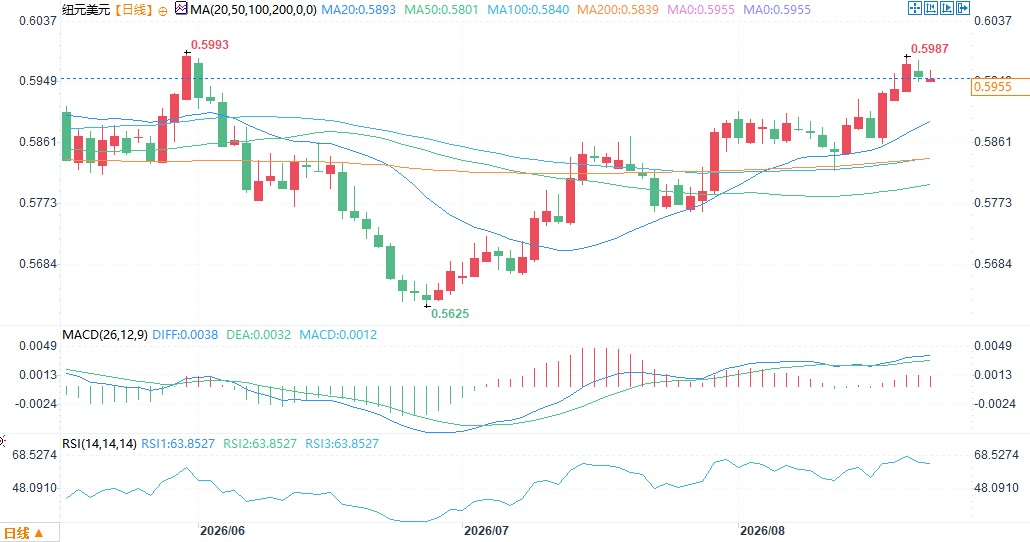 (NZD/USD daily chart, source: EasyTrade) At 14:59 Beijing time on August 25, the NZD/USD exchange rate was 0.5955/56.
The Reserve Bank of New Zealand's rate hike expectations are "almost fully priced in," supporting the New Zealand dollar.
The New Zealand dollar is currently trading around 0.5955 against the US dollar, having successfully recovered from the previous day's modest losses and showing relative strength overall. Persistently high inflation in New Zealand is the core factor supporting the NZD. The market has "almost fully priced in" the Reserve Bank of New Zealand's expectation of a second consecutive 25 basis point rate hike to 2.75% in September, with investors generally believing the central bank will maintain its tightening policy trajectory. Strategists at Brown Brothers Harriman pointed out that the policy decision on September 2nd will include a new monetary policy statement, and market expectations are quite firm. Despite recent mixed domestic data, high inflationary pressures continue to dominate the policy outlook, giving the NZD some buying interest supported by interest rate expectations and suggesting continued upward momentum in the short term.US Treasury repurchase and geopolitical factors continue to put downward pressure on the dollar.
The New Zealand dollar also benefited from the continued pressure on the US dollar. The US Treasury decided to double the size of its long-term bond repurchase program, and market reports indicated that Treasury Secretary Bessant might use up to $1 trillion from the Treasury's total account to finance the repurchases. This move was intended to alleviate pressure from rapidly rising long-term interest rates, but it also raised concerns about US fiscal policy. Furthermore, the US expanded secondary sanctions against Iranian trade-related entities, and Bessant warned of possible enforcement action against a major financial institution this week, simultaneously escalating geopolitical tensions. These multiple factors combined suppressed dollar buying, indirectly providing relative support for non-US currencies such as the New Zealand dollar.This week's focus: US data and Jackson Hole speech
The market is turning its attention to a packed schedule of US economic events this week, with data and speeches directly impacting the dollar's performance and consequently influencing the short-term direction of the New Zealand dollar against the US dollar. Tuesday will see the release of the consumer confidence index, followed by the Fed's preferred inflation gauge—the PCE price index—on Wednesday. These two data points will provide the market with the latest clues on inflation and consumer momentum. Market focus will reach its climax on Thursday, with Fed Chairman Warsh speaking at the Jackson Hole annual symposium, potentially providing crucial guidance for the dollar's short-term direction. Strong data or a hawkish signal from Warsh could support the dollar and suppress the New Zealand dollar; conversely, weak data could further strengthen the New Zealand dollar's relative advantage.Summarize
The New Zealand dollar rose and then fell back against the US dollar, currently trading around 0.5955. The expectation of a second consecutive 25 basis point rate hike by the Reserve Bank of New Zealand in September is "almost fully priced in." Rumors of US Treasury bond buybacks (potentially involving up to $1 trillion) and secondary sanctions against Iran continue to weigh on the dollar. The market is focused on this week's US consumer confidence, PCE data, and the Warsh-Jackson Hole speech, events that could determine the short-term direction of the dollar and provide new catalysts for the New Zealand dollar against the US dollar. (NZD/USD daily chart, source: EasyTrade) At 14:59 Beijing time on August 25, the NZD/USD exchange rate was 0.5955/56.
- Risk Warning and Disclaimer
- The market involves risk, and trading may not be suitable for all investors. This article is for reference only and does not constitute personal investment advice, nor does it take into account certain users’ specific investment objectives, financial situation, or other needs. Any investment decisions made based on this information are at your own risk.