Geopolitical risks boosted demand for safe-haven assets, pushing the dollar index up to the 99 mark, but expectations of Federal Reserve policy limited further gains.
2026-08-25 14:41:02
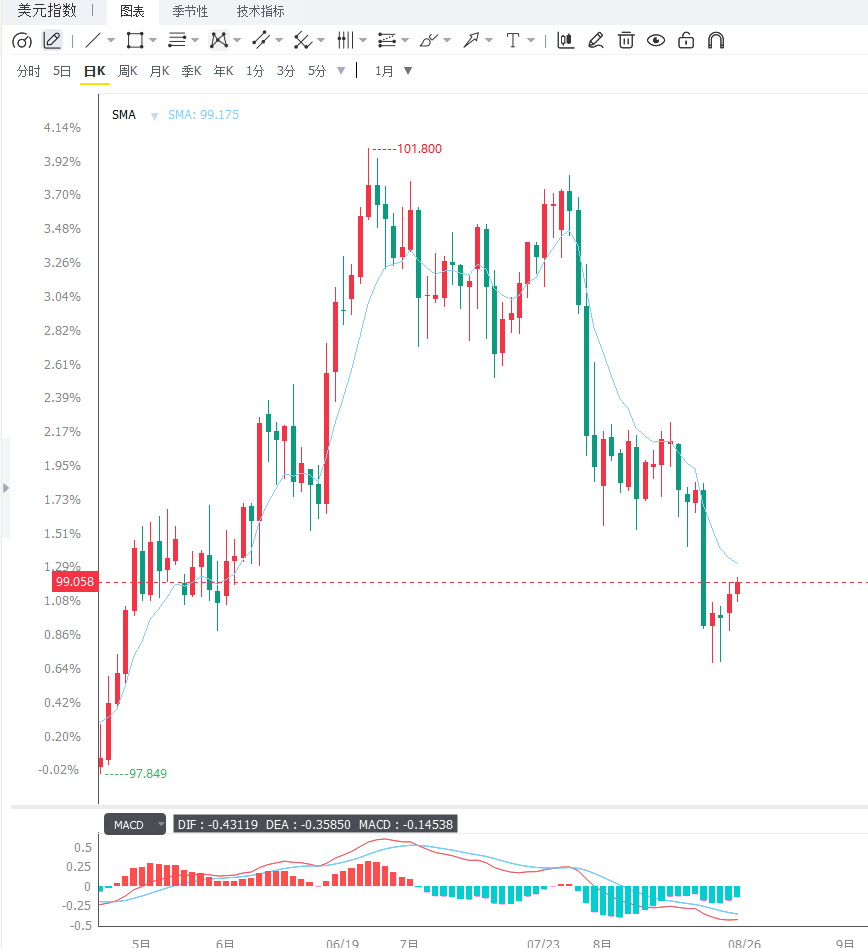
The US dollar index continued its rebound in Asian trading on Tuesday, holding above 99.00 for the second consecutive trading day. The main support for the dollar recently has come from safe-haven inflows and market repricing of global geopolitical risks. Following the US expansion of secondary sanctions against entities doing business with Iran, market concerns about energy supplies, global inflation, and financial market volatility have intensified, providing some buying support for the dollar as a traditional safe-haven asset.  U.S. Treasury Secretary Bessenter stated that the U.S. will further expand sanctions against Iran's economic network and warned institutions doing business with Iran that may face the risk of U.S. sanctions. Meanwhile, the U.S. is expected to take further action against a large financial institution this week. The extension of sanctions from Iran itself to third-party financial and commercial institutions has brought renewed market attention to the potential ripple effects on energy supply and the global financial system. In the short term, geopolitical risks have provided direct support for the dollar. If new disruptions occur in energy transportation or crude oil supply, oil prices may rise further, and global inflation expectations will also increase. For the U.S., high oil prices may increase costs for residents and businesses and limit the rate of further decline in inflation; therefore, market expectations for the Federal Reserve to tighten policy again in the future have not completely disappeared. However, the current rebound of the dollar still faces constraints from the U.S. bond market. The U.S. Treasury recently announced an expansion of its long-term Treasury bond repurchase operations, hoping to improve liquidity in the long-term bond market through repurchases. The market is also watching whether the Treasury will further utilize funds from its general account to support these operations. While repurchase agreements may improve bond market liquidity in the short term, if the fundamental reasons for persistently high long-term Treasury yields still stem from fiscal deficits, debt size, and term premiums, simply expanding the scale of repurchase agreements cannot completely eliminate market concerns about the US fiscal situation. A key contradiction currently facing the US dollar is that geopolitical risks drive safe-haven demand, while US fiscal pressure limits its attractiveness as a long-term store of value. This means that while the dollar may rebound in the short term due to safe-haven inflows, without further support from US economic data and interest rate expectations, its rise may be more of a technical correction than a new medium- to long-term trend. US economic data will be a crucial catalyst for the dollar's movement this week. On Tuesday, the market will focus on consumer confidence data, while Wednesday will see the release of the Personal Consumption Expenditures Price Index (PCE). As a key inflation indicator monitored by the Federal Reserve, the PCE will directly influence market judgments on future interest rate policy. If inflation data is higher than expected, US Treasury yields may rise further, potentially providing new interest rate support for the dollar; if inflation continues to cool, expectations of a Fed policy shift towards easing may resurface, thus limiting the dollar's rebound. Meanwhile, the market is awaiting Federal Reserve Chairman Kevin Warsh's speech at the Jackson Hole Economic Policy Symposium. US inflation remains somewhat sticky, and rising energy prices have increased uncertainty about future inflation. Therefore, investors are hoping to glean more clues about interest rate policy and inflation targets from Warsh's speech. This week, the core of the dollar's movement has shifted from simple safe-haven trading to a comprehensive interplay of "inflation data + Fed policy + US fiscal situation." If the PCE unexpectedly rises while Warsh releases hawkish signals, the dollar's rebound could extend further; conversely, if inflation data is moderate and the Fed emphasizes economic growth risks, the dollar index may come under renewed pressure. From a global market perspective, the dollar index remains a crucial link between the foreign exchange, gold, oil, and US Treasury markets. A stronger dollar typically increases the cost of holding dollar-denominated commodities and may exert short-term downward pressure on gold; however, if a rising dollar is accompanied by a significant increase in oil prices, the market may enter a complex environment of "dollar safe-haven demand + energy inflation." In this scenario, changes in US Treasury yields and real interest rates will be more important than nominal dollar fluctuations. Market sentiment remains cautious. Some investors have begun reducing their short dollar positions after the dollar's previous sustained weakness, and this position adjustment itself could drive a short-term dollar rebound. Market strategists believe that ahead of a flurry of macroeconomic data and policy events, investors tend to reduce their directional risk exposure, potentially leading to some defensive buying of the US dollar. However, this does not signify a fundamental change in the dollar's medium-term weakness. From a daily technical perspective, the US dollar index is currently trading around 99.00. Although it has rebounded for two consecutive trading days, it remains in a generally weak position. The index remains below short-term and medium-term exponential moving averages, and the 14-day RSI is around 35, nearing oversold territory, indicating that bearish momentum still dominates, although the short-term downside potential has narrowed. The first resistance level is around 99.22; a successful break above this level would target the medium-term moving average resistance around 99.98. Only a firm hold above 100 would significantly improve the short-term structure of the US dollar index. From a 4-hour chart perspective, the US dollar index has experienced a technical rebound after a period of consolidation, with some recovery in short-term momentum, but it remains a pullback within a weak structure. If 99.22 can be effectively broken, the US dollar may further test the 99.60-100.00 area; if it encounters resistance and falls back below 98.80, the rebound structure may be broken, and the market will retest the area around 98.50. The short-term MACD momentum needs to be monitored for continued upward expansion. If the RSI continues to rise from its lows, it will support further dollar recovery; if the momentum weakens rapidly during the rebound, a renewed weakening of the dollar should be anticipated.
  Editor's Summary: The US dollar index is currently in a typical phase of "short-term rebound, but medium-term weakness." Geopolitical risks and safe-haven demand have pushed the dollar back towards the 99 level, but US fiscal pressure, long-term bond yields, and market repricing of future Fed policies remain significant constraints. In the coming trading days, PCE inflation data and Warsh's speech at the Jackson Hole symposium will determine whether the dollar's rebound can transform from a technical correction into a trend-driven rise. If US inflation picks up again and pushes yields higher, the dollar could challenge 99.98 or even the 100 level; if PCE is lower than expected and Fed policy expectations shift back to easing, the dollar may fall back below 98.80. From an asset allocation perspective, the current dollar trend will directly impact gold and crude oil. If the dollar breaks through the 100 level, precious metals may face short-term pressure; conversely, if the dollar weakens again, gold is expected to receive stronger support. Therefore, 99.22 is the first key level for judging the strength of the dollar's rebound in the short term, while the 100 level is an important confirmation area for determining whether the dollar's trend has truly changed.
U.S. Treasury Secretary Bessenter stated that the U.S. will further expand sanctions against Iran's economic network and warned institutions doing business with Iran that may face the risk of U.S. sanctions. Meanwhile, the U.S. is expected to take further action against a large financial institution this week. The extension of sanctions from Iran itself to third-party financial and commercial institutions has brought renewed market attention to the potential ripple effects on energy supply and the global financial system. In the short term, geopolitical risks have provided direct support for the dollar. If new disruptions occur in energy transportation or crude oil supply, oil prices may rise further, and global inflation expectations will also increase. For the U.S., high oil prices may increase costs for residents and businesses and limit the rate of further decline in inflation; therefore, market expectations for the Federal Reserve to tighten policy again in the future have not completely disappeared. However, the current rebound of the dollar still faces constraints from the U.S. bond market. The U.S. Treasury recently announced an expansion of its long-term Treasury bond repurchase operations, hoping to improve liquidity in the long-term bond market through repurchases. The market is also watching whether the Treasury will further utilize funds from its general account to support these operations. While repurchase agreements may improve bond market liquidity in the short term, if the fundamental reasons for persistently high long-term Treasury yields still stem from fiscal deficits, debt size, and term premiums, simply expanding the scale of repurchase agreements cannot completely eliminate market concerns about the US fiscal situation. A key contradiction currently facing the US dollar is that geopolitical risks drive safe-haven demand, while US fiscal pressure limits its attractiveness as a long-term store of value. This means that while the dollar may rebound in the short term due to safe-haven inflows, without further support from US economic data and interest rate expectations, its rise may be more of a technical correction than a new medium- to long-term trend. US economic data will be a crucial catalyst for the dollar's movement this week. On Tuesday, the market will focus on consumer confidence data, while Wednesday will see the release of the Personal Consumption Expenditures Price Index (PCE). As a key inflation indicator monitored by the Federal Reserve, the PCE will directly influence market judgments on future interest rate policy. If inflation data is higher than expected, US Treasury yields may rise further, potentially providing new interest rate support for the dollar; if inflation continues to cool, expectations of a Fed policy shift towards easing may resurface, thus limiting the dollar's rebound. Meanwhile, the market is awaiting Federal Reserve Chairman Kevin Warsh's speech at the Jackson Hole Economic Policy Symposium. US inflation remains somewhat sticky, and rising energy prices have increased uncertainty about future inflation. Therefore, investors are hoping to glean more clues about interest rate policy and inflation targets from Warsh's speech. This week, the core of the dollar's movement has shifted from simple safe-haven trading to a comprehensive interplay of "inflation data + Fed policy + US fiscal situation." If the PCE unexpectedly rises while Warsh releases hawkish signals, the dollar's rebound could extend further; conversely, if inflation data is moderate and the Fed emphasizes economic growth risks, the dollar index may come under renewed pressure. From a global market perspective, the dollar index remains a crucial link between the foreign exchange, gold, oil, and US Treasury markets. A stronger dollar typically increases the cost of holding dollar-denominated commodities and may exert short-term downward pressure on gold; however, if a rising dollar is accompanied by a significant increase in oil prices, the market may enter a complex environment of "dollar safe-haven demand + energy inflation." In this scenario, changes in US Treasury yields and real interest rates will be more important than nominal dollar fluctuations. Market sentiment remains cautious. Some investors have begun reducing their short dollar positions after the dollar's previous sustained weakness, and this position adjustment itself could drive a short-term dollar rebound. Market strategists believe that ahead of a flurry of macroeconomic data and policy events, investors tend to reduce their directional risk exposure, potentially leading to some defensive buying of the US dollar. However, this does not signify a fundamental change in the dollar's medium-term weakness. From a daily technical perspective, the US dollar index is currently trading around 99.00. Although it has rebounded for two consecutive trading days, it remains in a generally weak position. The index remains below short-term and medium-term exponential moving averages, and the 14-day RSI is around 35, nearing oversold territory, indicating that bearish momentum still dominates, although the short-term downside potential has narrowed. The first resistance level is around 99.22; a successful break above this level would target the medium-term moving average resistance around 99.98. Only a firm hold above 100 would significantly improve the short-term structure of the US dollar index. From a 4-hour chart perspective, the US dollar index has experienced a technical rebound after a period of consolidation, with some recovery in short-term momentum, but it remains a pullback within a weak structure. If 99.22 can be effectively broken, the US dollar may further test the 99.60-100.00 area; if it encounters resistance and falls back below 98.80, the rebound structure may be broken, and the market will retest the area around 98.50. The short-term MACD momentum needs to be monitored for continued upward expansion. If the RSI continues to rise from its lows, it will support further dollar recovery; if the momentum weakens rapidly during the rebound, a renewed weakening of the dollar should be anticipated. Editor's Summary: The US dollar index is currently in a typical phase of "short-term rebound, but medium-term weakness." Geopolitical risks and safe-haven demand have pushed the dollar back towards the 99 level, but US fiscal pressure, long-term bond yields, and market repricing of future Fed policies remain significant constraints. In the coming trading days, PCE inflation data and Warsh's speech at the Jackson Hole symposium will determine whether the dollar's rebound can transform from a technical correction into a trend-driven rise. If US inflation picks up again and pushes yields higher, the dollar could challenge 99.98 or even the 100 level; if PCE is lower than expected and Fed policy expectations shift back to easing, the dollar may fall back below 98.80. From an asset allocation perspective, the current dollar trend will directly impact gold and crude oil. If the dollar breaks through the 100 level, precious metals may face short-term pressure; conversely, if the dollar weakens again, gold is expected to receive stronger support. Therefore, 99.22 is the first key level for judging the strength of the dollar's rebound in the short term, while the 100 level is an important confirmation area for determining whether the dollar's trend has truly changed.
- Risk Warning and Disclaimer
- The market involves risk, and trading may not be suitable for all investors. This article is for reference only and does not constitute personal investment advice, nor does it take into account certain users’ specific investment objectives, financial situation, or other needs. Any investment decisions made based on this information are at your own risk.