The Australian dollar is consolidating at recent highs: the hawkish minutes provide support, but CPI and PCE are the real tests.
2026-08-26 08:37:01
On Wednesday (August 26) during the Asian session, the Australian dollar continued its upward trend against the US dollar, currently trading around 0.7165, remaining within the strong zone established since June 4. The Reserve Bank of Australia's meeting minutes showed the committee was close to raising interest rates, boosting market expectations for tightening policies. US economic data was mixed – the August consumer confidence index fell to a seven-month low of 89.4, and building permits, while improving, missed expectations. In the Middle East, Russian media reported a ceasefire agreement between the US and Iran, causing a sharp drop in oil prices, but this news has not yet been confirmed by other media outlets. Boston Fed President Collins emphasized that inflation remains high and the economy is expanding at near-trend speed. The market is focused on Wednesday's Australian July CPI data (expected to fall to 3.2% year-on-year from 3.8%) and revised average CPI (expected to fall to 3.5% from 3.6%), as well as the US core PCE, durable goods orders, and Fed Chairman Warsh's Jackson Hole speech on Thursday. 
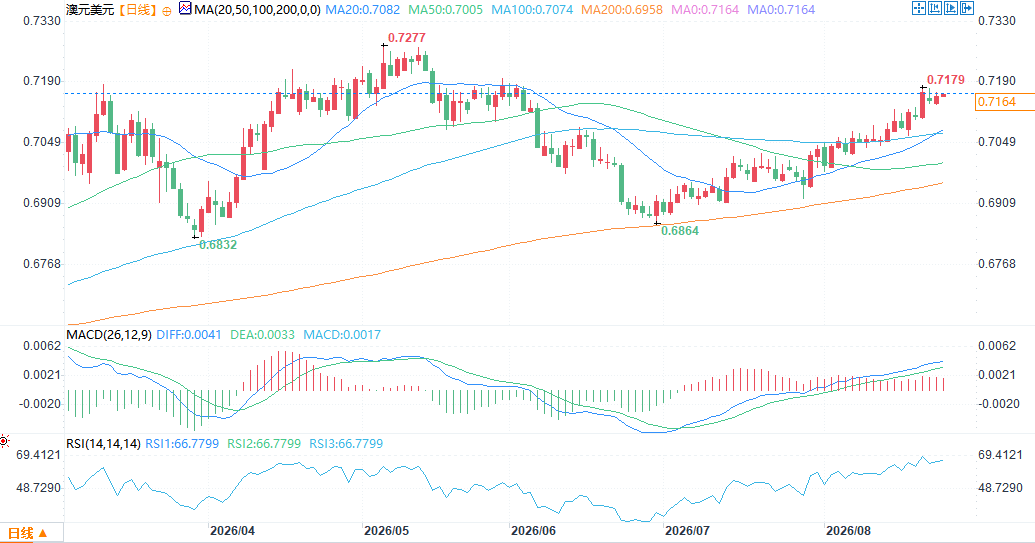 (Australian dollar/US dollar daily chart, source: EasyForex) At 8:24 AM Beijing time on August 26, the Australian dollar was trading at 0.7165/66 against the US dollar.
The Reserve Bank of Australia's minutes released a hawkish signal, providing support for the Australian dollar.
The Australian dollar strengthened significantly against the US dollar after the release of the meeting minutes yesterday, rising by about 0.15% and briefly reaching around 0.7167. The market generally interpreted the minutes as hawkish, focusing on the fact that the committee seriously discussed the option of raising interest rates and was close to taking action. This directly reinforced market expectations that the Reserve Bank of Australia (RBA) would maintain its tightening stance and might even further tighten policy in the coming months. The Australian dollar thus received significant support, with investors reassessing previously overly dovish pricing. Market attention quickly turned to the upcoming release of Australia's July CPI data. The market generally expects overall year-on-year inflation to fall from 3.8% to 3.2%, while the revised average CPI is expected to decline slightly from 3.6% to 3.5%. The revised average, as a core indicator that the RBA values more, will directly influence the policy path. ANZ analysts explicitly pointed out that if the revised average CPI is largely in line with expectations, the November meeting will truly be a "living" meeting, meaning that both the possibility of a rate hike and maintaining the current rate need to be carefully considered, rather than being locked in in advance. The currency market has already reacted to this. The current implied tightening at the December meeting is approximately 14 basis points, corresponding to about a 50% probability of a rate hike. This pricing suggests that the market is no longer completely ruling out another rate hike this year, but rather has reopened policy space. If subsequent inflation data remains sticky, or the labor market remains resilient, the Australian dollar may continue to receive support; conversely, if the data is significantly weaker than expected, caution is warranted regarding the downward pressure from a rapid shift in policy expectations towards a dovish stance. Overall, the hawkish signals released in the minutes have changed the trading atmosphere for the Australian dollar in the short term, giving it a breather from its previous weakness and making it a focus of attention for bulls once again.Mixed US data and rumors of a Middle East ceasefire weighed on oil prices.
The latest US economic data presents a mixed picture. The consumer confidence index fell to 89.4 in August, a seven-month low, indicating a significant deepening of household concerns about the future economic outlook. Specifically, expectations for business conditions, the job market, and household income all deteriorated, reflecting the fragility of consumer sentiment. Meanwhile, while building permits data improved in July, the improvement was less than market expectations, indicating that the housing market recovery remains weak and has failed to provide stronger momentum for economic growth. In the commodities market, Middle East geopolitical news was the main driver of sharp fluctuations in oil prices. Russian media reported that the US and Iran had reached a ceasefire agreement, causing oil prices to fall by more than 5%. However, this news has not yet been confirmed by other mainstream media or official channels, and the market remains cautious. If the ceasefire agreement is subsequently confirmed, oil prices may face further downward pressure; if the news is proven false, oil prices may rebound quickly. The large fluctuations in oil prices also indirectly affect market judgments on the Federal Reserve's policy path through inflation expectations. Boston Fed President Collins, in her speech, continued to emphasize that inflation remains high, the economy is expanding at near-trend pace, and the job market remains largely consistent with full employment. Her overall tone was neutral to hawkish, suggesting that the Fed has little room for a significant shift towards easing in the short term. In summary, the mixed performance of US data, coupled with geopolitical uncertainty, has increased volatility in the dollar and risk assets, requiring the market to constantly weigh data against news.This week's focus: Australian CPI and US PCE data
This week, the market will be highly focused on two key data releases: Australia's July CPI, released on Wednesday, and a series of other important indicators including the US core PCE price index, durable goods orders, GDP, and initial jobless claims. The Australian CPI, especially the revised average reading, will directly verify the market's assessment of the inflation decline path and determine whether the November and December Fed meetings will truly "come alive." If the data meets or exceeds expectations, the Australian dollar may continue to receive support; if it is significantly lower than expected, tightening expectations may cool rapidly. In the US, the core PCE, as the Fed's most valued inflation indicator, will influence the market's pricing of whether interest rates will be cut or maintained this year. Durable goods orders and GDP data will help determine whether economic momentum has truly slowed, while initial jobless claims continue to track marginal changes in the labor market. These data collectively form the core picture of the US economic landscape this week. The Fed Chairman's speech in Jackson Hole on Thursday is the most important event of the week. The market widely expects his remarks to provide key guidance for the short-term direction of the US dollar: if he emphasizes sticky inflation and policy patience, the dollar may find support; if he releases more concerns about economic growth or the job market, it may open a window for expectations of further easing. Overall, this week is packed with data and speeches, and market volatility may be significantly amplified. The Australian dollar, the US dollar, and risk assets will all be repriced under the impact of multiple information shocks. Investors need to closely monitor the subtle differences between actual data and official wording to avoid being overly driven by a single piece of news.Summarize
The Australian dollar is currently rising to around 0.7165 against the US dollar, following a hawkish release of the Reserve Bank of Australia's minutes. US consumer confidence fell to a seven-month low, and rumors of a Middle East ceasefire pressured oil prices down by more than 5%. The market is focused on Wednesday's Australian CPI and US PCE data, as well as Thursday's Jackson Hole speech, which will determine the short-term direction of the Australian dollar. The money market is pricing in a roughly 50% probability of a December rate hike; higher-than-expected Australian CPI data could further boost the Australian dollar. (Australian dollar/US dollar daily chart, source: EasyForex) At 8:24 AM Beijing time on August 26, the Australian dollar was trading at 0.7165/66 against the US dollar.
- Risk Warning and Disclaimer
- The market involves risk, and trading may not be suitable for all investors. This article is for reference only and does not constitute personal investment advice, nor does it take into account certain users’ specific investment objectives, financial situation, or other needs. Any investment decisions made based on this information are at your own risk.