A weaker dollar supported gold's continued rise, but it has entered a period of intense resistance, leading to further divergence in market sentiment.
2026-08-26 09:41:00
Spot gold continued its high-level consolidation in early Asian trading on Wednesday, rising to around $4,670 per ounce before retreating to around $4,650. This rise was not solely driven by safe-haven demand; a weaker dollar and declining US long-term Treasury yields were the main financial market factors propelling gold through key resistance levels. As the US Treasury expands its long-term Treasury repurchase program, the bond market is readjusting the supply and demand structure of maturity assets, and gold benefits from lower actual holding costs and a change in the attractiveness of dollar-denominated assets.  U.S. Treasury Secretary Scott Bessant previously stated that the Treasury Department might further increase the scale of its Treasury bond repurchase programs to over $4 billion per transaction in the future. The Treasury had already announced a doubling of its long-term Treasury bond repurchase program, with a focus on longer-term securities. The market's direct reaction was downward pressure on long-term U.S. Treasury yields, with some short positions previously betting on further yield increases being covered, leading to a significant rise in bond prices. As yields decline, the opportunity cost of gold relative to interest-bearing assets decreases, creating favorable conditions for a rapid rise in gold prices. From the perspective of the US dollar, the recent continuous decline in the dollar index has further amplified the rise in gold prices. Gold is priced in dollars; when the dollar weakens, the relative cost for investors holding other currencies to buy gold decreases, typically increasing international demand for gold. At the same time, the decline in long-term U.S. Treasury yields signifies a repricing of the U.S. long-term interest rate path and fiscal financing environment, with some funds being reallocated to non-yielding assets such as gold. However, the current rise in gold prices also faces significant fundamental contradictions. On the one hand, the US Treasury's buyback program and a weakening dollar provide financial support for gold; on the other hand, the global energy market and the situation in the Middle East may still transmit to inflation through energy prices. If energy prices remain high, US inflationary pressures may resurface, limiting the Fed's room for future interest rate cuts and even increasing market repricing of the risk of subsequent rate hikes. This logic is particularly important for gold. Gold possesses anti-inflation and safe-haven attributes, but it does not generate interest income. When market interest rates are high, the opportunity cost of holding gold increases accordingly. Therefore, if rising energy prices ultimately lead to a significant increase in US inflation expectations and push US Treasury yields higher again, gold's current upward trend may encounter a temporary headwind. The market is also currently focused on Fed Chairman Kevin Warsh's speech at the Jackson Hole Economic Symposium. As market expectations for the future interest rate path are readjusted, the policy statements of Fed officials may become an important catalyst for the next stage of gold's movement. If the policy rhetoric is clearly hawkish, the market may quickly increase its expectations for the duration of the higher interest rate environment, and a rebound in the US dollar and US Treasury yields will put downward pressure on gold. Conversely, if the policy stance is relatively dovish, it may further strengthen market expectations for future interest rate declines, opening up new upside potential for gold. From a funding perspective, the recent rapid rise in gold also exhibits clear short-covering characteristics. When the US dollar and US Treasury yields weaken simultaneously, previously established short positions in gold face stop-loss pressure, forcing some investors to cover their positions, thus further amplifying the speed of the gold price increase. Therefore, the current rise in gold prices reflects both fundamental fund reallocation and significant position adjustment factors. This means that if the US dollar or US Treasury yields move in opposite directions, the short-term pullback in gold may be greater than normal. TD Securities has recently maintained a relatively cautious attitude towards gold's performance. The institution believes that with the market still pricing in the risk of future interest rate increases and potential inflationary pressures in the energy market, the current rise in gold may be slightly premature. In other words, although gold has re-entered a strong zone, a clearer macroeconomic policy environment is still needed before it can challenge historical highs again. From a global asset allocation perspective, gold remains highly attractive. The US fiscal deficit, the size of long-term debt, uncertainty surrounding the global interest rate path, and geopolitical risks collectively constitute the long-term allocation logic for gold. Especially given the sharp fluctuations in long-term US Treasury yields, some investors may view gold as an important tool for mitigating portfolio interest rate risk. However, if US inflation rises significantly again in the future, gold's real yield advantage may be compressed. Therefore, investors need to pay attention to the US dollar, US Treasury yields, and energy prices simultaneously, rather than solely relying on safe-haven sentiment to determine gold price direction. From a daily chart perspective, spot gold continues its clear bullish trend, with prices firmly above the 100-day moving average and the Bollinger Band's middle line, maintaining a complete short-to-medium-term trend structure. With gold prices rapidly rising to around $4670, they have entered the upper half of the Bollinger Bands and are beginning to approach the upper band, indicating a significant increase in bullish momentum. Meanwhile, the 14-day RSI has risen to approximately 73, entering overbought territory, suggesting that while the current rise is strong, the short-term technical picture has become somewhat overheated. The first resistance level to watch is the upper Bollinger Band at around $4725. If the daily candlestick closes above this level, it could open up further upside potential to $4750 or even $4800. However, if consecutive attempts to break through $4725 fail, increased profit-taking should be anticipated. On the downside, the first support level to watch is the psychological level of $4600. If gold prices fall back to this area and find buying support, the bullish structure remains largely intact. A more significant medium-term support level lies near the 100-day moving average at $4380, followed by the middle Bollinger Band at around $4340. In the event of a deeper correction, the lower Bollinger Band around $3955 would provide further technical support in the longer term. Overall, the daily trend remains bullish, but the overbought RSI indicates increasing risk of chasing the rally. Future price action will depend more on the validity of breakouts rather than simply focusing on intraday highs. From a 4-hour chart perspective, gold is currently in a short-term accelerated upward trend. After breaking through previous highs consecutively, the bulls' control has clearly strengthened, but the rapid rise has also widened the divergence between the moving averages and the price. If the price can firmly hold above $4670 and further break through the $4700-$4725 area, the 4-hour chart is expected to maintain its upward channel, with the next targets gradually shifting towards $4750 and $4800. Conversely, if the price falls below $4600 after the initial surge, a short-term technical correction may occur, first retracing to around $4550, and then further testing the psychological level of $4500. With the current RSI significantly high, gold is more likely to exhibit a pattern of "strong rise – high-level consolidation – re-selection of direction," therefore, a pullback does not necessarily indicate an immediate trend reversal.
 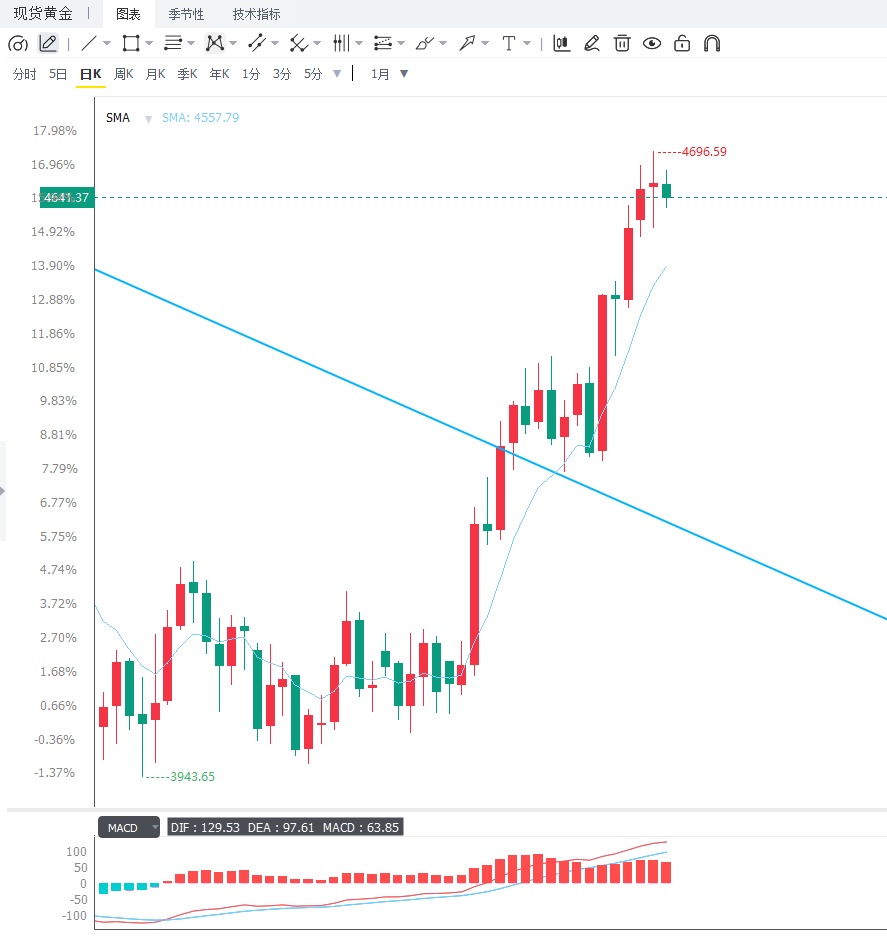 Editor's Summary: Gold's breakout above $4670 was primarily driven by the US Treasury's expanded long-term Treasury bond repurchase programs, a weakening dollar, and declining long-term US Treasury yields. As funds reassessed the risks of dollar assets and interest rates, gold saw significant demand. Simultaneously, global energy prices and geopolitical risks provided gold with a long-term safe-haven and inflation hedge. However, current gold prices are clearly at technical highs, with the RSI entering overbought territory, and the market still faces the risk that energy inflation may limit the Federal Reserve's policy easing space. Therefore, $4700-$4725 will be a key watershed for short-term bulls and bears. A successful breakout suggests the trend could extend further to $4750-$4800; a failed breakout could lead to profit-taking at higher levels, potentially pushing gold prices back to retest $4600 or even $4500. In the medium term, as long as the dollar remains weak and long-term US Treasury yields are suppressed, the foundation for gold's rise remains intact. However, if the Federal Reserve re-emerges with hawkish signals, leading to a simultaneous rebound in the dollar and real interest rates, gold may experience a significant period of consolidation. Investors should currently focus on whether gold, US Treasury yields, and the US dollar index continue to move in the same direction, as this will be more decisive in determining the direction of gold prices in the next stage than simply relying on risk aversion.
U.S. Treasury Secretary Scott Bessant previously stated that the Treasury Department might further increase the scale of its Treasury bond repurchase programs to over $4 billion per transaction in the future. The Treasury had already announced a doubling of its long-term Treasury bond repurchase program, with a focus on longer-term securities. The market's direct reaction was downward pressure on long-term U.S. Treasury yields, with some short positions previously betting on further yield increases being covered, leading to a significant rise in bond prices. As yields decline, the opportunity cost of gold relative to interest-bearing assets decreases, creating favorable conditions for a rapid rise in gold prices. From the perspective of the US dollar, the recent continuous decline in the dollar index has further amplified the rise in gold prices. Gold is priced in dollars; when the dollar weakens, the relative cost for investors holding other currencies to buy gold decreases, typically increasing international demand for gold. At the same time, the decline in long-term U.S. Treasury yields signifies a repricing of the U.S. long-term interest rate path and fiscal financing environment, with some funds being reallocated to non-yielding assets such as gold. However, the current rise in gold prices also faces significant fundamental contradictions. On the one hand, the US Treasury's buyback program and a weakening dollar provide financial support for gold; on the other hand, the global energy market and the situation in the Middle East may still transmit to inflation through energy prices. If energy prices remain high, US inflationary pressures may resurface, limiting the Fed's room for future interest rate cuts and even increasing market repricing of the risk of subsequent rate hikes. This logic is particularly important for gold. Gold possesses anti-inflation and safe-haven attributes, but it does not generate interest income. When market interest rates are high, the opportunity cost of holding gold increases accordingly. Therefore, if rising energy prices ultimately lead to a significant increase in US inflation expectations and push US Treasury yields higher again, gold's current upward trend may encounter a temporary headwind. The market is also currently focused on Fed Chairman Kevin Warsh's speech at the Jackson Hole Economic Symposium. As market expectations for the future interest rate path are readjusted, the policy statements of Fed officials may become an important catalyst for the next stage of gold's movement. If the policy rhetoric is clearly hawkish, the market may quickly increase its expectations for the duration of the higher interest rate environment, and a rebound in the US dollar and US Treasury yields will put downward pressure on gold. Conversely, if the policy stance is relatively dovish, it may further strengthen market expectations for future interest rate declines, opening up new upside potential for gold. From a funding perspective, the recent rapid rise in gold also exhibits clear short-covering characteristics. When the US dollar and US Treasury yields weaken simultaneously, previously established short positions in gold face stop-loss pressure, forcing some investors to cover their positions, thus further amplifying the speed of the gold price increase. Therefore, the current rise in gold prices reflects both fundamental fund reallocation and significant position adjustment factors. This means that if the US dollar or US Treasury yields move in opposite directions, the short-term pullback in gold may be greater than normal. TD Securities has recently maintained a relatively cautious attitude towards gold's performance. The institution believes that with the market still pricing in the risk of future interest rate increases and potential inflationary pressures in the energy market, the current rise in gold may be slightly premature. In other words, although gold has re-entered a strong zone, a clearer macroeconomic policy environment is still needed before it can challenge historical highs again. From a global asset allocation perspective, gold remains highly attractive. The US fiscal deficit, the size of long-term debt, uncertainty surrounding the global interest rate path, and geopolitical risks collectively constitute the long-term allocation logic for gold. Especially given the sharp fluctuations in long-term US Treasury yields, some investors may view gold as an important tool for mitigating portfolio interest rate risk. However, if US inflation rises significantly again in the future, gold's real yield advantage may be compressed. Therefore, investors need to pay attention to the US dollar, US Treasury yields, and energy prices simultaneously, rather than solely relying on safe-haven sentiment to determine gold price direction. From a daily chart perspective, spot gold continues its clear bullish trend, with prices firmly above the 100-day moving average and the Bollinger Band's middle line, maintaining a complete short-to-medium-term trend structure. With gold prices rapidly rising to around $4670, they have entered the upper half of the Bollinger Bands and are beginning to approach the upper band, indicating a significant increase in bullish momentum. Meanwhile, the 14-day RSI has risen to approximately 73, entering overbought territory, suggesting that while the current rise is strong, the short-term technical picture has become somewhat overheated. The first resistance level to watch is the upper Bollinger Band at around $4725. If the daily candlestick closes above this level, it could open up further upside potential to $4750 or even $4800. However, if consecutive attempts to break through $4725 fail, increased profit-taking should be anticipated. On the downside, the first support level to watch is the psychological level of $4600. If gold prices fall back to this area and find buying support, the bullish structure remains largely intact. A more significant medium-term support level lies near the 100-day moving average at $4380, followed by the middle Bollinger Band at around $4340. In the event of a deeper correction, the lower Bollinger Band around $3955 would provide further technical support in the longer term. Overall, the daily trend remains bullish, but the overbought RSI indicates increasing risk of chasing the rally. Future price action will depend more on the validity of breakouts rather than simply focusing on intraday highs. From a 4-hour chart perspective, gold is currently in a short-term accelerated upward trend. After breaking through previous highs consecutively, the bulls' control has clearly strengthened, but the rapid rise has also widened the divergence between the moving averages and the price. If the price can firmly hold above $4670 and further break through the $4700-$4725 area, the 4-hour chart is expected to maintain its upward channel, with the next targets gradually shifting towards $4750 and $4800. Conversely, if the price falls below $4600 after the initial surge, a short-term technical correction may occur, first retracing to around $4550, and then further testing the psychological level of $4500. With the current RSI significantly high, gold is more likely to exhibit a pattern of "strong rise – high-level consolidation – re-selection of direction," therefore, a pullback does not necessarily indicate an immediate trend reversal. Editor's Summary: Gold's breakout above $4670 was primarily driven by the US Treasury's expanded long-term Treasury bond repurchase programs, a weakening dollar, and declining long-term US Treasury yields. As funds reassessed the risks of dollar assets and interest rates, gold saw significant demand. Simultaneously, global energy prices and geopolitical risks provided gold with a long-term safe-haven and inflation hedge. However, current gold prices are clearly at technical highs, with the RSI entering overbought territory, and the market still faces the risk that energy inflation may limit the Federal Reserve's policy easing space. Therefore, $4700-$4725 will be a key watershed for short-term bulls and bears. A successful breakout suggests the trend could extend further to $4750-$4800; a failed breakout could lead to profit-taking at higher levels, potentially pushing gold prices back to retest $4600 or even $4500. In the medium term, as long as the dollar remains weak and long-term US Treasury yields are suppressed, the foundation for gold's rise remains intact. However, if the Federal Reserve re-emerges with hawkish signals, leading to a simultaneous rebound in the dollar and real interest rates, gold may experience a significant period of consolidation. Investors should currently focus on whether gold, US Treasury yields, and the US dollar index continue to move in the same direction, as this will be more decisive in determining the direction of gold prices in the next stage than simply relying on risk aversion.
- Risk Warning and Disclaimer
- The market involves risk, and trading may not be suitable for all investors. This article is for reference only and does not constitute personal investment advice, nor does it take into account certain users’ specific investment objectives, financial situation, or other needs. Any investment decisions made based on this information are at your own risk.