With US inflation and Federal Reserve policy signals looming, the pound fell against the dollar but remained near a six-month high.
2026-08-26 14:35:01
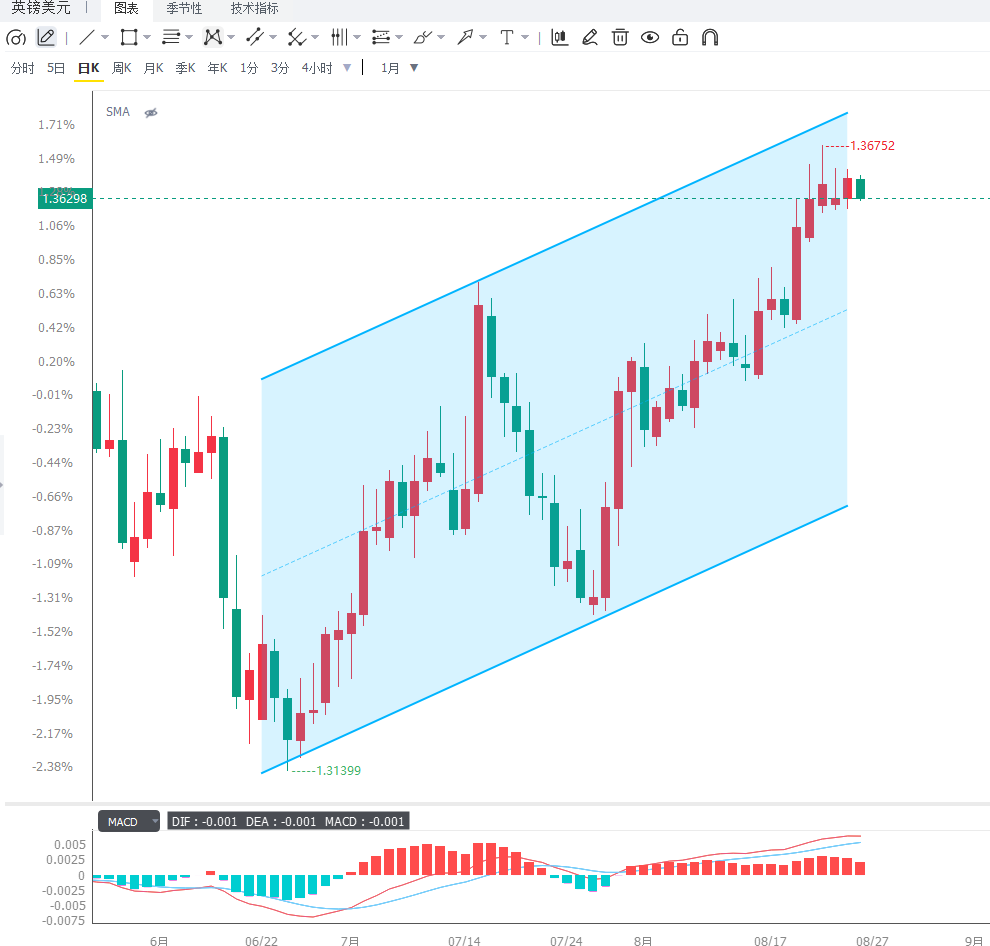
The pound/dollar pair saw a slight pullback in early Asian trading on Wednesday, trading around 1.3630, retreating from the previous day's high but still near its highest level in the past six months. Currently, there are no clear signs of a trend reversal, with investors primarily adjusting positions ahead of key US inflation data releases. The US July PCE data and Federal Reserve Chairman Kevin Warsh's speech at the Jackson Hole symposium will be key variables determining the next direction of the pound/dollar pair.  Recent US macroeconomic data has released relatively complex signals, but overall it has lowered market expectations for further tightening by the Federal Reserve in the short term. Easing inflationary pressures in the US and a less robust labor market have led the market to gradually shift towards a scenario where the Fed maintains its policy rate at its September 15-16 meeting. This shift in interest rate expectations directly impacts the dollar's performance. As the market reduces its bets on a short-term US rate hike, US Treasury yields are under pressure, and the dollar's interest rate advantage is diminishing. In particular, after the US Treasury expanded its long-term Treasury repurchase operations, the market further reassessed the supply and demand relationship for long-term US Treasuries, putting downward pressure on long-term yields and thus exerting additional downward pressure on the dollar. The market is also currently focused on the possibility that the US Treasury may use its nearly $1 trillion fiscal account balance to fund further long-term Treasury repurchase operations. If this operation continues, it may alleviate long-term Treasury supply pressure in the short term, but it could also lower long-term yields. For GBP/USD, as long as US yields cannot rise rapidly again, the dollar will struggle to form a sustained upward trend. Meanwhile, the Fed's policy communication itself has also become a focus of market attention. DBS Bank analysts believe that recent changes in US yields have exposed gaps in the Federal Reserve's policy communication. The market needs a clearer understanding of how future policy will guide interest rate expectations and to what extent the Fed can tolerate a rise in long-term yields. If policy communication continues to lack clarity, the dollar may face additional pressure on confidence. US PCE data is therefore of high importance. If core PCE continues to cool, the market may further weaken its bets on rising US interest rates, and both US Treasury yields and the dollar may come under pressure, giving GBP/USD a chance to break through the 1.3660-1.3665 range. Conversely, if core inflation is significantly higher than expected, it may push interest rate expectations higher again, and a dollar rebound will put short-term pressure on the pound. Changes in energy prices are also altering US inflation expectations. Recently, international crude oil prices have fallen to near two-week lows, mainly due to expectations of a resumption of commercial shipping in the Strait of Hormuz and progress in US-Iran diplomacy. Lower energy prices mean that future US inflationary pressures may ease further, thus reducing market demand for the Fed to maintain high interest rates. However, the impact of lower energy prices on GBP/USD is not entirely one-sided. A decline in crude oil prices typically helps reduce global inflation risks, thus supporting risk assets. However, if the market interprets the drop in oil prices as a signal of weak global demand, it could weaken overall risk appetite and indirectly increase demand for the US dollar as a safe haven. Therefore, whether the pound can continue to strengthen depends on how the market interprets changes in energy prices. Geopolitical risks remain a significant variable in the short-term movement of the US dollar. Recent resumption of negotiations regarding shipping arrangements in the Strait of Hormuz has eased market concerns about energy transportation risks. If related diplomatic progress continues, demand for the US dollar as a safe haven may decrease, further improving the external environment for GBP/USD. However, if the situation deteriorates again, demand for the US dollar as a traditional safe-haven asset could rebound rapidly, limiting the pound's upside potential. From the perspective of the UK's own fundamentals, the pound is currently supported more by the US dollar than by a significant acceleration in UK economic growth. Therefore, the current rise in GBP/USD has certain characteristics of a "weak dollar trade." If future US data strengthens the dollar again while UK economic data does not improve simultaneously, the pound may quickly give back its previous gains. Overall, GBP/USD currently maintains a bullish structure but has entered a phase of macroeconomic data verification. The biggest risk for bulls at present is not the technical structure itself, but whether the US PCE and the Fed's policy statements will push up expectations for dollar interest rates again. From the daily chart, GBP/USD maintains a clear bullish trend, with the price trading above major medium-term moving averages, and recent highs and lows continuing to rise. However, the exchange rate is currently approaching the 1.3660-1.3665 supply zone, which is a key resistance area in the short-term battle between bulls and bears. If the daily chart can effectively break through and hold above 1.3665, the upside potential may open further, with the next targets at 1.3700 and 1.3750, and in a strong scenario, testing the vicinity of 1.3800. Conversely, if repeated attempts to break through this area fail, profit-taking at higher levels may increase, and the exchange rate may fall back to around 1.3600. The first support level to watch is the 1.3600 psychological level; if this level is breached, the short-term correction may extend further to the 1.3550-1.3560 area. If this area also fails to provide effective support, GBP/USD may seek new buying opportunities near 1.3500. The current technical structure remains bullish, so until a break below 1.3550, it's more appropriate to interpret any pullback as a correction within an uptrend rather than an immediate confirmation of a medium-term reversal. From a 4-hour perspective, the short-term bullish pattern for GBP/USD remains intact, but the price is facing significant resistance in the 1.3660-1.3665 area, and short-term momentum has slowed. If the exchange rate breaks above 1.3665 and holds above it, the bulls are expected to regain momentum, initially targeting 1.3700, with further focus on 1.3750. However, if the rally fails and breaks below 1.3600, the 4-hour correction pressure will increase significantly, and the price may retrace to the 1.3550 area. Therefore, 1.3665 is currently the most important directional confirmation level; a break above it signifies a continuation of the trend, while resistance suggests increased risk of high-level consolidation and a pullback.
  Editor's Summary: The GBP/USD pair remains in a relatively strong position, but the recent rise has been primarily driven by a weaker dollar, rather than a significant improvement in UK fundamentals. Cooling US inflation, declining US Treasury yields, and expectations that the Fed will maintain interest rates in September have provided a favorable external environment for the pound. Meanwhile, falling oil prices and reduced shipping risks in the Strait of Hormuz have also reduced some demand for the dollar as a safe haven. In the short term, 1.3660-1.3665 is a key area for whether GBP/USD can open up further upside potential. If US PCE is lower than expected and the Fed releases dovish signals, the pair could move towards 1.37 and 1.3750 after breaking through this area. If PCE shows renewed inflation stickiness, or the Fed releases hawkish signals, a dollar rebound could push GBP/USD back to 1.36 and 1.3550. Overall, the current GBP/USD pair is near a six-month high, and the risk of chasing the rally has increased significantly. Going forward, key factors to watch include US PCE, US Treasury yields, the dollar index, and the Jackson Hole policy signals, as these will determine whether the current strong performance of the pound can continue.
Recent US macroeconomic data has released relatively complex signals, but overall it has lowered market expectations for further tightening by the Federal Reserve in the short term. Easing inflationary pressures in the US and a less robust labor market have led the market to gradually shift towards a scenario where the Fed maintains its policy rate at its September 15-16 meeting. This shift in interest rate expectations directly impacts the dollar's performance. As the market reduces its bets on a short-term US rate hike, US Treasury yields are under pressure, and the dollar's interest rate advantage is diminishing. In particular, after the US Treasury expanded its long-term Treasury repurchase operations, the market further reassessed the supply and demand relationship for long-term US Treasuries, putting downward pressure on long-term yields and thus exerting additional downward pressure on the dollar. The market is also currently focused on the possibility that the US Treasury may use its nearly $1 trillion fiscal account balance to fund further long-term Treasury repurchase operations. If this operation continues, it may alleviate long-term Treasury supply pressure in the short term, but it could also lower long-term yields. For GBP/USD, as long as US yields cannot rise rapidly again, the dollar will struggle to form a sustained upward trend. Meanwhile, the Fed's policy communication itself has also become a focus of market attention. DBS Bank analysts believe that recent changes in US yields have exposed gaps in the Federal Reserve's policy communication. The market needs a clearer understanding of how future policy will guide interest rate expectations and to what extent the Fed can tolerate a rise in long-term yields. If policy communication continues to lack clarity, the dollar may face additional pressure on confidence. US PCE data is therefore of high importance. If core PCE continues to cool, the market may further weaken its bets on rising US interest rates, and both US Treasury yields and the dollar may come under pressure, giving GBP/USD a chance to break through the 1.3660-1.3665 range. Conversely, if core inflation is significantly higher than expected, it may push interest rate expectations higher again, and a dollar rebound will put short-term pressure on the pound. Changes in energy prices are also altering US inflation expectations. Recently, international crude oil prices have fallen to near two-week lows, mainly due to expectations of a resumption of commercial shipping in the Strait of Hormuz and progress in US-Iran diplomacy. Lower energy prices mean that future US inflationary pressures may ease further, thus reducing market demand for the Fed to maintain high interest rates. However, the impact of lower energy prices on GBP/USD is not entirely one-sided. A decline in crude oil prices typically helps reduce global inflation risks, thus supporting risk assets. However, if the market interprets the drop in oil prices as a signal of weak global demand, it could weaken overall risk appetite and indirectly increase demand for the US dollar as a safe haven. Therefore, whether the pound can continue to strengthen depends on how the market interprets changes in energy prices. Geopolitical risks remain a significant variable in the short-term movement of the US dollar. Recent resumption of negotiations regarding shipping arrangements in the Strait of Hormuz has eased market concerns about energy transportation risks. If related diplomatic progress continues, demand for the US dollar as a safe haven may decrease, further improving the external environment for GBP/USD. However, if the situation deteriorates again, demand for the US dollar as a traditional safe-haven asset could rebound rapidly, limiting the pound's upside potential. From the perspective of the UK's own fundamentals, the pound is currently supported more by the US dollar than by a significant acceleration in UK economic growth. Therefore, the current rise in GBP/USD has certain characteristics of a "weak dollar trade." If future US data strengthens the dollar again while UK economic data does not improve simultaneously, the pound may quickly give back its previous gains. Overall, GBP/USD currently maintains a bullish structure but has entered a phase of macroeconomic data verification. The biggest risk for bulls at present is not the technical structure itself, but whether the US PCE and the Fed's policy statements will push up expectations for dollar interest rates again. From the daily chart, GBP/USD maintains a clear bullish trend, with the price trading above major medium-term moving averages, and recent highs and lows continuing to rise. However, the exchange rate is currently approaching the 1.3660-1.3665 supply zone, which is a key resistance area in the short-term battle between bulls and bears. If the daily chart can effectively break through and hold above 1.3665, the upside potential may open further, with the next targets at 1.3700 and 1.3750, and in a strong scenario, testing the vicinity of 1.3800. Conversely, if repeated attempts to break through this area fail, profit-taking at higher levels may increase, and the exchange rate may fall back to around 1.3600. The first support level to watch is the 1.3600 psychological level; if this level is breached, the short-term correction may extend further to the 1.3550-1.3560 area. If this area also fails to provide effective support, GBP/USD may seek new buying opportunities near 1.3500. The current technical structure remains bullish, so until a break below 1.3550, it's more appropriate to interpret any pullback as a correction within an uptrend rather than an immediate confirmation of a medium-term reversal. From a 4-hour perspective, the short-term bullish pattern for GBP/USD remains intact, but the price is facing significant resistance in the 1.3660-1.3665 area, and short-term momentum has slowed. If the exchange rate breaks above 1.3665 and holds above it, the bulls are expected to regain momentum, initially targeting 1.3700, with further focus on 1.3750. However, if the rally fails and breaks below 1.3600, the 4-hour correction pressure will increase significantly, and the price may retrace to the 1.3550 area. Therefore, 1.3665 is currently the most important directional confirmation level; a break above it signifies a continuation of the trend, while resistance suggests increased risk of high-level consolidation and a pullback. Editor's Summary: The GBP/USD pair remains in a relatively strong position, but the recent rise has been primarily driven by a weaker dollar, rather than a significant improvement in UK fundamentals. Cooling US inflation, declining US Treasury yields, and expectations that the Fed will maintain interest rates in September have provided a favorable external environment for the pound. Meanwhile, falling oil prices and reduced shipping risks in the Strait of Hormuz have also reduced some demand for the dollar as a safe haven. In the short term, 1.3660-1.3665 is a key area for whether GBP/USD can open up further upside potential. If US PCE is lower than expected and the Fed releases dovish signals, the pair could move towards 1.37 and 1.3750 after breaking through this area. If PCE shows renewed inflation stickiness, or the Fed releases hawkish signals, a dollar rebound could push GBP/USD back to 1.36 and 1.3550. Overall, the current GBP/USD pair is near a six-month high, and the risk of chasing the rally has increased significantly. Going forward, key factors to watch include US PCE, US Treasury yields, the dollar index, and the Jackson Hole policy signals, as these will determine whether the current strong performance of the pound can continue.
- Risk Warning and Disclaimer
- The market involves risk, and trading may not be suitable for all investors. This article is for reference only and does not constitute personal investment advice, nor does it take into account certain users’ specific investment objectives, financial situation, or other needs. Any investment decisions made based on this information are at your own risk.