The US dollar index remained range-bound, while the USD/JPY pair retreated pending guidance from the PCE.
2026-08-26 14:39:01
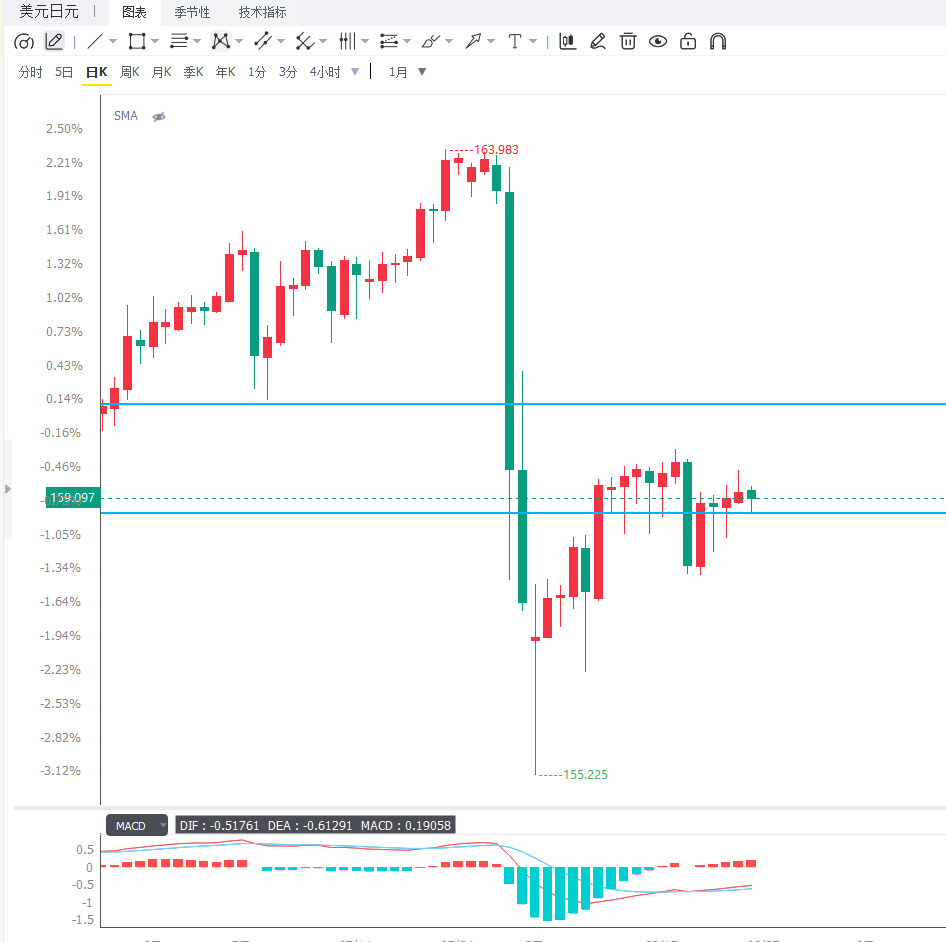
The USD/JPY pair retreated to around 159 during Asian trading on Wednesday, weakening from its previous highs. The market is currently readjusting positions primarily in two directions: firstly, the US Treasury's expanded long-term Treasury repurchase operations are putting downward pressure on long-term US yields, diminishing the dollar's interest rate advantage; secondly, rising expectations of further tightening by the Bank of Japan are providing new fundamental support for the yen.  U.S. Treasury Secretary Scott Bessant previously stated that the Treasury would increase the size of its Treasury bond repurchase operations to at least $4 billion per transaction, up from the previous $2 billion limit, in order to alleviate the problem of rapidly rising long-term financing costs. The market subsequently began to focus on whether the Treasury would utilize its nearly $1 trillion fiscal account balance to provide funding for expanding long-term Treasury bond repurchases. From a bond market perspective, long-term Treasury bond repurchases can improve the supply and demand relationship for specific maturities and may lower long-term yields. If this trend continues, the yield advantage between the U.S. and Japan may narrow marginally, naturally putting downward pressure on the USD/JPY exchange rate. The convergence of lower U.S. long-term yields and rising expectations of interest rate hikes in Japan is the core driver of the current decline in USD/JPY. Meanwhile, the U.S. fiscal situation remains a medium-term variable for the dollar. With U.S. government debt exceeding $40 trillion, market attention to long-term fiscal sustainability continues to rise. While Treasury bond repurchases can alleviate some pressure on the bond market, they cannot fundamentally change the trend of fiscal deficit and debt expansion. Therefore, the recent rebound in the dollar remains susceptible to changes in long-term interest rates and expectations of fiscal policy. Regarding Japan, market judgments on the Bank of Japan's future policy path are changing. The Bank of Japan (BOJ) confirmed on Wednesday that Governor Kazuo Ueda will be unable to attend this week's Jackson Hole meeting due to a scheduling conflict, and will be represented by BOJ policy board member Naoki Tamura. While Ueda's absence does not necessarily indicate a change in Japan's policy stance, the market will pay closer attention to statements from other BOJ officials regarding the future path of interest rates. Expectations for a rate hike at the BOJ's September 18 meeting have clearly intensified. In a market survey, approximately 57% of economists expect the BOJ to raise rates in September, a significant shift from previous surveys; a minority of economists also predict that the BOJ may further raise the policy rate to 1.50% in October or December. This means that the market is no longer solely focused on whether the BOJ will raise rates in September, but is beginning to assess the policy path following such a rate hike. If the BOJ signals a continued tightening of policy, the Japan-US interest rate differential may narrow further, increasing upward pressure on the yen; conversely, if the BOJ emphasizes that subsequent policy still depends on economic and inflation data, the yen's previous appreciation may experience a temporary pause. Scotiabank strategists also pointed out that the market has largely priced in the expectation of a tightening policy from the Bank of Japan in September. Therefore, what truly deserves attention is the policy tone of the Bank of Japan after its September meeting. The strength or weakness of the yen in the next stage may no longer depend entirely on a single rate hike, but rather on whether the Bank of Japan signals a continued path of rate hikes. In the US, the July PCE data has been a significant catalyst for USD/JPY recently. If US inflation continues to cool, the market may further reduce its expectations for the Federal Reserve to maintain high interest rates or even tighten again, potentially leading to a simultaneous weakening of US Treasury yields and the dollar, putting greater pressure on USD/JPY. If the PCE data is higher than expected, the situation may change. A renewed increase in US inflation stickiness could push up US Treasury yields and re-strengthen the dollar's interest rate advantage. In this scenario, even with expectations of a September rate hike by the Bank of Japan, USD/JPY could still experience a rapid rebound. Furthermore, policy communication at the Jackson Hole meeting is also worth noting. Due to the absence of the Bank of Japan governor, market attention to Japanese policy may have decreased, but statements from Federal Reserve officials will still directly influence dollar interest rate expectations. If the Federal Reserve signals a hawkish stance, the USD/JPY interest rate differential could widen again; if the policy stance is dovish, USD/JPY may seek further downside support. From a risk sentiment perspective, USD/JPY remains susceptible to global market volatility. If market risk appetite deteriorates, the yen's traditional safe-haven appeal may be supported; if global risk assets remain strong, the yen may be suppressed by carry trade demand. Therefore, simply observing US and Japanese monetary policies is insufficient to fully judge the exchange rate; global risk appetite is also a crucial variable. From a daily chart perspective, USD/JPY remains bearish in the short term, with the price trading below the 100-day simple moving average, indicating that the previous upward trend is facing significant challenges. Although the exchange rate is still above the 20-day Bollinger Band middle line, it is being suppressed by the upper Bollinger Band, suggesting a technical correction after a large-scale rise rather than a clear re-acceleration. The 100-day moving average, around 160.00, is currently the most important medium-term resistance; a decisive break above 160.00 would target the upper Bollinger Band around 160.30, and further down, a retest of the 161.00 area is possible. The first support level to watch is the 20-day Bollinger Band middle line around 158.75. A decisive break below this level would indicate increased short-term downward pressure, potentially testing the lower Bollinger Band around 157.20. If 157.20 also falls, USD/JPY may seek further support around 156.50. The RSI is currently around 43.64, below the neutral 50 level, indicating limited bullish momentum and that bears retain some control. On the 4-hour chart, USD/JPY is in a slightly weak, oscillating state, with the 159.00 area becoming a battleground between bulls and bears. A break below 158.75 and confirmation of this level could open up further downside potential, with the first target at 158.00, followed by 157.20. If the dollar receives support from interest rate expectations after the data release and the pair regains 159.50, it could potentially test 160.00. Whether 160.00 can be effectively broken will determine whether the current correction has ended, while 158.75 is the key watershed for judging whether the bears can further expand.
  Editor's Summary: The fundamentals for USD/JPY are undergoing significant changes. The US Treasury's expanded long-term Treasury repurchase program is putting pressure on US Treasury yields, weakening the dollar's interest rate advantage. Simultaneously, expectations of a September rate hike by the Bank of Japan are rising significantly, strengthening expectations of a narrowing interest rate differential between Japan and the US, thus supporting the yen. In the short term, the US July PCE data will be a crucial catalyst for the direction of USD/JPY. If inflation cools, US Treasury yields and the dollar may weaken further, with the exchange rate potentially falling below 158.50 and heading towards 157.20. If the PCE is unexpectedly strong, the dollar may regain support, pushing the exchange rate to test 160.00 and 160.30. In the medium term, market focus will gradually shift from whether the Bank of Japan will raise interest rates in September to its subsequent policy path. If the Bank of Japan signals continued tightening while the Federal Reserve's policy tends towards easing, the medium-term downside risk for USD/JPY will further increase. Therefore, the focus should be on the US PCE, US Treasury yields, the Bank of Japan's policy statements, and changes in the Japan-US interest rate differential, as these factors will determine which direction the 158.50-160.00 range will ultimately break through.
U.S. Treasury Secretary Scott Bessant previously stated that the Treasury would increase the size of its Treasury bond repurchase operations to at least $4 billion per transaction, up from the previous $2 billion limit, in order to alleviate the problem of rapidly rising long-term financing costs. The market subsequently began to focus on whether the Treasury would utilize its nearly $1 trillion fiscal account balance to provide funding for expanding long-term Treasury bond repurchases. From a bond market perspective, long-term Treasury bond repurchases can improve the supply and demand relationship for specific maturities and may lower long-term yields. If this trend continues, the yield advantage between the U.S. and Japan may narrow marginally, naturally putting downward pressure on the USD/JPY exchange rate. The convergence of lower U.S. long-term yields and rising expectations of interest rate hikes in Japan is the core driver of the current decline in USD/JPY. Meanwhile, the U.S. fiscal situation remains a medium-term variable for the dollar. With U.S. government debt exceeding $40 trillion, market attention to long-term fiscal sustainability continues to rise. While Treasury bond repurchases can alleviate some pressure on the bond market, they cannot fundamentally change the trend of fiscal deficit and debt expansion. Therefore, the recent rebound in the dollar remains susceptible to changes in long-term interest rates and expectations of fiscal policy. Regarding Japan, market judgments on the Bank of Japan's future policy path are changing. The Bank of Japan (BOJ) confirmed on Wednesday that Governor Kazuo Ueda will be unable to attend this week's Jackson Hole meeting due to a scheduling conflict, and will be represented by BOJ policy board member Naoki Tamura. While Ueda's absence does not necessarily indicate a change in Japan's policy stance, the market will pay closer attention to statements from other BOJ officials regarding the future path of interest rates. Expectations for a rate hike at the BOJ's September 18 meeting have clearly intensified. In a market survey, approximately 57% of economists expect the BOJ to raise rates in September, a significant shift from previous surveys; a minority of economists also predict that the BOJ may further raise the policy rate to 1.50% in October or December. This means that the market is no longer solely focused on whether the BOJ will raise rates in September, but is beginning to assess the policy path following such a rate hike. If the BOJ signals a continued tightening of policy, the Japan-US interest rate differential may narrow further, increasing upward pressure on the yen; conversely, if the BOJ emphasizes that subsequent policy still depends on economic and inflation data, the yen's previous appreciation may experience a temporary pause. Scotiabank strategists also pointed out that the market has largely priced in the expectation of a tightening policy from the Bank of Japan in September. Therefore, what truly deserves attention is the policy tone of the Bank of Japan after its September meeting. The strength or weakness of the yen in the next stage may no longer depend entirely on a single rate hike, but rather on whether the Bank of Japan signals a continued path of rate hikes. In the US, the July PCE data has been a significant catalyst for USD/JPY recently. If US inflation continues to cool, the market may further reduce its expectations for the Federal Reserve to maintain high interest rates or even tighten again, potentially leading to a simultaneous weakening of US Treasury yields and the dollar, putting greater pressure on USD/JPY. If the PCE data is higher than expected, the situation may change. A renewed increase in US inflation stickiness could push up US Treasury yields and re-strengthen the dollar's interest rate advantage. In this scenario, even with expectations of a September rate hike by the Bank of Japan, USD/JPY could still experience a rapid rebound. Furthermore, policy communication at the Jackson Hole meeting is also worth noting. Due to the absence of the Bank of Japan governor, market attention to Japanese policy may have decreased, but statements from Federal Reserve officials will still directly influence dollar interest rate expectations. If the Federal Reserve signals a hawkish stance, the USD/JPY interest rate differential could widen again; if the policy stance is dovish, USD/JPY may seek further downside support. From a risk sentiment perspective, USD/JPY remains susceptible to global market volatility. If market risk appetite deteriorates, the yen's traditional safe-haven appeal may be supported; if global risk assets remain strong, the yen may be suppressed by carry trade demand. Therefore, simply observing US and Japanese monetary policies is insufficient to fully judge the exchange rate; global risk appetite is also a crucial variable. From a daily chart perspective, USD/JPY remains bearish in the short term, with the price trading below the 100-day simple moving average, indicating that the previous upward trend is facing significant challenges. Although the exchange rate is still above the 20-day Bollinger Band middle line, it is being suppressed by the upper Bollinger Band, suggesting a technical correction after a large-scale rise rather than a clear re-acceleration. The 100-day moving average, around 160.00, is currently the most important medium-term resistance; a decisive break above 160.00 would target the upper Bollinger Band around 160.30, and further down, a retest of the 161.00 area is possible. The first support level to watch is the 20-day Bollinger Band middle line around 158.75. A decisive break below this level would indicate increased short-term downward pressure, potentially testing the lower Bollinger Band around 157.20. If 157.20 also falls, USD/JPY may seek further support around 156.50. The RSI is currently around 43.64, below the neutral 50 level, indicating limited bullish momentum and that bears retain some control. On the 4-hour chart, USD/JPY is in a slightly weak, oscillating state, with the 159.00 area becoming a battleground between bulls and bears. A break below 158.75 and confirmation of this level could open up further downside potential, with the first target at 158.00, followed by 157.20. If the dollar receives support from interest rate expectations after the data release and the pair regains 159.50, it could potentially test 160.00. Whether 160.00 can be effectively broken will determine whether the current correction has ended, while 158.75 is the key watershed for judging whether the bears can further expand. Editor's Summary: The fundamentals for USD/JPY are undergoing significant changes. The US Treasury's expanded long-term Treasury repurchase program is putting pressure on US Treasury yields, weakening the dollar's interest rate advantage. Simultaneously, expectations of a September rate hike by the Bank of Japan are rising significantly, strengthening expectations of a narrowing interest rate differential between Japan and the US, thus supporting the yen. In the short term, the US July PCE data will be a crucial catalyst for the direction of USD/JPY. If inflation cools, US Treasury yields and the dollar may weaken further, with the exchange rate potentially falling below 158.50 and heading towards 157.20. If the PCE is unexpectedly strong, the dollar may regain support, pushing the exchange rate to test 160.00 and 160.30. In the medium term, market focus will gradually shift from whether the Bank of Japan will raise interest rates in September to its subsequent policy path. If the Bank of Japan signals continued tightening while the Federal Reserve's policy tends towards easing, the medium-term downside risk for USD/JPY will further increase. Therefore, the focus should be on the US PCE, US Treasury yields, the Bank of Japan's policy statements, and changes in the Japan-US interest rate differential, as these factors will determine which direction the 158.50-160.00 range will ultimately break through.
- Risk Warning and Disclaimer
- The market involves risk, and trading may not be suitable for all investors. This article is for reference only and does not constitute personal investment advice, nor does it take into account certain users’ specific investment objectives, financial situation, or other needs. Any investment decisions made based on this information are at your own risk.