Schnabel's statement sends a key signal: the logic behind euro trading is undergoing a profound change.
2026-08-26 16:23:01
On Wednesday, August 26, the core of pricing in the euro market is shifting from a single energy shock to a second round of inflation risks comprised of energy prices, services inflation, wage transmission, and economic resilience. European Central Bank Executive Board member Isabel Schnabel recently stated that policy cannot wait until inflation clearly transmits to wages and broader prices before taking action, emphasizing that inflation may remain above the 2% target for an extended period. Meanwhile, the eurozone's Harmonized Index of Consumer Prices (HICP) rose to 2.9% year-on-year in July, up from 2.8% in June, with energy prices rising 10.0% year-on-year and services prices rising 3.3%, indicating that current inflation is no longer solely driven by energy. The significance of Schnabel's speech lies not in reiterating concern about inflation, but in shifting the policy judgment criteria further upstream. The so-called second round effect refers to the cycle where rising energy, transportation, and production costs lead to companies raising prices to maintain profit margins, while workers compensate for the loss of purchasing power through wage negotiations, ultimately creating a mutually reinforcing cycle between prices and wages. The ECB's current challenge is that while overall inflation reached 2.9% in July, inflation excluding energy was approximately 2.2% year-on-year. This means that energy remains a significant source of this round of reflation, but the 3.3% growth in service prices suggests that price pressures have a basis for spreading to sticky items.  Schnabel recently emphasized that action cannot wait until wages show a significant second-round reaction before taking action, as there is a time lag in the transmission of monetary policy to financing costs, demand, and wage negotiations. This statement essentially indicates that the ECB is increasing the weighting of leading inflation indicators, rather than reacting solely to already published core inflation. The natural gas market is an unavoidable variable in current policy discussions. European benchmark natural gas prices recently rose to over €65 per megawatt-hour, reaching their highest level since March, with a cumulative increase of over 130% since 2026. As of this week, European natural gas inventory levels are around 63%, significantly lower than the five-year average of around 80% for the same period, thus increasing winter restocking pressure. The impact of rising energy prices on monetary policy has two phases. The first phase mechanically pushes up residential energy bills and transportation costs; the second phase, which is more sensitive for the ECB, involves businesses passing on costs to goods and services prices, while workers demand wage compensation. It is worth noting that the EU's goods trade deficit reached €21.8 billion in the second quarter, with the energy product deficit widening to €101.1 billion from €71.3 billion in the first quarter. This indicates that high energy costs are not only affecting consumer prices but are also re-influencing Europe's external balance of payments and corporate cost structures. Therefore, natural gas prices themselves cannot mechanically determine interest rates, but if high energy costs persist for an extended period, their policy implications will gradually shift from short-term price shocks to medium-term inflation sustainability issues. Unlike typical energy shock periods, the Eurozone economy has not currently experienced a significant contraction. Latest data shows that Eurozone GDP grew by 0.4% quarter-on-quarter and 1.0% year-on-year in the second quarter, while the economy essentially stagnated in the first quarter. Employment increased by 0.1% quarter-on-quarter and 0.5% year-on-year during the same period. This data is crucial for monetary policy. If high inflation is accompanied by a significant economic contraction, the ECB must better balance price stability with growth risks; however, with economic activity regaining momentum, the demand side's ability to bear higher financing costs is relatively increased. The ECB's current deposit facility rate is 2.25%, and the main refinancing rate is 2.40%. The market has recently refocused its assessment of the September meeting, with the money market pricing in further tightening this year by more than 40 basis points, making a policy rate adjustment in September highly probable. It is important to emphasize that this market pricing reflects a probabilistic view of the policy path and does not imply a pre-commitment by the ECB to subsequent actions. Schnabel also stressed that the magnitude of policy adjustments still depends on subsequent data. The daily chart shows that the euro/dollar exchange rate is currently fluctuating around 1.167. The exchange rate previously broke away from the Bollinger Band's middle band and entered the upper half of the band, with the middle band continuing to rise.
 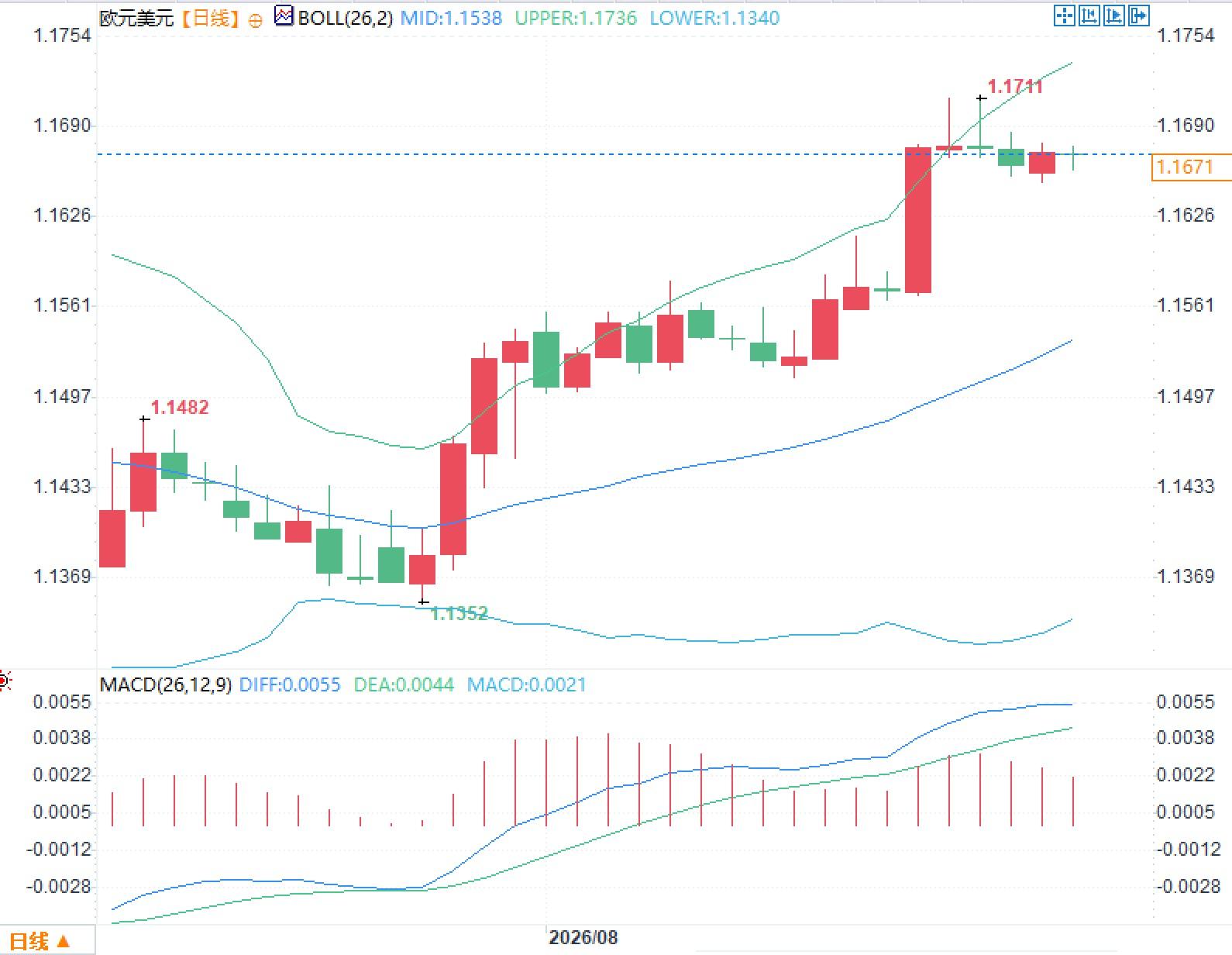 Regarding the MACD, the DIFF line remains above the DEA line, and both curves are above the zero axis, but the histogram has narrowed compared to previous highs. This combination does not reflect a simple bullish or bearish conclusion, but rather a divergence between trend strength and marginal momentum. In other words, the price structure still retains the inertia formed during the previous upward phase, but the speed at which short-term funds chase prices has slowed.
Schnabel recently emphasized that action cannot wait until wages show a significant second-round reaction before taking action, as there is a time lag in the transmission of monetary policy to financing costs, demand, and wage negotiations. This statement essentially indicates that the ECB is increasing the weighting of leading inflation indicators, rather than reacting solely to already published core inflation. The natural gas market is an unavoidable variable in current policy discussions. European benchmark natural gas prices recently rose to over €65 per megawatt-hour, reaching their highest level since March, with a cumulative increase of over 130% since 2026. As of this week, European natural gas inventory levels are around 63%, significantly lower than the five-year average of around 80% for the same period, thus increasing winter restocking pressure. The impact of rising energy prices on monetary policy has two phases. The first phase mechanically pushes up residential energy bills and transportation costs; the second phase, which is more sensitive for the ECB, involves businesses passing on costs to goods and services prices, while workers demand wage compensation. It is worth noting that the EU's goods trade deficit reached €21.8 billion in the second quarter, with the energy product deficit widening to €101.1 billion from €71.3 billion in the first quarter. This indicates that high energy costs are not only affecting consumer prices but are also re-influencing Europe's external balance of payments and corporate cost structures. Therefore, natural gas prices themselves cannot mechanically determine interest rates, but if high energy costs persist for an extended period, their policy implications will gradually shift from short-term price shocks to medium-term inflation sustainability issues. Unlike typical energy shock periods, the Eurozone economy has not currently experienced a significant contraction. Latest data shows that Eurozone GDP grew by 0.4% quarter-on-quarter and 1.0% year-on-year in the second quarter, while the economy essentially stagnated in the first quarter. Employment increased by 0.1% quarter-on-quarter and 0.5% year-on-year during the same period. This data is crucial for monetary policy. If high inflation is accompanied by a significant economic contraction, the ECB must better balance price stability with growth risks; however, with economic activity regaining momentum, the demand side's ability to bear higher financing costs is relatively increased. The ECB's current deposit facility rate is 2.25%, and the main refinancing rate is 2.40%. The market has recently refocused its assessment of the September meeting, with the money market pricing in further tightening this year by more than 40 basis points, making a policy rate adjustment in September highly probable. It is important to emphasize that this market pricing reflects a probabilistic view of the policy path and does not imply a pre-commitment by the ECB to subsequent actions. Schnabel also stressed that the magnitude of policy adjustments still depends on subsequent data. The daily chart shows that the euro/dollar exchange rate is currently fluctuating around 1.167. The exchange rate previously broke away from the Bollinger Band's middle band and entered the upper half of the band, with the middle band continuing to rise. Regarding the MACD, the DIFF line remains above the DEA line, and both curves are above the zero axis, but the histogram has narrowed compared to previous highs. This combination does not reflect a simple bullish or bearish conclusion, but rather a divergence between trend strength and marginal momentum. In other words, the price structure still retains the inertia formed during the previous upward phase, but the speed at which short-term funds chase prices has slowed.
- Risk Warning and Disclaimer
- The market involves risk, and trading may not be suitable for all investors. This article is for reference only and does not constitute personal investment advice, nor does it take into account certain users’ specific investment objectives, financial situation, or other needs. Any investment decisions made based on this information are at your own risk.