Iraq and Afghanistan reach agreement on opening the Strait of Hormuz; oil prices weaken as they closely watch how the US will respond.
2026-08-26 16:21:00
On Wednesday (August 26), during the Asian and European sessions, international oil prices continued to decline. Currently, WTI crude oil futures are holding onto their 4.5% loss from Tuesday, trading around 80.30, down 2.51%. Iran and Oman reached an understanding on a temporary shipping route, which is undoubtedly beneficial for navigation if the US does not interfere. Previous articles have assumed that rising oil prices are very unfavorable to the US, meaning that when oil prices fall, the US is unlikely to take any extra action; instead, it is Iran that is anxious. Therefore, with oil prices currently falling, the main focus is on subsequent actions by Iran and the US response; that is, during periods of falling oil prices, it is even more important to pay attention to Iran's statements. 
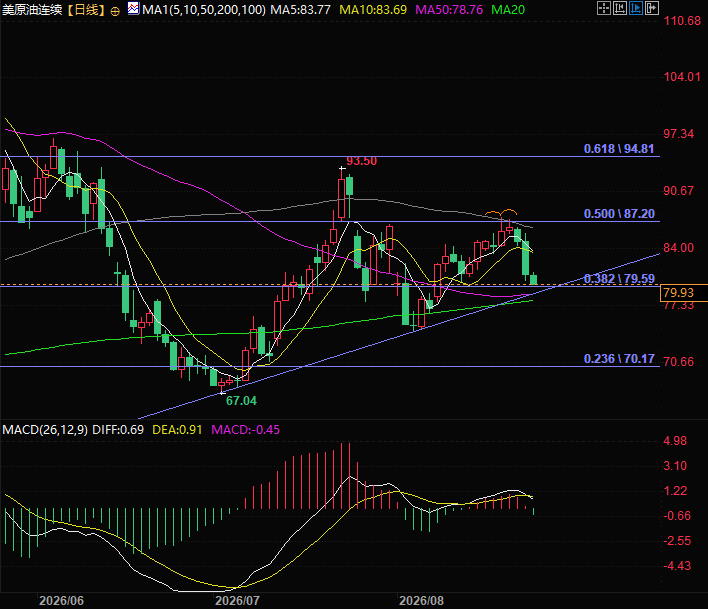 (WTI crude oil futures daily chart, source: EasyTrade) At 16:18 Beijing time, WTI crude oil futures were trading at $80.25 per barrel.
Iran and Oman reach an understanding on opening up shipping routes, but there are still hurdles to overcome before the temporary merchant shipping corridor is officially established.
Shipping through the Strait of Hormuz has recently seen progress in bilateral diplomacy, with Oman's Foreign Minister visiting Iran and the two countries reaching an understanding on a temporary joint maritime corridor. According to the consensus, routes entering the Persian Gulf pass through Iranian waters, while routes leaving the Persian Gulf pass through the waters of both Iran and Oman. It is important to note that this understanding does not equate to an immediate full opening of the strait; it is merely a transitional arrangement. Iran and Oman plan to continue negotiations within 30-60 days to discuss a permanent shipping route plan. Back in June, Oman, in conjunction with the International Maritime Organization (IMO), proposed an alternative shipping route. However, this plan was not consulted with Iran beforehand, resulting in a public warning from Iran and subsequent attacks on some vessels passing through the strait, forcing the IMO to suspend the planned passage. Past cases clearly demonstrate that no passage mechanism through the Strait of Hormuz can bypass the sovereign coastal state of Iran.Iran has drawn a hard line for reopening the Straits, but the maritime military risks have not been eliminated.
Iran has clearly stated the preconditions for the normal reopening of the Strait of Hormuz: a complete end to all fighting, including on the Lebanese front, lifting of the blockade against Iran, a proper resolution to the Yemen issue, and the full fulfillment of all previous commitments by the United States. The Strait of Hormuz will remain closed unless these conditions are met. Iran refuted the US claim that it had "cleared mines from the strait," characterizing it as propaganda and issuing a strong warning that it would strike US minesweepers that intrude into the area. Even if Iran and Afghanistan reach a temporary framework for merchant ship passage, the risk of accidental clashes at sea remains high. If a maritime conflict occurs between the US and Iran, the newly negotiated temporary passage could be interrupted again at any time.US-Iran standoff escalates: a game of economic strangulation and countermeasures.
Since the start of the US-Israel conflict six months ago, the US has continuously intensified its comprehensive economic pressure on Iran. US Treasury Secretary Bessenter stated that he would completely decouple Iran from the global economic system. A maritime blockade, coupled with escalating secondary sanctions, and the UAE's announcement of severing all trade and financial ties with Iran, further tightened Iran's external space for survival. Under this heavy pressure, domestic economic hardship in Iran has become increasingly apparent. Long queues have formed at gas stations in Tehran, with people worried about rising fuel prices and insufficient fuel supply. Domestic inflation remains in double digits, and the rial exchange rate has repeatedly hit record lows. Although supermarket shelves are still adequately stocked, the purchasing power of ordinary people has shrunk significantly, and the cost of living has risen across the board. Even with such a heavy burden on people's livelihoods, the Iranian leadership has not shown any signs of compromising with US sanctions. Iranian President Pesashkyan publicly stated that he would not yield to external pressure. Holding the Strait of Hormuz as a core bargaining chip, Iran hopes that by controlling the passage through the strait, high oil prices will impact US domestic inflation, influence the political agenda related to the US midterm elections, and force the Trump administration to back down. Market analysts believe the two sides are engaged in a race against time: the US hopes a maritime blockade will wear down Iran and exacerbate internal social conflicts; Iran, on the other hand, is betting that the energy costs of disruptions in the Strait will backfire on the US. However, the outcome remains uncertain.Summary and Technical Analysis:
News of temporary shipping lane negotiations briefly eased extreme market panic regarding a complete oil supply disruption, leading to a temporary price correction. However, the risks are far from over. This temporary arrangement has not yet been implemented and is limited to merchant shipping; regional conflicts and the US-Iran military standoff continue. Iran holds the initiative in opening and closing the Strait of Hormuz; if its demands are not met, it can block the lane again. Analysts estimate that if the Strait of Hormuz remains blocked for an extended period, obstructing the Gulf's oil export routes will directly reshape the global oil supply and demand landscape, pushing up oil prices and exporting inflation worldwide. Currently, the Iran-Afghanistan understanding is merely a technical transitional solution and does not resolve the fundamental contradictions between the US and Iran. For oil trading participants, two key signals need to be monitored: first, whether Iran's preconditions for a ceasefire and lifting the blockade will be met; and second, given the previous US threats against Oman, and the fact that this agreement bypasses the US, what is the US's clear response? Will the US turn a blind eye to the falling oil prices? The US's feedback is a crucial clue as to whether and to what extent it will compromise later. Technical Analysis: WTI crude oil futures are currently still bearish in the short term, with resistance around 83 and support around the 200-day moving average and the upward trend line. (WTI crude oil futures daily chart, source: EasyTrade) At 16:18 Beijing time, WTI crude oil futures were trading at $80.25 per barrel.
- Risk Warning and Disclaimer
- The market involves risk, and trading may not be suitable for all investors. This article is for reference only and does not constitute personal investment advice, nor does it take into account certain users’ specific investment objectives, financial situation, or other needs. Any investment decisions made based on this information are at your own risk.