Gold faces significant resistance; the Jackson Hole meeting may provide key guidance.
2026-08-26 16:37:00
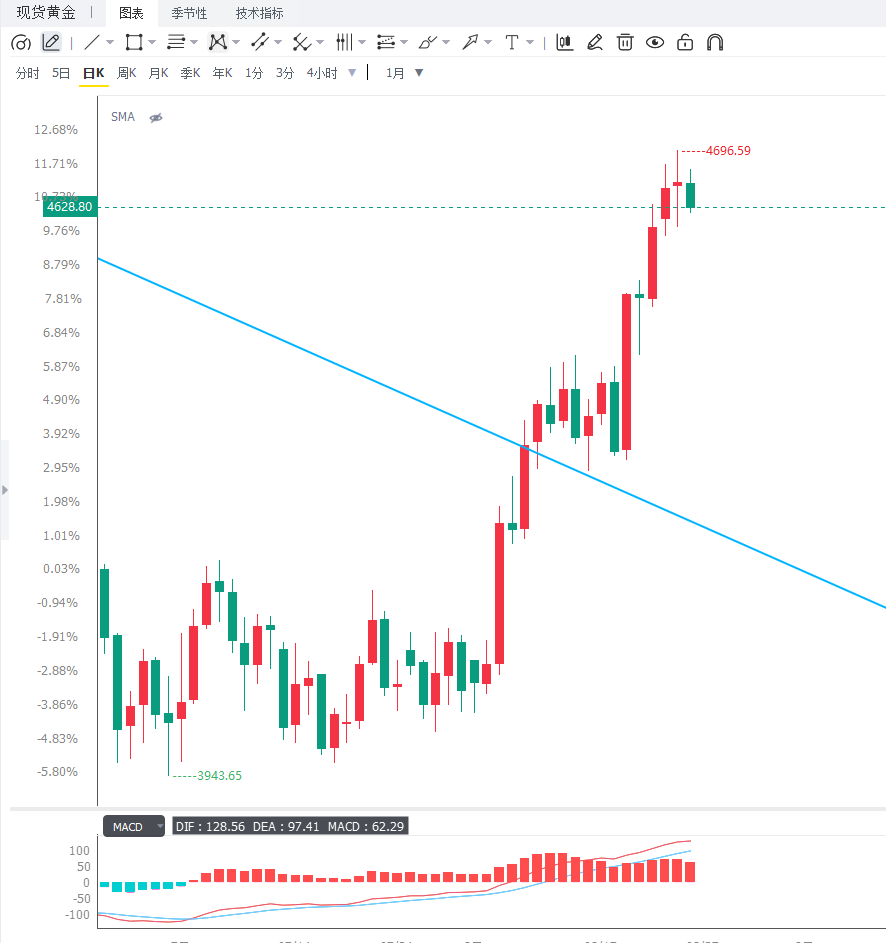
Gold prices have continued to remain high recently, supported by a combination of macroeconomic factors. A weaker US dollar index has lowered the cost of holding gold for non-dollar investors, while declining US Treasury yields have reduced the opportunity cost of holding non-interest-bearing gold. Meanwhile, concerns about the sustainability of the US fiscal deficit and debt continue to strengthen the demand for gold as a long-term store of value.  However, the market structure for the current gold price surge is changing. Citigroup points out that the recent gold price breakout was largely driven by speculative funds in the futures market, while physical demand has not kept pace. This means that the "financial attributes" of the current gold price increase are significantly strengthening, and the price is becoming more sensitive to changes in the US dollar, real interest rates, and policy expectations. From a trading structure perspective, speculative funds exhibit clear pro-cyclical characteristics. When prices break through key technical resistance and form an upward trend, trend-following funds often further increase their long positions, amplifying the price increase. However, at the same time, once the core market logic changes, these funds may also quickly reduce their positions, leading to a significant short-term correction in gold prices. Therefore, compared to traditional safe-haven assets, gold currently exhibits a more pronounced high-beta macroeconomic characteristic. In the past, the market primarily judged gold's direction based on geopolitical risks and risk aversion sentiment, but the current trading logic has expanded to include the US dollar's performance, real interest rates, fiscal risks, and expectations of Federal Reserve policy. The US Treasury market is one of the most important transmission channels. The recent decline in US long-term Treasury yields has created a more favorable interest rate environment for gold price increases. If long-term yields continue to decline, the opportunity cost of gold will further decrease. Meanwhile, long-term concerns about fiscal deficits and debt levels may also drive investors to increase their gold holdings. However, it's important to note that declining bond yields do not necessarily mean a sustained rise in gold prices. If the decline in yields stems from deteriorating economic growth expectations rather than a shift towards looser monetary policy, market risk appetite may decline accordingly. While gold will still have safe-haven demand, the balance of power between bulls and bears may be disrupted. Currently, the market is truly focused on the Jackson Hole Economic Symposium. Federal Reserve Chairman Kevin Warsh's speech will be a crucial indicator of future monetary policy direction. If his policy statement emphasizes the continued risk of inflation and hints at the need to maintain higher interest rates, then US real interest rates and the dollar may strengthen again, putting pressure on the large number of speculative long positions previously accumulated in gold to take profits. Conversely, if the Fed releases a more dovish policy signal, the market may further lower its expectations for future interest rate levels, putting pressure on US Treasury yields and the dollar. In this scenario, gold is expected to regain upward momentum and expand into higher price ranges. Therefore, the impact of the Jackson Hole meeting may not only be reflected in the direction of gold but may also directly determine whether current speculative funds continue to chase the rally or exit en masse. This is also one of the main reasons for the recent significant increase in gold price volatility. From a medium-term fundamental perspective, gold still has relatively solid support. The continued increase in gold reserves by global central banks, the expansion of fiscal deficits, and concerns among some investors about sovereign debt risks are all enhancing the allocation value of gold as a non-sovereign asset. At the same time, uncertainty in global financial markets remains high, and gold's safe-haven attribute has not disappeared. However, medium- to long-term positive factors do not mean that there is no risk of short-term price adjustments. Gold has already accumulated strong upward momentum. If the Fed's policy expectations change rapidly, or if the dollar and real interest rates rebound simultaneously, concentrated liquidation of speculative positions could create a strong price reaction. The more gold relies on financial funds for its growth, the more likely its short-term price movements will exhibit the characteristics of "rapid rises followed by rapid falls." Whether physical demand can keep up also deserves continued observation. If gold prices remain high for an extended period, jewelry consumption and some physical markets may be suppressed by price sensitivity. Investors need to distinguish between the financial market's fund-driven growth and the actual absorption capacity of end-consumer demand. Only when speculative funds, central bank gold purchases, and physical demand form a more stable joint support can the high-level rise in gold prices achieve stronger sustainability. From a global asset allocation perspective, gold is currently becoming an important pricing tool for changes in the dollar system, real interest rates, and fiscal risks. A weaker dollar generally benefits gold, as does a decline in real interest rates, while rising fiscal risks enhance long-term allocation demand. When these three variables move in a favorable direction simultaneously, gold often experiences strong trend opportunities. Conversely, if the Federal Reserve re-emphasizes tightening expectations, US real interest rates rise rapidly, and the dollar index stabilizes and rebounds, gold will face triple pressure. At that time, even if geopolitical risks persist, they may not be enough to offset the short-term impact of financial capital outflows. Therefore, the most important thing to pay attention to in the current gold market is not simply judging whether it will "rise or fall," but whether the underlying capital structure is changing. If speculative funds continue to increase, and the dollar and real interest rates remain weak, the strong gold rally still has room to continue; if policy expectations reverse, the crowded long positions at high levels may become amplifiers for a rapid price pullback. From a daily chart perspective, gold is still in a clear bullish trend overall, with prices remaining above major medium-term moving averages and the Bollinger Band middle line, and the upward structure after the previous breakout has not been broken. However, with gold prices continuing to trade at high levels, short-term momentum has clearly strengthened, and technical indicators are gradually entering overbought territory, meaning the risk of chasing the rally is also increasing. The first resistance level to watch is the $4670-$4700 area. If it can effectively break through and hold above $4700, the market may further challenge $4725 and $4750; if it fails to break higher, profit-taking at higher levels may increase. On the downside, the first support level to watch is around $4600, followed by $4580 and $4550. If gold prices can hold above $4550, the medium-term bullish structure remains relatively intact; if there is a rapid drop below $4550, it means that the previous upward momentum has clearly weakened, and the price may further seek support near $4500. From the 4-hour chart, gold still maintains an upward-trending structure, but in the short term, it has entered a strong consolidation phase at high levels. If the price retraces to the $4620-$4600 area and finds buying support, the bulls may retest the $4670-$4700 range. A break above $4700 with valid confirmation could open up further upside potential. Conversely, a break below $4600 could extend the short-term correction to around $4550. Currently, the key levels on the 4-hour chart are between $4600 and $4700; the direction of the breakout will determine the next short-term trend.
  Editor's Summary: Gold currently possesses strong medium- to long-term fundamental support, with a weakening dollar, declining US Treasury yields, fiscal risks, and central bank gold purchases all contributing to the upward trend. However, compared to previous rallies driven solely by safe-haven demand, current gold prices are more reliant on financial funds such as futures contracts, and increased speculative positions suggest potentially amplified market volatility. In the short term, the Jackson Hole meeting will be a crucial policy test for gold bulls. A dovish Fed signal could push the dollar and real interest rates lower, creating conditions for gold to break through previous highs; a hawkish policy statement could trigger a rebound in the dollar and yields, prompting speculative funds to take profits. Therefore, the medium-term upward logic for gold remains unchanged, but the short-term market has entered a high-volatility phase. Investors should closely monitor the dollar index, US real interest rates, long-term US Treasury yields, central bank gold purchases, and futures market fund flows. As long as the dollar and real interest rates remain weak, gold still has further upward potential; if both rebound simultaneously, caution should be exercised regarding a rapid pullback due to overcrowding at higher levels.
However, the market structure for the current gold price surge is changing. Citigroup points out that the recent gold price breakout was largely driven by speculative funds in the futures market, while physical demand has not kept pace. This means that the "financial attributes" of the current gold price increase are significantly strengthening, and the price is becoming more sensitive to changes in the US dollar, real interest rates, and policy expectations. From a trading structure perspective, speculative funds exhibit clear pro-cyclical characteristics. When prices break through key technical resistance and form an upward trend, trend-following funds often further increase their long positions, amplifying the price increase. However, at the same time, once the core market logic changes, these funds may also quickly reduce their positions, leading to a significant short-term correction in gold prices. Therefore, compared to traditional safe-haven assets, gold currently exhibits a more pronounced high-beta macroeconomic characteristic. In the past, the market primarily judged gold's direction based on geopolitical risks and risk aversion sentiment, but the current trading logic has expanded to include the US dollar's performance, real interest rates, fiscal risks, and expectations of Federal Reserve policy. The US Treasury market is one of the most important transmission channels. The recent decline in US long-term Treasury yields has created a more favorable interest rate environment for gold price increases. If long-term yields continue to decline, the opportunity cost of gold will further decrease. Meanwhile, long-term concerns about fiscal deficits and debt levels may also drive investors to increase their gold holdings. However, it's important to note that declining bond yields do not necessarily mean a sustained rise in gold prices. If the decline in yields stems from deteriorating economic growth expectations rather than a shift towards looser monetary policy, market risk appetite may decline accordingly. While gold will still have safe-haven demand, the balance of power between bulls and bears may be disrupted. Currently, the market is truly focused on the Jackson Hole Economic Symposium. Federal Reserve Chairman Kevin Warsh's speech will be a crucial indicator of future monetary policy direction. If his policy statement emphasizes the continued risk of inflation and hints at the need to maintain higher interest rates, then US real interest rates and the dollar may strengthen again, putting pressure on the large number of speculative long positions previously accumulated in gold to take profits. Conversely, if the Fed releases a more dovish policy signal, the market may further lower its expectations for future interest rate levels, putting pressure on US Treasury yields and the dollar. In this scenario, gold is expected to regain upward momentum and expand into higher price ranges. Therefore, the impact of the Jackson Hole meeting may not only be reflected in the direction of gold but may also directly determine whether current speculative funds continue to chase the rally or exit en masse. This is also one of the main reasons for the recent significant increase in gold price volatility. From a medium-term fundamental perspective, gold still has relatively solid support. The continued increase in gold reserves by global central banks, the expansion of fiscal deficits, and concerns among some investors about sovereign debt risks are all enhancing the allocation value of gold as a non-sovereign asset. At the same time, uncertainty in global financial markets remains high, and gold's safe-haven attribute has not disappeared. However, medium- to long-term positive factors do not mean that there is no risk of short-term price adjustments. Gold has already accumulated strong upward momentum. If the Fed's policy expectations change rapidly, or if the dollar and real interest rates rebound simultaneously, concentrated liquidation of speculative positions could create a strong price reaction. The more gold relies on financial funds for its growth, the more likely its short-term price movements will exhibit the characteristics of "rapid rises followed by rapid falls." Whether physical demand can keep up also deserves continued observation. If gold prices remain high for an extended period, jewelry consumption and some physical markets may be suppressed by price sensitivity. Investors need to distinguish between the financial market's fund-driven growth and the actual absorption capacity of end-consumer demand. Only when speculative funds, central bank gold purchases, and physical demand form a more stable joint support can the high-level rise in gold prices achieve stronger sustainability. From a global asset allocation perspective, gold is currently becoming an important pricing tool for changes in the dollar system, real interest rates, and fiscal risks. A weaker dollar generally benefits gold, as does a decline in real interest rates, while rising fiscal risks enhance long-term allocation demand. When these three variables move in a favorable direction simultaneously, gold often experiences strong trend opportunities. Conversely, if the Federal Reserve re-emphasizes tightening expectations, US real interest rates rise rapidly, and the dollar index stabilizes and rebounds, gold will face triple pressure. At that time, even if geopolitical risks persist, they may not be enough to offset the short-term impact of financial capital outflows. Therefore, the most important thing to pay attention to in the current gold market is not simply judging whether it will "rise or fall," but whether the underlying capital structure is changing. If speculative funds continue to increase, and the dollar and real interest rates remain weak, the strong gold rally still has room to continue; if policy expectations reverse, the crowded long positions at high levels may become amplifiers for a rapid price pullback. From a daily chart perspective, gold is still in a clear bullish trend overall, with prices remaining above major medium-term moving averages and the Bollinger Band middle line, and the upward structure after the previous breakout has not been broken. However, with gold prices continuing to trade at high levels, short-term momentum has clearly strengthened, and technical indicators are gradually entering overbought territory, meaning the risk of chasing the rally is also increasing. The first resistance level to watch is the $4670-$4700 area. If it can effectively break through and hold above $4700, the market may further challenge $4725 and $4750; if it fails to break higher, profit-taking at higher levels may increase. On the downside, the first support level to watch is around $4600, followed by $4580 and $4550. If gold prices can hold above $4550, the medium-term bullish structure remains relatively intact; if there is a rapid drop below $4550, it means that the previous upward momentum has clearly weakened, and the price may further seek support near $4500. From the 4-hour chart, gold still maintains an upward-trending structure, but in the short term, it has entered a strong consolidation phase at high levels. If the price retraces to the $4620-$4600 area and finds buying support, the bulls may retest the $4670-$4700 range. A break above $4700 with valid confirmation could open up further upside potential. Conversely, a break below $4600 could extend the short-term correction to around $4550. Currently, the key levels on the 4-hour chart are between $4600 and $4700; the direction of the breakout will determine the next short-term trend. Editor's Summary: Gold currently possesses strong medium- to long-term fundamental support, with a weakening dollar, declining US Treasury yields, fiscal risks, and central bank gold purchases all contributing to the upward trend. However, compared to previous rallies driven solely by safe-haven demand, current gold prices are more reliant on financial funds such as futures contracts, and increased speculative positions suggest potentially amplified market volatility. In the short term, the Jackson Hole meeting will be a crucial policy test for gold bulls. A dovish Fed signal could push the dollar and real interest rates lower, creating conditions for gold to break through previous highs; a hawkish policy statement could trigger a rebound in the dollar and yields, prompting speculative funds to take profits. Therefore, the medium-term upward logic for gold remains unchanged, but the short-term market has entered a high-volatility phase. Investors should closely monitor the dollar index, US real interest rates, long-term US Treasury yields, central bank gold purchases, and futures market fund flows. As long as the dollar and real interest rates remain weak, gold still has further upward potential; if both rebound simultaneously, caution should be exercised regarding a rapid pullback due to overcrowding at higher levels.- Risk Warning and Disclaimer
- The market involves risk, and trading may not be suitable for all investors. This article is for reference only and does not constitute personal investment advice, nor does it take into account certain users’ specific investment objectives, financial situation, or other needs. Any investment decisions made based on this information are at your own risk.