Gold prices continued to fluctuate at high levels, with the market awaiting a directional move following the Jackson Hole meeting.
2026-08-27 10:31:00
Spot gold traded in a narrow range in early Asian trading on Thursday, retreating from a three-month high to around $4,640 per ounce. The recent rapid rise in gold prices had already resulted in significant gains, so this pullback was influenced by both US inflation data and profit-taking by some long positions. The market's primary focus now is whether US inflation will be sufficient to force the Federal Reserve to reinforcing its tightening policy, and whether the high-interest-rate environment can truly alter gold's recent strong performance.  Data released by the U.S. Bureau of Economic Analysis showed that the Personal Consumption Expenditures (PCE) price index rose 3.7% year-on-year in July, unchanged from June, but higher than the market's previous expectation of 3.6%. Core PCE, excluding food and energy, rose 3.3% year-on-year, in line with market expectations; on a monthly basis, both overall PCE and core PCE rose by about 0.2%. This data releases a relatively complex signal. On the one hand, overall inflation has remained at 3.7%, significantly higher than the Fed's long-term target of 2%, indicating that price pressures remain sticky; on the other hand, core PCE did not experience an unexpected acceleration, and the monthly growth rate is within an acceptable range for the market. Therefore, while the data increased market concerns about the Fed continuing to tighten policy, it is insufficient to constitute a strong reason for a reversal in the gold trend. Changes in the interest rate market have already reflected this impact. According to the CME FedWatch tool, after the data release, the market's expectation of a 25 basis point rate hike by the Fed in September rose to about 38%, higher than about 36% before the data release. The increased probability of a rate hike means that gold, a non-interest-bearing asset, faces a higher opportunity cost. Further strengthening of the dollar and U.S. Treasury yields could suppress gold's short-term performance. However, gold did not experience a significant panic sell-off. Gold prices remained above $4,600, indicating that investors did not withdraw from the gold market en masse due to the PCE data. The previous rapid rise in gold prices had already accumulated considerable short-term profit-taking, so a pullback after the data release was not unexpected. Market analyst Peter Grant believes that the recent price action after the gold price increase reflects more profit-taking, and since the PCE data was generally in line with expectations, it is currently still in a consolidation phase within the previous trading range. This is crucial for judging the future trend of gold. If US inflation data significantly exceeds expectations, or if Federal Reserve officials release further strong hawkish signals, gold may face a more significant valuation correction. However, the current data has not reached that level, so gold prices are more likely to digest previous gains through sideways consolidation and a phase of correction, rather than immediately entering a sustained downward trend. Meanwhile, the sharp fluctuations in the US long-term Treasury market are also worth noting. Recently, long-term US Treasuries have rebounded significantly, and discussions surrounding US fiscal policy, Treasury supply, and long-term yields continue to intensify. Rabobank analysts believe that even with a significant rise in the US long-term Treasury market, gold has not experienced a significant "capitulation" sell-off. This means that the underlying buying pressure in the gold market remains relatively resilient. From an asset allocation perspective, this performance indicates that the current pricing logic for gold is no longer solely dependent on the Federal Reserve's interest rates. Besides real interest rates and the US dollar, the US fiscal situation, long-term debt, global central bank gold reserves, and geopolitical risks are all influencing gold valuations. As long as these factors do not show significant reversals, even if the Federal Reserve maintains a tight policy in the short term, gold may maintain a strong medium-term trend through high-level fluctuations. The US dollar's performance is a key variable to watch in the coming trading days. If PCE data drives the dollar to continue strengthening while US Treasury yields continue to rise, gold may face further valuation pressure; conversely, if the dollar weakens again, or the market believes that US inflation is insufficient to change the overall policy direction, then gold has the opportunity to attract capital inflows again. The Jackson Hole Economic Symposium on Friday therefore becomes a key risk event for the gold market. Federal Reserve Chairman Kevin Warsh's speech will be closely watched. If Warsh emphasizes that inflation remains high and hints that policy needs to remain restrictive, the market may further increase the probability of a September rate hike, potentially putting short-term pressure on gold. However, if his rhetoric places more emphasis on economic growth risks, changes in the labor market, and policy flexibility, the dollar and US Treasury yields may fall, providing impetus for a renewed upward move in gold. From a daily chart perspective, gold currently maintains a clear bullish pattern. The price is above the 100-day simple moving average and the 20-day Bollinger Band middle line, indicating that the previous upward structure has not been broken. The current gold price is trading in the upper half of the Bollinger Bands, suggesting that the bulls still control the trend. However, as the price continues to approach the upper Bollinger Band, the risk of chasing the price higher in the short term is increasing. The daily RSI is around 67.64, approaching overbought territory, indicating strong upward momentum, but also suggesting that the probability of the market entering a high-level consolidation and technical correction is increasing. The first resistance level to watch is the upper Bollinger Band at approximately $4745, which is currently a significant technical resistance level. If gold prices can break through and hold above this level with significant volume, it suggests the current upward trend may expand further. However, if bulls fail to break through repeatedly, profit-taking may increase, pushing prices to retest lower support levels. The initial daily support level is near the rising 100-day moving average, around $4380, with the 20-day Bollinger Band middle line at approximately $4365 below. These two levels form a relatively dense demand area, serving as an important reference for determining whether the medium-term upward structure remains intact. Looking at the 4-hour chart, gold has shifted from a rapid upward surge to a high-level consolidation, with the $4610 area becoming the current battleground between bulls and bears. If prices can stabilize above $4600 and break through the $4650-$4700 area again, bulls still have a chance to challenge $4745. Conversely, if $4600 is breached, and short-term moving averages show a clear downward turn, with the MACD expanding further downward, a short-term pullback could develop towards the $4550 or even $4500 area.
 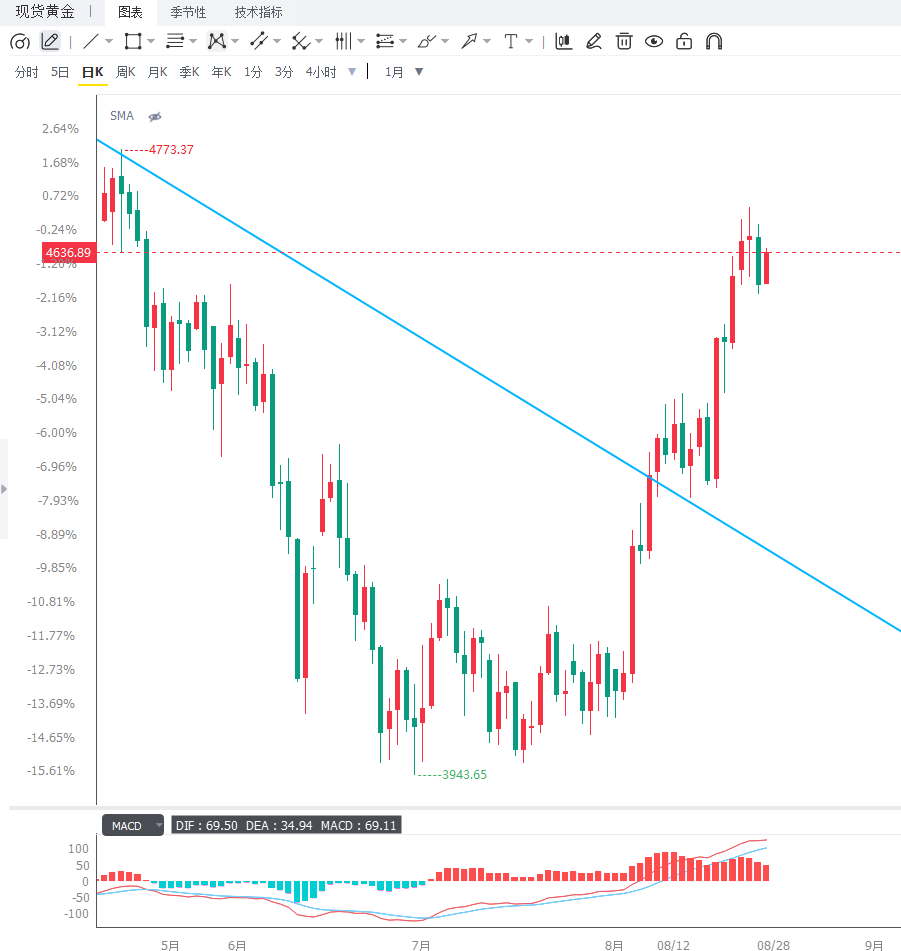 Editor's Summary: Gold prices retreated from a three-month high to around $4,610, primarily influenced by the US July PCE inflation rate remaining at 3.7% and rising expectations of a Fed rate hike. However, the core PCE year-on-year growth of 3.3% was in line with expectations, and the market did not exhibit extreme hawkish repricing. Therefore, this round of decline is currently more of a consolidation at high levels than a trend reversal. The core variable for gold in the future remains the Fed's policy path. If the Jackson Hole meeting releases hawkish signals, the dollar and US Treasury yields may continue to suppress gold prices; if the policy statement is less hawkish than the market expects, gold may regain upward momentum. Given that US fiscal pressure, global risk factors, and central bank allocation needs have not yet significantly reversed, the medium-term bullish foundation for gold still exists, but in the short term, it has entered a high-volatility, high-sensitivity zone, and the risk of chasing the rally is significantly higher than before.
Data released by the U.S. Bureau of Economic Analysis showed that the Personal Consumption Expenditures (PCE) price index rose 3.7% year-on-year in July, unchanged from June, but higher than the market's previous expectation of 3.6%. Core PCE, excluding food and energy, rose 3.3% year-on-year, in line with market expectations; on a monthly basis, both overall PCE and core PCE rose by about 0.2%. This data releases a relatively complex signal. On the one hand, overall inflation has remained at 3.7%, significantly higher than the Fed's long-term target of 2%, indicating that price pressures remain sticky; on the other hand, core PCE did not experience an unexpected acceleration, and the monthly growth rate is within an acceptable range for the market. Therefore, while the data increased market concerns about the Fed continuing to tighten policy, it is insufficient to constitute a strong reason for a reversal in the gold trend. Changes in the interest rate market have already reflected this impact. According to the CME FedWatch tool, after the data release, the market's expectation of a 25 basis point rate hike by the Fed in September rose to about 38%, higher than about 36% before the data release. The increased probability of a rate hike means that gold, a non-interest-bearing asset, faces a higher opportunity cost. Further strengthening of the dollar and U.S. Treasury yields could suppress gold's short-term performance. However, gold did not experience a significant panic sell-off. Gold prices remained above $4,600, indicating that investors did not withdraw from the gold market en masse due to the PCE data. The previous rapid rise in gold prices had already accumulated considerable short-term profit-taking, so a pullback after the data release was not unexpected. Market analyst Peter Grant believes that the recent price action after the gold price increase reflects more profit-taking, and since the PCE data was generally in line with expectations, it is currently still in a consolidation phase within the previous trading range. This is crucial for judging the future trend of gold. If US inflation data significantly exceeds expectations, or if Federal Reserve officials release further strong hawkish signals, gold may face a more significant valuation correction. However, the current data has not reached that level, so gold prices are more likely to digest previous gains through sideways consolidation and a phase of correction, rather than immediately entering a sustained downward trend. Meanwhile, the sharp fluctuations in the US long-term Treasury market are also worth noting. Recently, long-term US Treasuries have rebounded significantly, and discussions surrounding US fiscal policy, Treasury supply, and long-term yields continue to intensify. Rabobank analysts believe that even with a significant rise in the US long-term Treasury market, gold has not experienced a significant "capitulation" sell-off. This means that the underlying buying pressure in the gold market remains relatively resilient. From an asset allocation perspective, this performance indicates that the current pricing logic for gold is no longer solely dependent on the Federal Reserve's interest rates. Besides real interest rates and the US dollar, the US fiscal situation, long-term debt, global central bank gold reserves, and geopolitical risks are all influencing gold valuations. As long as these factors do not show significant reversals, even if the Federal Reserve maintains a tight policy in the short term, gold may maintain a strong medium-term trend through high-level fluctuations. The US dollar's performance is a key variable to watch in the coming trading days. If PCE data drives the dollar to continue strengthening while US Treasury yields continue to rise, gold may face further valuation pressure; conversely, if the dollar weakens again, or the market believes that US inflation is insufficient to change the overall policy direction, then gold has the opportunity to attract capital inflows again. The Jackson Hole Economic Symposium on Friday therefore becomes a key risk event for the gold market. Federal Reserve Chairman Kevin Warsh's speech will be closely watched. If Warsh emphasizes that inflation remains high and hints that policy needs to remain restrictive, the market may further increase the probability of a September rate hike, potentially putting short-term pressure on gold. However, if his rhetoric places more emphasis on economic growth risks, changes in the labor market, and policy flexibility, the dollar and US Treasury yields may fall, providing impetus for a renewed upward move in gold. From a daily chart perspective, gold currently maintains a clear bullish pattern. The price is above the 100-day simple moving average and the 20-day Bollinger Band middle line, indicating that the previous upward structure has not been broken. The current gold price is trading in the upper half of the Bollinger Bands, suggesting that the bulls still control the trend. However, as the price continues to approach the upper Bollinger Band, the risk of chasing the price higher in the short term is increasing. The daily RSI is around 67.64, approaching overbought territory, indicating strong upward momentum, but also suggesting that the probability of the market entering a high-level consolidation and technical correction is increasing. The first resistance level to watch is the upper Bollinger Band at approximately $4745, which is currently a significant technical resistance level. If gold prices can break through and hold above this level with significant volume, it suggests the current upward trend may expand further. However, if bulls fail to break through repeatedly, profit-taking may increase, pushing prices to retest lower support levels. The initial daily support level is near the rising 100-day moving average, around $4380, with the 20-day Bollinger Band middle line at approximately $4365 below. These two levels form a relatively dense demand area, serving as an important reference for determining whether the medium-term upward structure remains intact. Looking at the 4-hour chart, gold has shifted from a rapid upward surge to a high-level consolidation, with the $4610 area becoming the current battleground between bulls and bears. If prices can stabilize above $4600 and break through the $4650-$4700 area again, bulls still have a chance to challenge $4745. Conversely, if $4600 is breached, and short-term moving averages show a clear downward turn, with the MACD expanding further downward, a short-term pullback could develop towards the $4550 or even $4500 area. Editor's Summary: Gold prices retreated from a three-month high to around $4,610, primarily influenced by the US July PCE inflation rate remaining at 3.7% and rising expectations of a Fed rate hike. However, the core PCE year-on-year growth of 3.3% was in line with expectations, and the market did not exhibit extreme hawkish repricing. Therefore, this round of decline is currently more of a consolidation at high levels than a trend reversal. The core variable for gold in the future remains the Fed's policy path. If the Jackson Hole meeting releases hawkish signals, the dollar and US Treasury yields may continue to suppress gold prices; if the policy statement is less hawkish than the market expects, gold may regain upward momentum. Given that US fiscal pressure, global risk factors, and central bank allocation needs have not yet significantly reversed, the medium-term bullish foundation for gold still exists, but in the short term, it has entered a high-volatility, high-sensitivity zone, and the risk of chasing the rally is significantly higher than before.
- Risk Warning and Disclaimer
- The market involves risk, and trading may not be suitable for all investors. This article is for reference only and does not constitute personal investment advice, nor does it take into account certain users’ specific investment objectives, financial situation, or other needs. Any investment decisions made based on this information are at your own risk.