The US July PCE remained high, supporting the dollar, with the dollar index approaching the 99 mark. The Jackson Hole meeting will be a key variable.
2026-08-27 14:29:04
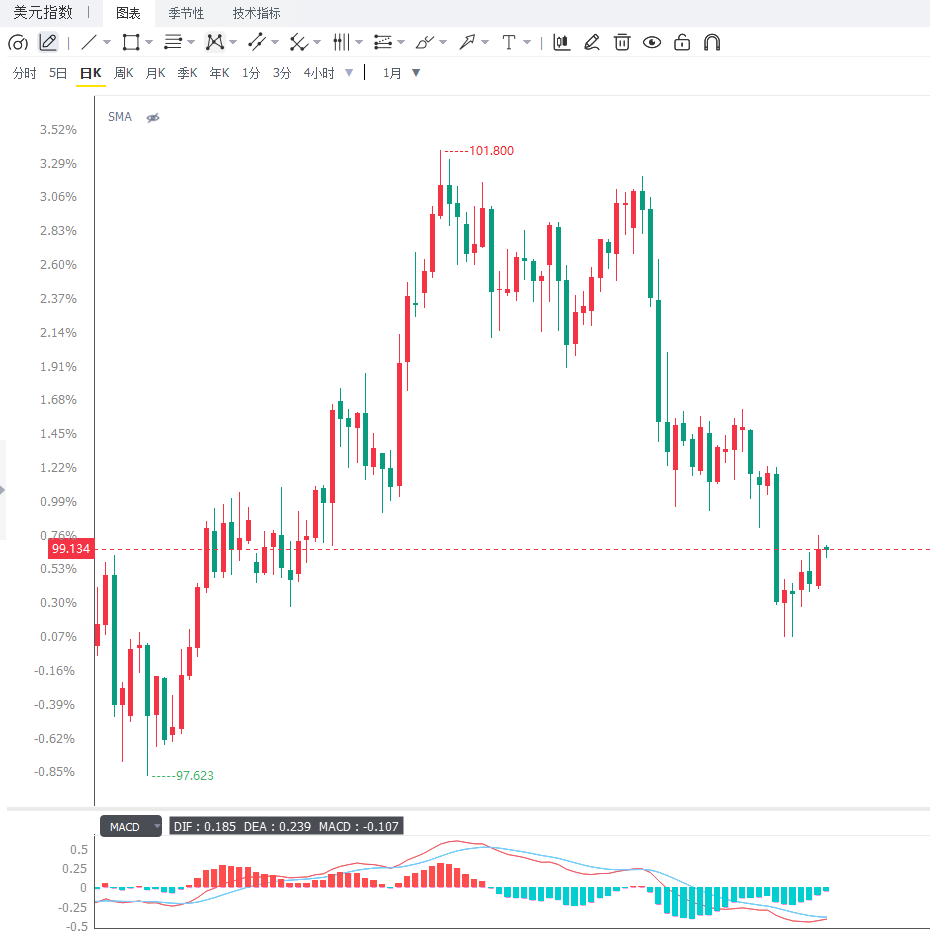
The dollar extended its rebound from the previous trading day on Thursday, with the dollar index holding steady around 99.00 in early European trading. US July inflation data slightly exceeded market expectations, prompting investors to reassess the Federal Reserve's future policy path. While core PCE met expectations, overall inflation remains at a high level, meaning the Fed is still far from achieving its 2% inflation target, thus providing some support for the dollar based on interest rate expectations.  Data released by the U.S. Bureau of Economic Analysis showed that the PCE price index rose 0.2% month-over-month and 3.7% year-over-year in July, the latter exceeding market expectations of 3.6%. Core PCE also rose 0.2% month-over-month and remained at 3.3% year-over-year. Meanwhile, personal income grew 0.4% in July, and nominal personal consumption expenditure increased by 0.2%, but real PCE showed virtually no growth. The data indicates that price pressures remain significant, while actual consumer spending has shown signs of cooling. This data has a distinctly two-sided impact on the dollar. The higher-than-expected overall PCE reinforces the assessment of sticky inflation, making it difficult for the market to completely rule out the possibility of further interest rate hikes by the Federal Reserve; however, the lack of further increase in core PCE, coupled with stagnant real consumption growth, limits the market's imagination regarding continuous tightening policies. Therefore, the dollar is receiving more support from short-term interest rate expectations than from a new long-term strong logic. From the interest rate market perspective, the main expectation for the September Federal Reserve meeting remains unchanged. Market data shows that investors currently still give a high probability of no change in September, while expectations of a rate hike have increased after the PCE release. Recent market pricing also reflects a significant shift: investors are increasingly focusing on whether inflation is accelerating again, rather than simply betting on when the Federal Reserve will cut interest rates. This implies a further increase in the importance of future US economic data. If the job market continues to be resilient and inflation does not decline significantly, the Fed may need to maintain higher interest rates for a longer period, or even reconsider raising rates. Conversely, if consumption, employment, and core inflation cool down simultaneously, the path of maintaining interest rates unchanged in September and gradually shifting to easing remains valid. Whether the current dollar rebound can be sustained largely depends on this difference in policy expectations. The market has now turned its attention to the Jackson Hole Economic Symposium. The 2026 Jackson Hole symposium will be held from August 27 to 29, with Federal Reserve Chairman Kevin Warsh speaking on Friday. As this is a crucial policy communication window for Warsh since becoming Fed Chairman, the market will focus on his statements regarding inflation, interest rates, and future policy response mechanisms. The biggest policy communication challenge at present is that the Fed needs to maintain its policy independence and price stability goals while explaining to the market how future policies will address changes in the relationship between inflation and economic growth. Market strategists generally believe that if Warsh emphasizes inflation risks and policy constraints in his speech, the dollar may receive further support; however, if he emphasizes slower economic growth, employment risks, and policy flexibility, the dollar's previous gains may be suppressed again. The US fiscal and bond markets are also worth noting. Recently, US long-term Treasury yields have been at high levels, and fiscal financing pressures and market concerns about long-term bond supply continue to affect dollar asset pricing. If long-term yields continue to climb, the dollar may gain a certain yield advantage, but if bond market volatility is excessive and triggers concerns about fiscal sustainability, the dollar may not be able to continue to benefit. Therefore, the traditional positive correlation between the dollar and US Treasury yields also needs to be assessed in conjunction with fiscal risks. From a global market perspective, the dollar is not currently entirely supported by US economic fundamentals. The situation in the Middle East, energy prices, global risk appetite, and the policy divergence among major central banks are all influencing capital flows. If geopolitical risks further ease, the safe-haven dollar may face some selling pressure; while if energy supply risks escalate again, inflation expectations may rise again, thereby reinforcing expectations of a tighter Fed policy and providing new support for the dollar. At the same time, the European Central Bank's hawkish stance also constitutes a significant constraint on the dollar index's upward movement. The European Central Bank recently signaled further tightening of policy. If Eurozone interest rate expectations continue to be revised upward, the euro may receive support, thus limiting further gains in the US dollar index. Whether the US dollar can effectively break through the 99 level depends not only on US data but also on whether the policy expectation gap between the US and Europe continues to widen in favor of the dollar. From a daily technical perspective, the US dollar index has recently rebounded from its lows and is currently approaching the 99.00 level again. Previously, the US dollar index found buying support near its downtrend support and began a correction; the current rebound is approaching a key resistance area. If it can effectively break through 99.00 and further stabilize in the 99.20-99.30 area, the short-term bullish structure is expected to strengthen further, with psychological resistance levels to watch at 99.80 and around 100.00. However, it should be noted that the US dollar index is still in the correction phase of its previous downtrend and cannot be simply considered a completed medium-term reversal. If the 99 level is repeatedly resisted and the price falls below 98.50 again, it indicates that the momentum of this rebound is weakening, and the market may retest 98.00 or even 97.50. Recent technical analysis also indicates that the dollar's rebound is approaching a key trend resistance zone, and the Jackson Hole speech may determine whether a breakout will materialize. Looking at the 4-hour chart, the dollar index maintains a slightly bullish structure in the short term, but the pace of increase has clearly slowed. The area around 99.00 is currently the core battleground between bulls and bears. If the price breaks through this area effectively, and the MACD maintains positive expansion, the dollar still has room to rise in the short term; if it fails to break higher and forms a death cross at a high level, it may re-enter a period of consolidation. In the short term, the first support level to watch is the 98.60-98.50 area; if this level is breached, further support will be seen around 98.20.
  Editor's Summary: The US July PCE rose 3.7% year-on-year, and core PCE rose 3.3% year-on-year, indicating that inflation remains sticky. The dollar continued its rebound and approached the 99 mark again. However, real consumption growth has stalled, and core inflation has not accelerated further, meaning the Federal Reserve's rationale for an immediate and significant tightening of policy remains insufficient. In the medium term, whether the dollar can form a more sustainable rebound depends on whether US inflation, employment, and real consumption can jointly support a higher interest rate environment, while also observing the policy divergence among major central banks such as the European Central Bank. The Jackson Hole meeting, especially Warsh's speech, will be the most important policy catalyst for the dollar's recent movement. Before the speech, the dollar index may continue to fluctuate at high levels, and investors should pay close attention to the transmission of policy wording to US Treasury yields and interest rate expectations.
Data released by the U.S. Bureau of Economic Analysis showed that the PCE price index rose 0.2% month-over-month and 3.7% year-over-year in July, the latter exceeding market expectations of 3.6%. Core PCE also rose 0.2% month-over-month and remained at 3.3% year-over-year. Meanwhile, personal income grew 0.4% in July, and nominal personal consumption expenditure increased by 0.2%, but real PCE showed virtually no growth. The data indicates that price pressures remain significant, while actual consumer spending has shown signs of cooling. This data has a distinctly two-sided impact on the dollar. The higher-than-expected overall PCE reinforces the assessment of sticky inflation, making it difficult for the market to completely rule out the possibility of further interest rate hikes by the Federal Reserve; however, the lack of further increase in core PCE, coupled with stagnant real consumption growth, limits the market's imagination regarding continuous tightening policies. Therefore, the dollar is receiving more support from short-term interest rate expectations than from a new long-term strong logic. From the interest rate market perspective, the main expectation for the September Federal Reserve meeting remains unchanged. Market data shows that investors currently still give a high probability of no change in September, while expectations of a rate hike have increased after the PCE release. Recent market pricing also reflects a significant shift: investors are increasingly focusing on whether inflation is accelerating again, rather than simply betting on when the Federal Reserve will cut interest rates. This implies a further increase in the importance of future US economic data. If the job market continues to be resilient and inflation does not decline significantly, the Fed may need to maintain higher interest rates for a longer period, or even reconsider raising rates. Conversely, if consumption, employment, and core inflation cool down simultaneously, the path of maintaining interest rates unchanged in September and gradually shifting to easing remains valid. Whether the current dollar rebound can be sustained largely depends on this difference in policy expectations. The market has now turned its attention to the Jackson Hole Economic Symposium. The 2026 Jackson Hole symposium will be held from August 27 to 29, with Federal Reserve Chairman Kevin Warsh speaking on Friday. As this is a crucial policy communication window for Warsh since becoming Fed Chairman, the market will focus on his statements regarding inflation, interest rates, and future policy response mechanisms. The biggest policy communication challenge at present is that the Fed needs to maintain its policy independence and price stability goals while explaining to the market how future policies will address changes in the relationship between inflation and economic growth. Market strategists generally believe that if Warsh emphasizes inflation risks and policy constraints in his speech, the dollar may receive further support; however, if he emphasizes slower economic growth, employment risks, and policy flexibility, the dollar's previous gains may be suppressed again. The US fiscal and bond markets are also worth noting. Recently, US long-term Treasury yields have been at high levels, and fiscal financing pressures and market concerns about long-term bond supply continue to affect dollar asset pricing. If long-term yields continue to climb, the dollar may gain a certain yield advantage, but if bond market volatility is excessive and triggers concerns about fiscal sustainability, the dollar may not be able to continue to benefit. Therefore, the traditional positive correlation between the dollar and US Treasury yields also needs to be assessed in conjunction with fiscal risks. From a global market perspective, the dollar is not currently entirely supported by US economic fundamentals. The situation in the Middle East, energy prices, global risk appetite, and the policy divergence among major central banks are all influencing capital flows. If geopolitical risks further ease, the safe-haven dollar may face some selling pressure; while if energy supply risks escalate again, inflation expectations may rise again, thereby reinforcing expectations of a tighter Fed policy and providing new support for the dollar. At the same time, the European Central Bank's hawkish stance also constitutes a significant constraint on the dollar index's upward movement. The European Central Bank recently signaled further tightening of policy. If Eurozone interest rate expectations continue to be revised upward, the euro may receive support, thus limiting further gains in the US dollar index. Whether the US dollar can effectively break through the 99 level depends not only on US data but also on whether the policy expectation gap between the US and Europe continues to widen in favor of the dollar. From a daily technical perspective, the US dollar index has recently rebounded from its lows and is currently approaching the 99.00 level again. Previously, the US dollar index found buying support near its downtrend support and began a correction; the current rebound is approaching a key resistance area. If it can effectively break through 99.00 and further stabilize in the 99.20-99.30 area, the short-term bullish structure is expected to strengthen further, with psychological resistance levels to watch at 99.80 and around 100.00. However, it should be noted that the US dollar index is still in the correction phase of its previous downtrend and cannot be simply considered a completed medium-term reversal. If the 99 level is repeatedly resisted and the price falls below 98.50 again, it indicates that the momentum of this rebound is weakening, and the market may retest 98.00 or even 97.50. Recent technical analysis also indicates that the dollar's rebound is approaching a key trend resistance zone, and the Jackson Hole speech may determine whether a breakout will materialize. Looking at the 4-hour chart, the dollar index maintains a slightly bullish structure in the short term, but the pace of increase has clearly slowed. The area around 99.00 is currently the core battleground between bulls and bears. If the price breaks through this area effectively, and the MACD maintains positive expansion, the dollar still has room to rise in the short term; if it fails to break higher and forms a death cross at a high level, it may re-enter a period of consolidation. In the short term, the first support level to watch is the 98.60-98.50 area; if this level is breached, further support will be seen around 98.20. Editor's Summary: The US July PCE rose 3.7% year-on-year, and core PCE rose 3.3% year-on-year, indicating that inflation remains sticky. The dollar continued its rebound and approached the 99 mark again. However, real consumption growth has stalled, and core inflation has not accelerated further, meaning the Federal Reserve's rationale for an immediate and significant tightening of policy remains insufficient. In the medium term, whether the dollar can form a more sustainable rebound depends on whether US inflation, employment, and real consumption can jointly support a higher interest rate environment, while also observing the policy divergence among major central banks such as the European Central Bank. The Jackson Hole meeting, especially Warsh's speech, will be the most important policy catalyst for the dollar's recent movement. Before the speech, the dollar index may continue to fluctuate at high levels, and investors should pay close attention to the transmission of policy wording to US Treasury yields and interest rate expectations.- Risk Warning and Disclaimer
- The market involves risk, and trading may not be suitable for all investors. This article is for reference only and does not constitute personal investment advice, nor does it take into account certain users’ specific investment objectives, financial situation, or other needs. Any investment decisions made based on this information are at your own risk.