The US dollar index rebounded slightly, while the British pound continued its correction against the dollar.
2026-08-27 14:33:07
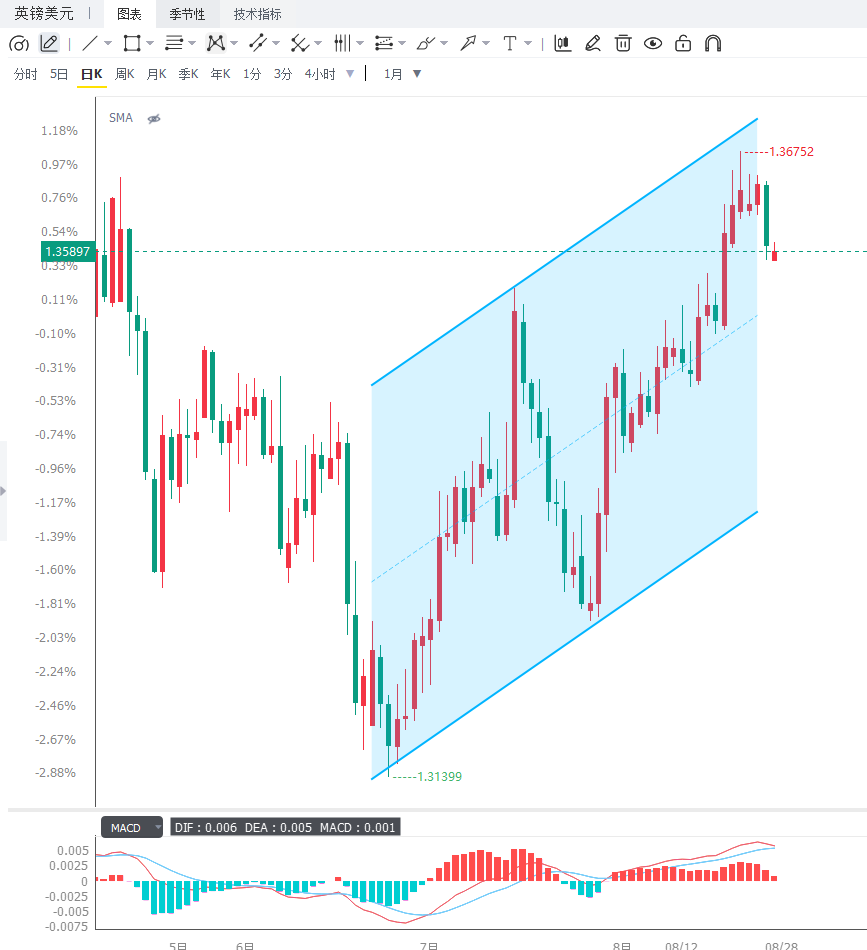
The pound/dollar pair remained weak in Asian trading on Thursday, trading below the 1.3600 level and near this week's lows. The dollar maintained some strength after the release of US inflation data, putting pressure on the pound, but the market did not develop a strong one-sided bearish sentiment. Investors are currently more cautious, preferring to wait for further confirmation of the Federal Reserve's future interest rate path before establishing new directional positions.  The US Personal Consumption Expenditures (PCE) price index rose 3.7% year-on-year in July, unchanged from the previous month but slightly higher than the market's previous expectation of 3.6%. Core PCE remained at 3.3% year-on-year, with both overall PCE and core PCE rising by about 0.2% monthly. Overall, US inflation remains significantly higher than the Federal Reserve's long-term target of 2%, and the rate of decline is not fast enough, keeping the market open to the possibility of further tightening by the Fed this year. For GBP/USD, US interest rate expectations are currently the most direct source of pressure. If the market believes that the Fed needs to maintain high interest rates for a longer period, or even that further rate hikes are possible, US Treasury yields and the dollar may be supported, while GBP/USD is likely to be suppressed. Especially given the recent pullback in the pound, the dollar's interest rate advantage has widened again, further increasing short-term downward pressure on the exchange rate. However, the current rise in the dollar is also subject to significant constraints. The US Treasury has recently continued its long-term Treasury repurchase strategy, alleviating market supply pressure by repurchasing some long-term bonds, thus putting some pressure on long-term Treasury yields. If long-term yields cannot continue to rise, even if US inflation remains high, the dollar's yield advantage may be limited. Furthermore, signs of easing tensions in the Middle East have emerged, with market expectations rising for a temporary agreement between the US and Iran, and discussions about the resumption of commercial shipping in the Strait of Hormuz increasing. As safe-haven demand has declined, some of the risk premium previously enjoyed by the US dollar has begun to recede, a key reason why the decline in GBP/USD has been limited. However, it's important to note that these shipping arrangements do not mean that geopolitical risks have been completely eliminated. Iran has stated that a full resumption of navigation in the Strait still requires the US to fulfill its commitments. This means that energy transportation risks remain, and crude oil prices still carry a certain risk premium. If energy prices rise again and push up global inflation expectations, the market may re-increase expectations that major central banks will maintain tight monetary policies, thus creating a complex impact on the US dollar. For the UK, the pound's performance is also influenced by domestic economic conditions and expectations regarding the Bank of England's policy. If UK inflation and wage pressures remain high, the Bank of England's room for interest rate cuts will be limited, providing some interest rate support for the pound; conversely, if UK economic data weakens significantly, and the market re-increases its bets on interest rate cuts, the pound may face greater pressure. Currently, market focus is gradually shifting to the Jackson Hole Global Central Bank Conference. Federal Reserve Chairman Kevin Warsh will speak on Friday, and his assessment of inflation, employment, and future interest rate policy will directly impact the dollar's trajectory. If Warsh releases a clearly hawkish signal, emphasizing that inflation risks remain high, the pound/dollar may face further pressure. If he emphasizes slower economic growth and flexibility in future policy adjustments, the dollar may give back some of its gains, creating conditions for a pound rebound. Therefore, it is not appropriate to simply rely on PCE data to conclude that the dollar will continue to rise. While sticky US inflation does increase the necessity for the Fed to maintain high interest rates, the impact of repurchase agreements on US long-term bond yields, coupled with declining safe-haven demand, limits the dollar's upside potential. The pound/dollar is therefore more likely to await new policy catalysts to confirm its direction. From a daily chart perspective, the pound/dollar has entered a correction phase after its recent rebound and is currently facing resistance in the 1.3660-1.3665 supply zone. This area is a significant resistance level for the bulls to regain control. If the exchange rate can effectively break through and hold above 1.3665, it would mean that the recent downward pressure has significantly weakened, and a retest of 1.3700 or even higher levels is expected. Looking down, the previous consolidation area around 1.3450 forms intermediate support, while the lower 1.3300-1.3350 area is a more important medium-term demand zone. If the exchange rate continues to fall but finds buying support in these areas, the previous medium-term rebound structure is likely to remain intact. Conversely, if the 1.3300 area is effectively broken, we need to be wary of GBP/USD turning from a rebound into a deeper trend correction. From the 4-hour chart, GBP/USD is currently weak in the short term, with the price trading below the 1.3600 level, indicating that the bears are temporarily in control. However, as the exchange rate approaches the previous support area, the downward momentum may gradually weaken. If the price recovers 1.3600 and breaks through the 1.3660-1.3665 area, while the MACD turns from weak to strong, a short-term rebound phase is expected.
  Editor's Summary: The GBP/USD pair is currently facing the dual impact of sticky US inflation and declining safe-haven demand for the dollar. US July PCE rose 3.7% year-on-year, while core PCE was 3.3%, maintaining the possibility of further tightening by the Federal Reserve and providing support for the dollar. However, long-term US Treasury repurchase agreements are suppressing yields, and signs of easing tensions in the Middle East are limiting further upside for the dollar. The real directional variable in the short term remains the Fed's policy expectations. If the Jackson Hole meeting releases hawkish signals, the dollar may continue to dominate, and GBP/USD will face further downward pressure; if the policy statement is less hawkish than the market expects, the dollar may fall, and the pound may regain buying interest. Currently, it is more appropriate to wait for a breakout at key technical levels to confirm the direction, rather than chasing highs and lows in the middle of the range.
The US Personal Consumption Expenditures (PCE) price index rose 3.7% year-on-year in July, unchanged from the previous month but slightly higher than the market's previous expectation of 3.6%. Core PCE remained at 3.3% year-on-year, with both overall PCE and core PCE rising by about 0.2% monthly. Overall, US inflation remains significantly higher than the Federal Reserve's long-term target of 2%, and the rate of decline is not fast enough, keeping the market open to the possibility of further tightening by the Fed this year. For GBP/USD, US interest rate expectations are currently the most direct source of pressure. If the market believes that the Fed needs to maintain high interest rates for a longer period, or even that further rate hikes are possible, US Treasury yields and the dollar may be supported, while GBP/USD is likely to be suppressed. Especially given the recent pullback in the pound, the dollar's interest rate advantage has widened again, further increasing short-term downward pressure on the exchange rate. However, the current rise in the dollar is also subject to significant constraints. The US Treasury has recently continued its long-term Treasury repurchase strategy, alleviating market supply pressure by repurchasing some long-term bonds, thus putting some pressure on long-term Treasury yields. If long-term yields cannot continue to rise, even if US inflation remains high, the dollar's yield advantage may be limited. Furthermore, signs of easing tensions in the Middle East have emerged, with market expectations rising for a temporary agreement between the US and Iran, and discussions about the resumption of commercial shipping in the Strait of Hormuz increasing. As safe-haven demand has declined, some of the risk premium previously enjoyed by the US dollar has begun to recede, a key reason why the decline in GBP/USD has been limited. However, it's important to note that these shipping arrangements do not mean that geopolitical risks have been completely eliminated. Iran has stated that a full resumption of navigation in the Strait still requires the US to fulfill its commitments. This means that energy transportation risks remain, and crude oil prices still carry a certain risk premium. If energy prices rise again and push up global inflation expectations, the market may re-increase expectations that major central banks will maintain tight monetary policies, thus creating a complex impact on the US dollar. For the UK, the pound's performance is also influenced by domestic economic conditions and expectations regarding the Bank of England's policy. If UK inflation and wage pressures remain high, the Bank of England's room for interest rate cuts will be limited, providing some interest rate support for the pound; conversely, if UK economic data weakens significantly, and the market re-increases its bets on interest rate cuts, the pound may face greater pressure. Currently, market focus is gradually shifting to the Jackson Hole Global Central Bank Conference. Federal Reserve Chairman Kevin Warsh will speak on Friday, and his assessment of inflation, employment, and future interest rate policy will directly impact the dollar's trajectory. If Warsh releases a clearly hawkish signal, emphasizing that inflation risks remain high, the pound/dollar may face further pressure. If he emphasizes slower economic growth and flexibility in future policy adjustments, the dollar may give back some of its gains, creating conditions for a pound rebound. Therefore, it is not appropriate to simply rely on PCE data to conclude that the dollar will continue to rise. While sticky US inflation does increase the necessity for the Fed to maintain high interest rates, the impact of repurchase agreements on US long-term bond yields, coupled with declining safe-haven demand, limits the dollar's upside potential. The pound/dollar is therefore more likely to await new policy catalysts to confirm its direction. From a daily chart perspective, the pound/dollar has entered a correction phase after its recent rebound and is currently facing resistance in the 1.3660-1.3665 supply zone. This area is a significant resistance level for the bulls to regain control. If the exchange rate can effectively break through and hold above 1.3665, it would mean that the recent downward pressure has significantly weakened, and a retest of 1.3700 or even higher levels is expected. Looking down, the previous consolidation area around 1.3450 forms intermediate support, while the lower 1.3300-1.3350 area is a more important medium-term demand zone. If the exchange rate continues to fall but finds buying support in these areas, the previous medium-term rebound structure is likely to remain intact. Conversely, if the 1.3300 area is effectively broken, we need to be wary of GBP/USD turning from a rebound into a deeper trend correction. From the 4-hour chart, GBP/USD is currently weak in the short term, with the price trading below the 1.3600 level, indicating that the bears are temporarily in control. However, as the exchange rate approaches the previous support area, the downward momentum may gradually weaken. If the price recovers 1.3600 and breaks through the 1.3660-1.3665 area, while the MACD turns from weak to strong, a short-term rebound phase is expected. Editor's Summary: The GBP/USD pair is currently facing the dual impact of sticky US inflation and declining safe-haven demand for the dollar. US July PCE rose 3.7% year-on-year, while core PCE was 3.3%, maintaining the possibility of further tightening by the Federal Reserve and providing support for the dollar. However, long-term US Treasury repurchase agreements are suppressing yields, and signs of easing tensions in the Middle East are limiting further upside for the dollar. The real directional variable in the short term remains the Fed's policy expectations. If the Jackson Hole meeting releases hawkish signals, the dollar may continue to dominate, and GBP/USD will face further downward pressure; if the policy statement is less hawkish than the market expects, the dollar may fall, and the pound may regain buying interest. Currently, it is more appropriate to wait for a breakout at key technical levels to confirm the direction, rather than chasing highs and lows in the middle of the range.
- Risk Warning and Disclaimer
- The market involves risk, and trading may not be suitable for all investors. This article is for reference only and does not constitute personal investment advice, nor does it take into account certain users’ specific investment objectives, financial situation, or other needs. Any investment decisions made based on this information are at your own risk.