With the European Central Bank's interest rate hike almost a certainty, will Jackson Hole "hijack" it?
2026-08-27 14:55:05
On Thursday (August 27) during the Asian session, the euro traded in a narrow range around 1.1655 against the US dollar, having briefly dipped to a more than one-week low of 1.1641 overnight before finding support and stabilizing. High expectations for a September rate hike by the European Central Bank (ECB) (market pricing in a 96% probability) provided the core support for the euro's rebound from its lows. ECB Executive Board member Schnabel stated on Wednesday that the protracted conflict in the Middle East and the unexpectedly strong Eurozone economy pose upside risks to inflation, requiring further increases in borrowing costs. The Eurozone economy has shown resilience, with data released last Friday showing business activity expanding at its fastest pace this year. The US July core PCE annual rate remained stable at 3.3%, while the overall PCE annual rate was 3.7% (higher than the expected 3.6%). The market is focusing on Friday's Jackson Hole speech by Federal Reserve Chairman Warsh for clues about the outlook for US interest rates. 
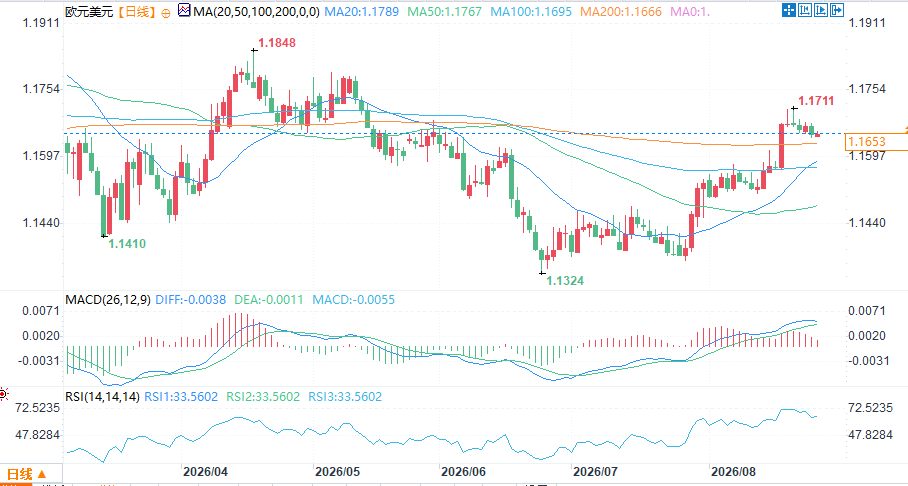 (Euro/USD daily chart, source: FX678) At 14:51 Beijing time on August 27, the euro/dollar exchange rate was 1.1653/54.
Hawkish expectations from the European Central Bank supported the euro.
The market has already priced in a 96% rate hike by the European Central Bank (ECB) in September, reflecting strong expectations of tightening. ECB Executive Board member Schnabel stated on Wednesday that the protracted conflict in the Middle East and the unexpectedly strong performance of the Eurozone economy both pose upside risks to inflation, thus necessitating a further increase in borrowing costs. This statement further solidified the market's assessment that the ECB will maintain a hawkish stance. Meanwhile, the Eurozone's economic fundamentals provided additional support: data released last Friday showed that business activity expanded at its fastest pace this year, reflecting a simultaneous recovery in demand and production momentum. Scotiabank pointed out that Schnabel's hawkish remarks effectively maintained the hawkish tone of the policy environment, reinforcing market expectations for further tightening. Overall, the continued hawkish communication from ECB officials and the resilience of the economy have created a synergy, providing relatively solid short-term support for the euro and giving it some upward potential against the dollar, even against a relatively stable dollar index.US PCE data reinforces inflation stickiness; market focus on Jackson Hole.
The US core PCE price index remained stable at 3.3% year-on-year in July, while the overall PCE year-on-year rate recorded 3.7%, higher than the market expectation of 3.6%; the month-on-month increase was 0.2%, also higher than the expected 0.1%. Overall, the data shows that US inflation remains sticky and has not shown signs of rapid cooling. Nevertheless, the CME FedWatch tool shows that the probability of the Federal Reserve holding rates steady in September remains stable at around 64%, with limited changes in rate hike expectations. Currently, the market is focusing all its attention on Federal Reserve Chairman Warsh's speech at the Jackson Hole symposium on Friday, hoping to glean more clues about the outlook for US interest rates. Warsh's remarks are expected to be a key catalyst for the short-term direction of the euro against the dollar: if his wording is hawkish, emphasizing inflation risks or retaining the option of rate hikes, the dollar may receive support, thus limiting the euro's upside potential; if his remarks are neutral or even dovish, adhering to a "less talk" strategy, the euro against the dollar may challenge the 1.1700 resistance level. Conversely, if the dollar weakens due to dovish signals, the exchange rate may also retrace to the 1.1600 support area. Therefore, Jackson Hole's speech will not only affect the US dollar itself, but will also directly determine the pace of the euro's short-term breakout or pullback.Institutional Views
UOB maintained its constructive view on the euro in its latest report on August 26, believing that EUR/USD has shown upward momentum and is expected to further test 1.1725, with a medium-term technical target of 1.1800 to 1.1850. The bank noted that the euro has broken out of its recent narrow trading range, and although the upward momentum is still in its early stages, as long as the strong support at 1.1640 holds, upside potential is likely to open up. UOB believes that hawkish statements from ECB officials and accelerated economic activity in the Eurozone provide fundamental support for the euro, while cautious sentiment towards the US dollar ahead of Jackson Hole has limited its rebound. The bank cautioned that if the exchange rate breaks below 1.1640, the short-term positive view needs to be reassessed. ING maintained a moderately bullish stance on the euro in its latest research report, expecting EUR/USD to rise to 1.17 by the end of September and reach 1.18 by the end of 2026, with a further 12-month target of 1.20. The bank's core logic is that the Federal Reserve is highly likely to hold off on rate hikes throughout the year, leading to a moderate weakening of the US dollar, while the European Central Bank may still raise rates in September, and the narrowing interest rate differential will support the euro. ING points out that current energy price volatility and the situation in the Middle East remain short-term risks, but the overall risk appetite environment is favorable for non-US currencies. The bank emphasizes that if US inflation data continues to show stickiness but does not trigger a hawkish shift by the Fed, the euro is expected to gradually rise amid fluctuations. ING also cautions that a short-term breakout above 1.1700 still requires further confirmation from a weakening US dollar; otherwise, the upside potential may be limited.Summarize
The expectation of a September rate hike by the European Central Bank continues to support the euro—the market is pricing in a 96% probability of a rate hike, and Schnabel's hawkish remarks reinforce tightening expectations. The Eurozone economy is showing resilience. US PCE data reinforced inflation stickiness—the overall annual rate was 3.7%, higher than expected, while the core annual rate remained stable at 3.3%. The market is focused on Jackson Hole's speech on Friday, whose comments will be a key catalyst for the short-term direction of the euro against the dollar. The exchange rate may fluctuate in the 1.1600-1.1700 range in the short term, awaiting new directional guidance. (Euro/USD daily chart, source: FX678) At 14:51 Beijing time on August 27, the euro/dollar exchange rate was 1.1653/54.
- Risk Warning and Disclaimer
- The market involves risk, and trading may not be suitable for all investors. This article is for reference only and does not constitute personal investment advice, nor does it take into account certain users’ specific investment objectives, financial situation, or other needs. Any investment decisions made based on this information are at your own risk.