Tariff escalation is dragging down Canadian economic growth expectations, and ING predicts the Canadian dollar will weaken further.
2026-08-27 15:34:02
On Thursday (August 27), the US dollar traded in a narrow range against the Canadian dollar during the European session, currently hovering around 1.3885, near a more than one-week high. ING expects the Canadian dollar to weaken further as the escalating US-Canada trade dispute continues to drag on economic growth, and the market has lowered its expectations for a Bank of Canada interest rate hike. 
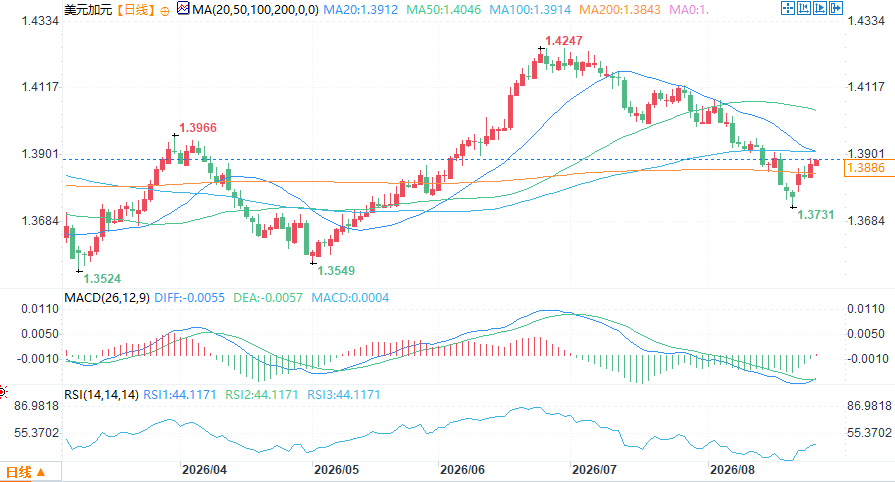 (USD/CAD daily chart, source: EasyForex) At 15:32 Beijing time, USD/CAD was trading at 1.3387/88.
The Canadian dollar still has room to fall, as the impact of tariffs has not yet been fully priced in.
A recent research report from ING indicates that the Canadian dollar still has room to weaken further, primarily because the escalating trade dispute between the US and Canada is dragging down Canada's economic growth prospects, and the market has correspondingly lowered its expectations for a Bank of Canada interest rate hike. The US officially imposed a 50% tariff on approximately C$20 billion worth of Canadian goods on August 22nd and plans to impose similar tariffs on Canadian automobiles, auto parts, and steel products starting January 1, 2027. In response, Canada announced that it will implement retaliatory tariffs of comparable scale starting September 8th, including a 50% tariff on steel and aluminum. ING emphasizes that despite the significant escalation of trade friction, the USD/CAD exchange rate has only risen by about 1.0% since the breakdown of negotiations; if the overall strengthening of the US dollar is excluded, the Canadian dollar has only fallen by about 0.5 percentage points relative to other currencies. The relatively restrained market reaction reflects that investors generally still expect both sides to eventually return to the negotiating table, rather than heading towards a protracted trade war. Therefore, the impact of tariffs has not yet been fully priced in, and if the expectation of negotiations fails to materialize, the Canadian dollar may face greater downward pressure.Policy shift and tariff risk premium support a weaker Canadian dollar.
ING believes the Canadian dollar will significantly underperform most G10 currencies in the coming months, primarily due to a rapidly dovish shift in domestic monetary policy expectations in Canada. Market pricing in cumulative interest rate hikes by April 2027 has quickly fallen from 63 basis points at the start of the week to 44 basis points, with ING itself expecting only one rate hike each in the second and fourth quarters of 2027. Meanwhile, rising tariff risk premiums are eroding the Canadian dollar's investment appeal. Notably, current exchange rate hedging costs remain significantly lower than when trade tensions first erupted in December 2024, indicating the market has not yet truly priced in a "persistent breakdown" scenario. This "underpricing" itself constitutes a potential risk for the Canadian dollar: if the trade dispute becomes protracted or Canadian economic data weakens further, monetary policy expectations may continue to ease, exacerbating downward pressure on the Canadian dollar. ING therefore views the policy shift and tariff premiums as the dual forces supporting a medium-term weakening of the Canadian dollar.The USD/CAD pair may rise to 1.39 in the short term, but its gains are limited in the medium term.
ING expects the USD/CAD exchange rate to rise to the 1.3920-1.3950 range in the short term. On the one hand, the current exchange rate is slightly below the bank's estimated short-term fair value; on the other hand, the market has not yet fully priced in the tariff risk premium, and the exchange rate could quickly catch up once sentiment turns pessimistic. However, the medium-term upside will be constrained by expectations of Federal Reserve policy. ING expects the Fed to not raise interest rates before the end of the year, and the market's current hawkish pricing of approximately 10 basis points in the September meeting and approximately 26 basis points in December is expected to gradually fade, thus limiting the overall strength of the US dollar. Based on this, ING's specific forecast is: USD/CAD at 1.39 by the end of the third quarter, and falling back to 1.38 by the end of the fourth quarter. In contrast, the Australian dollar and Norwegian krone, with their higher interest rate differentials and stronger fundamental support, are expected to significantly outperform the Canadian dollar. Overall, the Canadian dollar is under significant short-term pressure, but the medium-term depreciation may not be as drastic as some investors expect.Summarize
ING expects the Canadian dollar to weaken further, as escalating US-Canada tariffs drag down growth and lower expectations for a Bank of Canada rate hike. US tariffs on Canada have taken effect, and Canada retaliated on September 8th. The market's restrained reaction reflects continued expectations of a return to negotiations. ING forecasts the USD/CAD exchange rate to rise to 1.3920-1.3950 in the short term, but will be limited by the Fed's rate cuts in the medium term, reaching 1.39 by the end of Q3 and 1.38 by the end of Q4. The Australian dollar and Norwegian krone will significantly outperform the Canadian dollar due to higher interest rate differentials and stronger fundamentals. (USD/CAD daily chart, source: EasyForex) At 15:32 Beijing time, USD/CAD was trading at 1.3387/88.
- Risk Warning and Disclaimer
- The market involves risk, and trading may not be suitable for all investors. This article is for reference only and does not constitute personal investment advice, nor does it take into account certain users’ specific investment objectives, financial situation, or other needs. Any investment decisions made based on this information are at your own risk.