US Treasury bonds disrupt global bond markets: France, Japan, the UK, and Italy face pressure as the era of high debt faces repricing.
2026-08-27 22:03:04
The sell-off in the US Treasury market has attracted global attention, but the impact of this bond storm extends far beyond the United States. The adjustments experienced by overseas sovereign bonds, such as those of France, Italy, the UK, and Japan, have been even more severe than those in the US. The sharp rise in US borrowing costs, prompting Treasury Secretary Bessant to intervene and lower long-term yields, has also brought the increasingly serious global debt problem to the forefront. 
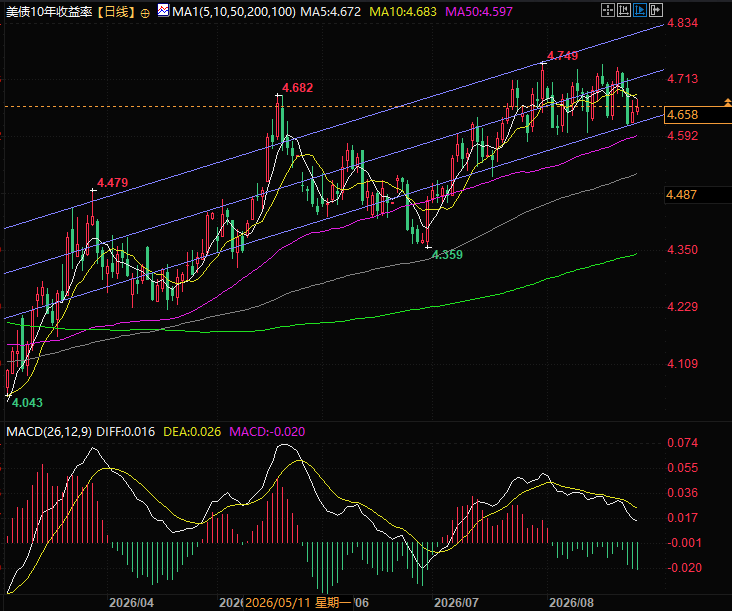 (Daily chart of the US 10-year Treasury yield, source: EasyTrade)
Global debt levels hit a new high, intensifying competition for funds in the bond market.
According to data from the Institute of International Finance, global debt has surpassed $350 trillion, equivalent to 305% of global GDP. The OECD estimates that developed economies alone will raise $18 trillion this year. Governments are competing with US tech companies for limited funds through bond issuance, intensifying buyer competition in the bond market. Although global bond yields have declined this week, yields in many countries remain at their highest levels in over a decade. Comparatively, since the end of June, the yield on 10-year US Treasury bonds has risen by about 0.2 percentage points; the yield on 10-year French bonds has risen by about 0.5 percentage points, with Italy experiencing a similar increase. European highly indebted economies are facing significantly greater market pressure than the US. Allianz's chief investment officer pointed out that the market is testing the bottom line of US financing costs while also examining the fiscal vulnerabilities of other economies. "Everyone is watching to see which country will be the first to succumb to the market pressure from the bond market." The so-called bond market is a market constraint exerted by investors selling bonds against sovereign entities that engage in fiscal waste. As the cornerstone of the global financial system, the price fluctuations of US Treasury bonds have a strong spillover effect, providing a pricing benchmark for various assets worldwide. The recent sharp decline in overseas bond markets is also driven by multiple independent factors: renewed geopolitical conflicts fueling inflation concerns, increased political uncertainty in various countries, and traditional stable bond buyers such as pension funds and insurance institutions withdrawing from bond markets in many countries, further amplifying selling pressure.The memory of the energy crisis resurfaces, and inflation expectations push up European bond yields.
The resurgence of inflation due to tightening energy supplies is a major disruptive factor in the European bond market. Many economists previously believed that inflationary pressures from geopolitical conflicts had subsided, but for Europe and Asia, which are highly dependent on energy imports, inflation risks are rising again. European natural gas prices have recently climbed to a more than three-year high, with European and Asian buyers vying for limited gas supplies from the Middle East, and European countries needing to fill their gas storage facilities before winter. Institutional strategists say the market still remembers the 2022 energy crisis, when Russia cut gas supplies, causing European natural gas prices to surge and directly prompting the ECB to begin an aggressive interest rate hike cycle. Natural gas prices are a leading indicator of rising inflation. Influenced by rising inflation expectations, the market is currently pricing in 1.5 ECB rate hikes this year, compared to only one expected in early August. This upward shift in rate hike expectations is directly pushing up European bond yields.France: Fiscal problems compounded by election turmoil turn it into the epicenter of a bond market storm.
France has become the epicenter of this bond market storm. The Macron government has struggled to control fiscal spending for years, with this year's budget deficit projected to remain at 5% of GDP, and economic growth weak. Next year, France will hold a presidential election, with polls showing populist leader Le Pin as the frontrunner, raising market concerns about whether he will tighten fiscal spending. Currently, French borrowing costs exceed those of most major European economies, including Greece and Italy. The risk premium of French 10-year bonds relative to German bonds has reached 0.85 percentage points, a high in recent years. Strategists at Edmund Rothschild predict that as the election approaches, this spread may exceed 1 percentage point, noting that "the market has realized that the long-term sustainability of French debt is questionable, and the outlook is not optimistic."Japan: Inflation Returns, Debt Burden Continues to Expand
The Japanese bond market has also experienced significant volatility. Decades of deflation are receding, and overall inflation in Japan is approaching the 2% target, yet the Bank of Japan has only raised interest rates once this year, bringing them down to 1%. The slow pace of interest rate hikes by the central bank continues to pressure the yen's exchange rate, prompting a rare joint intervention by the US and Japan to support the yen. The market widely expects the Bank of Japan to raise rates again around October. The Japanese government has also introduced spending plans including tax cuts and increased defense spending. Although Japan's debt is approximately 200% of GDP, its budget deficit is relatively low compared to other major economies. However, with rising financing costs, the debt interest burden is rapidly expanding, with debt servicing expenditures projected at approximately $230 billion in the next fiscal year, a 17% year-on-year increase. In the past, Japan relied on substantial overseas investment income to offset domestic interest expenses, but this buffer mechanism is being weakened by high domestic borrowing costs. The investment income surplus from overseas investments has served as an indirect risk buffer: improving the balance of payments, maintaining national credit, and reducing the probability of sovereign debt being heavily attacked by the market. With Japan raising interest rates and domestic debt servicing costs soaring, this historical buffer effect is weakening, which is one of the core risks in the current Japanese bond market.UK: The shadow of a historic debt market lingers, and the new government faces a major fiscal test.
The UK bond market has not yet recovered from the shadow of the Truss tax cuts of 2022. Subsequent governments have adhered to fiscal rules to restore market confidence, but investors remain concerned about the debt path. Like other European countries, pension funds that previously held large positions in long-term bonds are now flowing out of the bond market. New Prime Minister Bernham has proposed a housing construction and investment stimulus plan, but rising yields are increasing government financing costs. Societe Generale estimates that rising yields will impose approximately $10 billion in additional costs on the UK, squeezing the space for new fiscal spending. The government's first budget this autumn will be a crucial test of the UK's fiscal credibility.Conclusion: In an era of high debt, the repricing of the global bond market continues.
This global bond market repricing demonstrates that in a high-debt environment, fluctuations in any variable—such as recurring inflation, fiscal expansion, or political instability—can trigger severe volatility in sovereign bonds. While fluctuations in US Treasury bonds are radiating outwards, the fiscal and macroeconomic risks of individual countries determine the varying degrees of pressure they bear, indicating that the test of global debt risk will continue. (Daily chart of the US 10-year Treasury yield, source: EasyTrade)
- Risk Warning and Disclaimer
- The market involves risk, and trading may not be suitable for all investors. This article is for reference only and does not constitute personal investment advice, nor does it take into account certain users’ specific investment objectives, financial situation, or other needs. Any investment decisions made based on this information are at your own risk.