A chart shows that the Baltic Dry Index continues to rise, with freight rates for multiple vessel types increasing to a near three-month high.
2026-08-28 01:05:09
The latest data shows that the Baltic Dry Index (BDI) reached 3107 points on August 27, 2026, a new high since June 3, 2026, up 1.67% month-on-month, marking the sixth consecutive day of increase (including zero growth). Looking at the short-term charts, the recent 11 BDI data points show: 8 positive increases, 3 negative increases, and 0 zero increases. Specifically, the Panamax Freight Index (BPI) was 2292 points, up 2.05% from the previous value; the Capesize Freight Index (BCI) was 5138 points, up 2.09%; and the Supramax Freight Index (BSI) was 1645 points, up 0.06%. For detailed 720-day and 10-year trend charts of the Baltic Dry Index and its three main sub-indices, please refer to the charts specially created by FX678. 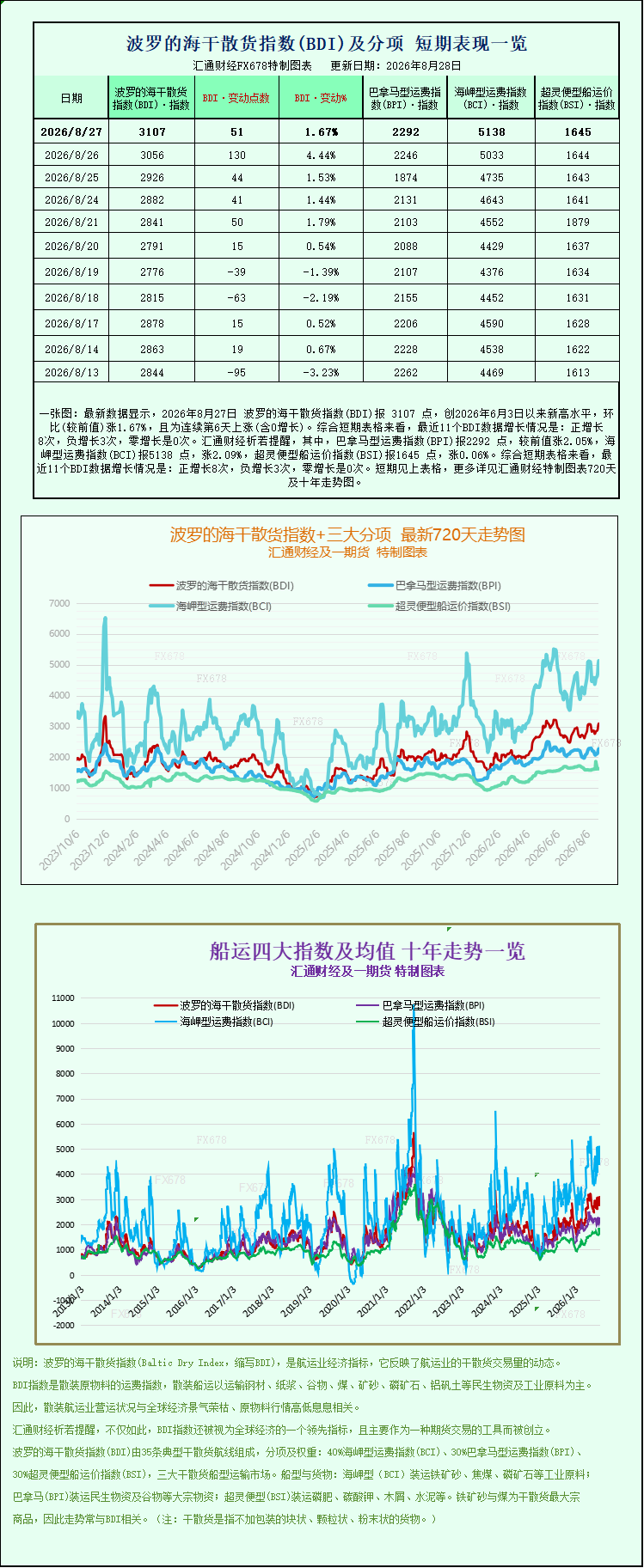 On August 27, 2026, the latest shipping market data showed that the international dry bulk shipping market continued its strong upward trend. The Baltic Dry Index (BDI) surged again, reaching a new high in nearly three months, and achieved a steady increase for six consecutive trading days. Freight rates for all types of vessels rose in tandem, indicating a continued warming of the global dry bulk shipping trade. By the close of trading that day, the Baltic Dry Index (BDI) rose 51 points to 3107 points, a single-day increase of 1.7%, completely reversing the previous weak market trend and becoming the most eye-catching market signal in the recent international shipping market. This index increase was characterized by a broad-based increase across all vessel types, with larger vessels leading the way. Freight rates for dry bulk vessels of different tonnages and carrying different types of goods all increased to varying degrees, with large vessels carrying bulk industrial raw materials showing the most significant increases, becoming the core driving force behind the index's rise. Looking at the data for specific vessel types, Capesize vessels performed the best, with the index surging 105 points, or 2.1%, to close at 5138 points, a near three-month high since June 3rd. This vessel type primarily carries ultra-large bulk cargoes of 150,000 tons, with core commodities including iron ore, thermal coal, and coking coal, making it a mainstay in global maritime trade of industrial raw materials. Profitability data more directly reflects market activity; the average daily revenue for Capesize vessels surged by $950 to $43,098, approaching its year-to-date high. It's worth noting that this round of Capesize freight rate increases is deeply intertwined with changes in the global steel industry chain's trade structure. Market data shows that while iron ore futures prices have recently declined slightly, coking coal costs have continued to rise, creating a clear cost support logic. On the one hand, the continued recovery in global steel export demand has driven a steady release of demand for cross-border iron ore transportation. On the other hand, rising coking coal prices have offset the negative impact of weakening iron ore prices, prompting steel mills to replenish their inventories, further boosting orders for ocean-going bulk raw material transportation and supporting the continued strength of freight rates for large Capesize vessels. The medium-sized vessel market followed suit, maintaining a strong upward trend. The Baltic Panamax Index rose 46 points, or 2.1%, to 2292 points, a new high since August 12. Panamax vessels, with a mainstream deadweight tonnage of 60,000 to 70,000 tons, mainly carry bulk cargoes such as coal, grain, and fertilizer, which are essential for people's livelihoods and industry. Their routes cover major trade routes in the Atlantic and Pacific Oceans, making them a mainstay of global dry cargo shipping. The rise in freight rates boosted their average daily operating revenue by $419, eventually reaching $20,632. The profitability of medium-sized bulk carriers steadily recovered, and the operating pressure on small and medium-sized shipping companies continued to ease. While the small vessel market saw relatively moderate increases, it continued its steady upward trend. The BSIS index, which tracks Supramax vessels, rose slightly by 1 point, or 0.06%, to close at 1645 points, maintaining its continuous and steady upward trajectory. Supramax vessels offer greater flexibility, are well-suited for short-haul, small-volume bulk cargo transportation, and cover regional trade and peripheral routes. Their stable recovery in freight rates signifies a comprehensive recovery in global dry bulk shipping demand. The price increase is not a structural phenomenon limited to a single route or product category, but rather a genuine recovery in overall market sentiment. In summary, the Baltic Dry Index's six consecutive days of increases, reaching a three-month high, is the result of a combination of factors, including recovering demand, supply disruptions, and climate and geopolitical influences. On the demand side, entering late August, global industrial production steadily recovered, with increased manufacturing activity in many parts of Asia and Europe, driving a rebound in import demand for industrial raw materials such as iron ore and coal. Simultaneously, pre-sales of autumn harvest grains in the Northern Hemisphere and early release of cross-border shipping orders further fueled the continued rise in dry bulk shipping demand. The temporary contraction in supply is a key driver of rising freight rates. Recent frequent typhoons in the Northwest Pacific and South China Sea have led to temporary port closures and vessel congestion in many areas, reducing shipping turnover efficiency and tightening short-term effective shipping capacity. Simultaneously, the Panama Canal's navigation restrictions continue to tighten, forcing some vessels to choose alternative routes, lengthening voyages and further depleting existing market capacity, pushing up shipping costs. Furthermore, the El Niño climate effect continues to manifest, with weakened monsoons and limited hydropower generation in regions like India, leading to a surge in regional coal import demand and further revitalizing the global seaborne coal trade market. Geopolitical risk premiums also continue to support freight rates. Uncertainty regarding the operation of major global shipping routes remains, slightly increasing route operating risk costs, leading shipping companies to generally raise their quotes, supporting a steady upward shift in the market's freight rate center. At the same time, previous negative market sentiment has largely dissipated, and the shipping market is gradually returning to supply and demand fundamentals. Improved capital and trading sentiment are contributing to the continued rise in the index. Regarding future market trends, industry analysts point out that as the traditional autumn and winter peak shipping season approaches, global demand for industrial raw material restocking and grain transportation will be further concentrated, potentially leading to continued expansion in dry bulk shipping demand. Coupled with the difficulty in quickly alleviating the tight supply of shipping capacity in the short term, the Baltic Dry Index is likely to continue its upward trend, with room for further recovery in freight rates across various vessel types. However, market uncertainties remain, requiring continued monitoring of commodity price fluctuations, the pace of global manufacturing recovery, and the impact of extreme weather and geopolitical events on shipping routes. Overall, the global dry bulk shipping market has entered a phase of recovery, with industry sentiment continuing to improve.
On August 27, 2026, the latest shipping market data showed that the international dry bulk shipping market continued its strong upward trend. The Baltic Dry Index (BDI) surged again, reaching a new high in nearly three months, and achieved a steady increase for six consecutive trading days. Freight rates for all types of vessels rose in tandem, indicating a continued warming of the global dry bulk shipping trade. By the close of trading that day, the Baltic Dry Index (BDI) rose 51 points to 3107 points, a single-day increase of 1.7%, completely reversing the previous weak market trend and becoming the most eye-catching market signal in the recent international shipping market. This index increase was characterized by a broad-based increase across all vessel types, with larger vessels leading the way. Freight rates for dry bulk vessels of different tonnages and carrying different types of goods all increased to varying degrees, with large vessels carrying bulk industrial raw materials showing the most significant increases, becoming the core driving force behind the index's rise. Looking at the data for specific vessel types, Capesize vessels performed the best, with the index surging 105 points, or 2.1%, to close at 5138 points, a near three-month high since June 3rd. This vessel type primarily carries ultra-large bulk cargoes of 150,000 tons, with core commodities including iron ore, thermal coal, and coking coal, making it a mainstay in global maritime trade of industrial raw materials. Profitability data more directly reflects market activity; the average daily revenue for Capesize vessels surged by $950 to $43,098, approaching its year-to-date high. It's worth noting that this round of Capesize freight rate increases is deeply intertwined with changes in the global steel industry chain's trade structure. Market data shows that while iron ore futures prices have recently declined slightly, coking coal costs have continued to rise, creating a clear cost support logic. On the one hand, the continued recovery in global steel export demand has driven a steady release of demand for cross-border iron ore transportation. On the other hand, rising coking coal prices have offset the negative impact of weakening iron ore prices, prompting steel mills to replenish their inventories, further boosting orders for ocean-going bulk raw material transportation and supporting the continued strength of freight rates for large Capesize vessels. The medium-sized vessel market followed suit, maintaining a strong upward trend. The Baltic Panamax Index rose 46 points, or 2.1%, to 2292 points, a new high since August 12. Panamax vessels, with a mainstream deadweight tonnage of 60,000 to 70,000 tons, mainly carry bulk cargoes such as coal, grain, and fertilizer, which are essential for people's livelihoods and industry. Their routes cover major trade routes in the Atlantic and Pacific Oceans, making them a mainstay of global dry cargo shipping. The rise in freight rates boosted their average daily operating revenue by $419, eventually reaching $20,632. The profitability of medium-sized bulk carriers steadily recovered, and the operating pressure on small and medium-sized shipping companies continued to ease. While the small vessel market saw relatively moderate increases, it continued its steady upward trend. The BSIS index, which tracks Supramax vessels, rose slightly by 1 point, or 0.06%, to close at 1645 points, maintaining its continuous and steady upward trajectory. Supramax vessels offer greater flexibility, are well-suited for short-haul, small-volume bulk cargo transportation, and cover regional trade and peripheral routes. Their stable recovery in freight rates signifies a comprehensive recovery in global dry bulk shipping demand. The price increase is not a structural phenomenon limited to a single route or product category, but rather a genuine recovery in overall market sentiment. In summary, the Baltic Dry Index's six consecutive days of increases, reaching a three-month high, is the result of a combination of factors, including recovering demand, supply disruptions, and climate and geopolitical influences. On the demand side, entering late August, global industrial production steadily recovered, with increased manufacturing activity in many parts of Asia and Europe, driving a rebound in import demand for industrial raw materials such as iron ore and coal. Simultaneously, pre-sales of autumn harvest grains in the Northern Hemisphere and early release of cross-border shipping orders further fueled the continued rise in dry bulk shipping demand. The temporary contraction in supply is a key driver of rising freight rates. Recent frequent typhoons in the Northwest Pacific and South China Sea have led to temporary port closures and vessel congestion in many areas, reducing shipping turnover efficiency and tightening short-term effective shipping capacity. Simultaneously, the Panama Canal's navigation restrictions continue to tighten, forcing some vessels to choose alternative routes, lengthening voyages and further depleting existing market capacity, pushing up shipping costs. Furthermore, the El Niño climate effect continues to manifest, with weakened monsoons and limited hydropower generation in regions like India, leading to a surge in regional coal import demand and further revitalizing the global seaborne coal trade market. Geopolitical risk premiums also continue to support freight rates. Uncertainty regarding the operation of major global shipping routes remains, slightly increasing route operating risk costs, leading shipping companies to generally raise their quotes, supporting a steady upward shift in the market's freight rate center. At the same time, previous negative market sentiment has largely dissipated, and the shipping market is gradually returning to supply and demand fundamentals. Improved capital and trading sentiment are contributing to the continued rise in the index. Regarding future market trends, industry analysts point out that as the traditional autumn and winter peak shipping season approaches, global demand for industrial raw material restocking and grain transportation will be further concentrated, potentially leading to continued expansion in dry bulk shipping demand. Coupled with the difficulty in quickly alleviating the tight supply of shipping capacity in the short term, the Baltic Dry Index is likely to continue its upward trend, with room for further recovery in freight rates across various vessel types. However, market uncertainties remain, requiring continued monitoring of commodity price fluctuations, the pace of global manufacturing recovery, and the impact of extreme weather and geopolitical events on shipping routes. Overall, the global dry bulk shipping market has entered a phase of recovery, with industry sentiment continuing to improve.
- Risk Warning and Disclaimer
- The market involves risk, and trading may not be suitable for all investors. This article is for reference only and does not constitute personal investment advice, nor does it take into account certain users’ specific investment objectives, financial situation, or other needs. Any investment decisions made based on this information are at your own risk.