Tokyo's core inflation rose to 1.8%, strengthening expectations of a September rate hike in Japan. The USD/JPY pair rebounded near the upper limit of its trading range, awaiting a directional move.
2026-08-28 13:25:03
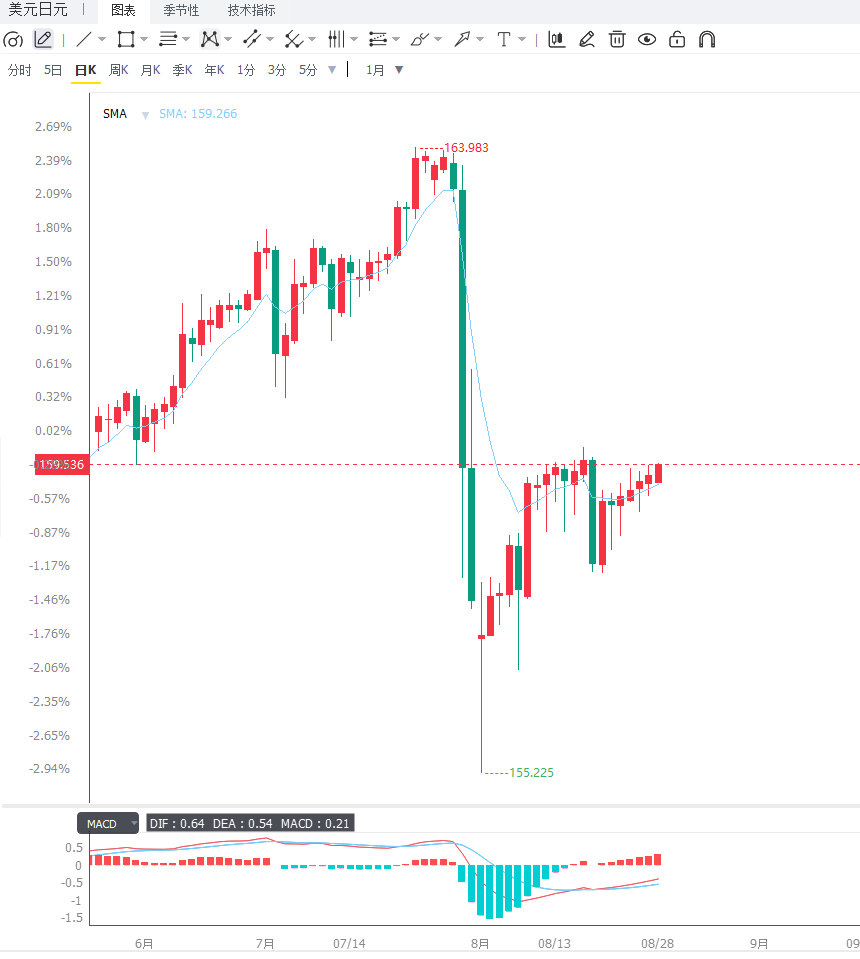
The USD/JPY pair rebounded to around 159.50 in early Asian trading on Friday, with the yen regaining some support after recent consolidation. The main factor driving the pair lower was improved Japanese inflation data, with Tokyo's August price increases accelerating again, leading the market to further bet that the Bank of Japan might continue tightening monetary policy at its September policy meeting. Meanwhile, the upcoming speech by Federal Reserve Chairman Kevin Warsh at the Jackson Hole Economic Symposium will also influence the short-term direction of the USD/JPY pair, making it susceptible to changes in interest rate expectations in both Japan and the US.  Data released by Japan's Ministry of Internal Affairs and Communications on Friday showed that Tokyo's overall CPI rose 1.9% year-on-year in August, up from 1.8% in July; the core CPI, excluding fresh food, rose 1.8% year-on-year, a further rebound from the revised 1.7% in July and higher than the market expectation of 1.7%. The CPI, excluding food and energy, which is more closely watched by the Bank of Japan, rose 2.0% year-on-year, a significant acceleration from the previously revised 1.8%. This data suggests that Japan's underlying inflationary pressures remain relatively resilient, providing new evidence for the continued normalization of policy. Tokyo's inflation data is highly valued by the market because it is generally considered an important leading indicator of national inflation trends. If core inflation continues to approach or reach the Bank of Japan's 2% target, while wages and service prices remain relatively sticky, the necessity for the Bank of Japan to maintain its ultra-loose policy will further decrease. The market has now significantly increased its expectations for an interest rate hike at the policy meeting on September 17-18, with the money market previously pricing in an approximately 86% probability of a September rate hike. This means that the yen's sensitivity to Japanese inflation data is significantly increasing. However, the policy signals within the Bank of Japan are still not entirely clear. Bank of Japan Deputy Governor Ryozo Himino previously stated that the Bank of Japan needs to pay closer attention to the upside risks of inflation than in the past, and emphasized that timely interest rate hikes would help avoid a future situation where the central bank is forced to suddenly tighten policy significantly. This statement clearly leans towards a hawkish stance, but he did not directly confirm that a rate hike in September is certain. It is precisely this "hawkish but without a clear timetable" communication style that led some investors to reduce their bets on a September rate hike, resulting in a temporary weakening of the yen. From a policy perspective, the core issue facing the Bank of Japan has gradually shifted from "whether to end ultra-loose monetary policy" to "how quickly interest rate hikes should be implemented." If core inflation in Tokyo continues to remain near the target, and economic activity and wage growth do not deteriorate significantly, the Bank of Japan may be more inclined to gradually raise policy rates. Conversely, if excessive appreciation of the yen leads to a significant decline in import prices, or if domestic demand cools down considerably, the central bank may slow the pace of tightening. Therefore, even though the probability of a September rate hike is high, the subsequent policy path remains highly uncertain. As for the US dollar, market focus has shifted to Jackson Hole. Federal Reserve Chairman Kevin Warsh will deliver a keynote speech at 10:00 AM local time on August 28th, his first keynote address at Jackson Hole since becoming Fed chairman. Given the recent high levels of US inflation and persistently high yields on long-term US Treasury bonds, investors are hoping to glean more clues from his speech regarding inflation assessments, the future path of interest rates, and the Fed's policy framework. Currently, market attention is significantly focused on Warsh's speech compared to speeches by other policy officials, as the dollar, US Treasury yields, and expectations for the September Federal Open Market Committee policy meeting are all likely to be influenced by his remarks. While the recent July PCE data did not completely disrupt market expectations, inflation remained above the Fed's 2% target, making the market cautious about the scope for short-term rate cuts. At the same time, relatively high yields on long-term US Treasury bonds, coupled with fiscal deficits and government financing needs, are increasing uncertainty surrounding dollar-denominated assets. If Warsh emphasizes the continued prominence of inflation risks and signals the need to maintain restrictive interest rates or even further tighten policy, US yields could gain new upward momentum, the dollar is expected to rebound, and USD/JPY may retest the 160.00 level. Conversely, if Warsh emphasizes economic growth risks, changes in the labor market, and future policy flexibility, the market may raise its expectations for a decline in US interest rates, further pressuring the dollar and increasing downward pressure on USD/JPY. Therefore, USD/JPY is currently in a typical dual game of "improved yen fundamentals and pending confirmation of dollar policy risks." Japanese inflation data provides directional support for the yen, but whether the dollar has truly weakened depends on the Fed Chairman's speech providing new interest rate signals. In this situation, even if the exchange rate falls below $159 in the short term, it does not mean that the medium-term trend has reversed; similarly, a return to $160 cannot be simply interpreted as the yen's interest rate hike logic failing. Three variables need to be closely watched in the coming trading days: first, whether Bank of Japan officials further reinforce the signal of a September rate hike; second, what impact Warsh's speech will have on US interest rate expectations; and third, whether US Treasury yields and the dollar index can move in tandem. If the Bank of Japan maintains a hawkish stance while the Federal Reserve gradually reveals its easing inclinations, the interest rate advantage of USD/JPY may narrow further. If sticky US inflation forces the Fed to maintain or even strengthen restrictive policies, while the Bank of Japan remains cautious, USD/JPY may continue to fluctuate at high levels. From a daily chart perspective, USD/JPY is currently still in a high-level consolidation pattern. After rebounding to around 159.50, short-term bullish momentum has weakened. The exchange rate is currently below the 100-day simple moving average, but still near the upper Bollinger Band, indicating that the medium-term bullish structure has not been completely broken, but upward pressure is already quite evident. The daily RSI is around 47, in the neutral-to-weak zone, showing that the previous upward momentum is waning. The first resistance level to watch is the 100-day moving average around 160.00. A successful break above this level would target the upper Bollinger Band around 160.30. If it can hold above 160.30, it could potentially reopen the space for a rebound towards 161.00 or even 162.00. The initial support level is located near the Bollinger Band middle line at 158.85. A break below this level would target the lower Bollinger Band at 157.45. A break below this level could trigger a more significant medium-term correction in USD/JPY. Looking at the 4-hour chart, USD/JPY has formed a weak, range-bound structure after recently retreating from near the 160 level. Short-term moving averages are gradually flattening, and the MACD momentum is converging from a previously strong state to the neutral zone, indicating that bulls currently lack the strength to sustain a break above $160. The 159.00-158.85 area is a key support zone that bulls need to hold in the short term. If the price stabilizes in this area and breaks above 159.70-160.00, there is a possibility of retesting 160.30 in the short term. Conversely, if the 4-hour chart shows a decisive break below 158.85, the pullback target could further point towards 158.00 and the vicinity of 157.45. Overall, the current technical picture does not show a clear one-sided trend. The $160 level remains a crucial watershed for judging the short-term strength or weakness of USD/JPY. Changes in policy expectations from the Bank of Japan and the Federal Reserve will determine whether a technical breakout can be confirmed by fundamentals.
  Editor's Summary: Tokyo's core inflation rebounded to 1.8%, and inflation excluding food and energy rose to 2.0%, reinforcing market expectations for further normalization by the Bank of Japan, providing new fundamental support for the yen. Meanwhile, Federal Reserve Chairman Warsh's Jackson Hole speech will be another decisive variable for USD/JPY. In the short term, 160.00-160.30 is a key resistance zone for USD/JPY, while 158.85 is an important downside watershed. If the Bank of Japan further signals a September rate hike, and Warsh's speech leans towards dovishness, USD/JPY may open up more downside potential; conversely, if US interest rate expectations rise again, the 160 level may be broken again. Therefore, the most important factor to watch is not a single economic data point, but whether the divergence between Japanese and US monetary policies has truly begun to narrow. If this trend continues, the risk of a pullback from the medium-term highs in USD/JPY will further increase; if US yields rise again, the exchange rate may remain volatile at high levels, awaiting a new directional catalyst.
Data released by Japan's Ministry of Internal Affairs and Communications on Friday showed that Tokyo's overall CPI rose 1.9% year-on-year in August, up from 1.8% in July; the core CPI, excluding fresh food, rose 1.8% year-on-year, a further rebound from the revised 1.7% in July and higher than the market expectation of 1.7%. The CPI, excluding food and energy, which is more closely watched by the Bank of Japan, rose 2.0% year-on-year, a significant acceleration from the previously revised 1.8%. This data suggests that Japan's underlying inflationary pressures remain relatively resilient, providing new evidence for the continued normalization of policy. Tokyo's inflation data is highly valued by the market because it is generally considered an important leading indicator of national inflation trends. If core inflation continues to approach or reach the Bank of Japan's 2% target, while wages and service prices remain relatively sticky, the necessity for the Bank of Japan to maintain its ultra-loose policy will further decrease. The market has now significantly increased its expectations for an interest rate hike at the policy meeting on September 17-18, with the money market previously pricing in an approximately 86% probability of a September rate hike. This means that the yen's sensitivity to Japanese inflation data is significantly increasing. However, the policy signals within the Bank of Japan are still not entirely clear. Bank of Japan Deputy Governor Ryozo Himino previously stated that the Bank of Japan needs to pay closer attention to the upside risks of inflation than in the past, and emphasized that timely interest rate hikes would help avoid a future situation where the central bank is forced to suddenly tighten policy significantly. This statement clearly leans towards a hawkish stance, but he did not directly confirm that a rate hike in September is certain. It is precisely this "hawkish but without a clear timetable" communication style that led some investors to reduce their bets on a September rate hike, resulting in a temporary weakening of the yen. From a policy perspective, the core issue facing the Bank of Japan has gradually shifted from "whether to end ultra-loose monetary policy" to "how quickly interest rate hikes should be implemented." If core inflation in Tokyo continues to remain near the target, and economic activity and wage growth do not deteriorate significantly, the Bank of Japan may be more inclined to gradually raise policy rates. Conversely, if excessive appreciation of the yen leads to a significant decline in import prices, or if domestic demand cools down considerably, the central bank may slow the pace of tightening. Therefore, even though the probability of a September rate hike is high, the subsequent policy path remains highly uncertain. As for the US dollar, market focus has shifted to Jackson Hole. Federal Reserve Chairman Kevin Warsh will deliver a keynote speech at 10:00 AM local time on August 28th, his first keynote address at Jackson Hole since becoming Fed chairman. Given the recent high levels of US inflation and persistently high yields on long-term US Treasury bonds, investors are hoping to glean more clues from his speech regarding inflation assessments, the future path of interest rates, and the Fed's policy framework. Currently, market attention is significantly focused on Warsh's speech compared to speeches by other policy officials, as the dollar, US Treasury yields, and expectations for the September Federal Open Market Committee policy meeting are all likely to be influenced by his remarks. While the recent July PCE data did not completely disrupt market expectations, inflation remained above the Fed's 2% target, making the market cautious about the scope for short-term rate cuts. At the same time, relatively high yields on long-term US Treasury bonds, coupled with fiscal deficits and government financing needs, are increasing uncertainty surrounding dollar-denominated assets. If Warsh emphasizes the continued prominence of inflation risks and signals the need to maintain restrictive interest rates or even further tighten policy, US yields could gain new upward momentum, the dollar is expected to rebound, and USD/JPY may retest the 160.00 level. Conversely, if Warsh emphasizes economic growth risks, changes in the labor market, and future policy flexibility, the market may raise its expectations for a decline in US interest rates, further pressuring the dollar and increasing downward pressure on USD/JPY. Therefore, USD/JPY is currently in a typical dual game of "improved yen fundamentals and pending confirmation of dollar policy risks." Japanese inflation data provides directional support for the yen, but whether the dollar has truly weakened depends on the Fed Chairman's speech providing new interest rate signals. In this situation, even if the exchange rate falls below $159 in the short term, it does not mean that the medium-term trend has reversed; similarly, a return to $160 cannot be simply interpreted as the yen's interest rate hike logic failing. Three variables need to be closely watched in the coming trading days: first, whether Bank of Japan officials further reinforce the signal of a September rate hike; second, what impact Warsh's speech will have on US interest rate expectations; and third, whether US Treasury yields and the dollar index can move in tandem. If the Bank of Japan maintains a hawkish stance while the Federal Reserve gradually reveals its easing inclinations, the interest rate advantage of USD/JPY may narrow further. If sticky US inflation forces the Fed to maintain or even strengthen restrictive policies, while the Bank of Japan remains cautious, USD/JPY may continue to fluctuate at high levels. From a daily chart perspective, USD/JPY is currently still in a high-level consolidation pattern. After rebounding to around 159.50, short-term bullish momentum has weakened. The exchange rate is currently below the 100-day simple moving average, but still near the upper Bollinger Band, indicating that the medium-term bullish structure has not been completely broken, but upward pressure is already quite evident. The daily RSI is around 47, in the neutral-to-weak zone, showing that the previous upward momentum is waning. The first resistance level to watch is the 100-day moving average around 160.00. A successful break above this level would target the upper Bollinger Band around 160.30. If it can hold above 160.30, it could potentially reopen the space for a rebound towards 161.00 or even 162.00. The initial support level is located near the Bollinger Band middle line at 158.85. A break below this level would target the lower Bollinger Band at 157.45. A break below this level could trigger a more significant medium-term correction in USD/JPY. Looking at the 4-hour chart, USD/JPY has formed a weak, range-bound structure after recently retreating from near the 160 level. Short-term moving averages are gradually flattening, and the MACD momentum is converging from a previously strong state to the neutral zone, indicating that bulls currently lack the strength to sustain a break above $160. The 159.00-158.85 area is a key support zone that bulls need to hold in the short term. If the price stabilizes in this area and breaks above 159.70-160.00, there is a possibility of retesting 160.30 in the short term. Conversely, if the 4-hour chart shows a decisive break below 158.85, the pullback target could further point towards 158.00 and the vicinity of 157.45. Overall, the current technical picture does not show a clear one-sided trend. The $160 level remains a crucial watershed for judging the short-term strength or weakness of USD/JPY. Changes in policy expectations from the Bank of Japan and the Federal Reserve will determine whether a technical breakout can be confirmed by fundamentals. Editor's Summary: Tokyo's core inflation rebounded to 1.8%, and inflation excluding food and energy rose to 2.0%, reinforcing market expectations for further normalization by the Bank of Japan, providing new fundamental support for the yen. Meanwhile, Federal Reserve Chairman Warsh's Jackson Hole speech will be another decisive variable for USD/JPY. In the short term, 160.00-160.30 is a key resistance zone for USD/JPY, while 158.85 is an important downside watershed. If the Bank of Japan further signals a September rate hike, and Warsh's speech leans towards dovishness, USD/JPY may open up more downside potential; conversely, if US interest rate expectations rise again, the 160 level may be broken again. Therefore, the most important factor to watch is not a single economic data point, but whether the divergence between Japanese and US monetary policies has truly begun to narrow. If this trend continues, the risk of a pullback from the medium-term highs in USD/JPY will further increase; if US yields rise again, the exchange rate may remain volatile at high levels, awaiting a new directional catalyst.
- Risk Warning and Disclaimer
- The market involves risk, and trading may not be suitable for all investors. This article is for reference only and does not constitute personal investment advice, nor does it take into account certain users’ specific investment objectives, financial situation, or other needs. Any investment decisions made based on this information are at your own risk.