Fund managers have proposed a cycle of fiscal doom, claiming that a gold price of $10,000 is just the beginning.
2026-08-28 12:15:01
Despite recent volatility, gold has achieved extraordinary gains over the past two years. According to one fund manager, after the recent pullback, the precious metal is poised to resume its long-term upward trend. He stated that while the months-long correction indicates the market is maturing, gold prices are far from reaching their peak.
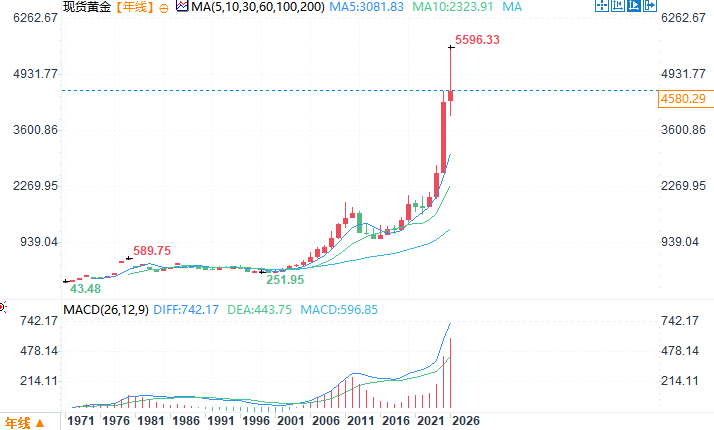 Spot gold annual chart source: FX678. As of 12:13 PM Beijing time on August 28, spot gold was trading at $4579.29 per ounce.
Mathematics is not on the side of the Federal Reserve
Larry Lepard, managing partner at Equity Management Associates, explains that the global monetary system is only just beginning to confront an uncomfortable mathematical reality: governments have accumulated too much debt to combat inflation as they have in the past. Despite Federal Reserve Chairman Kevin Warsh's reputation as an inflation hawk, Lepard says monetary and fiscal constraints will ultimately dominate policy. Warsh, in his preparation to take over the U.S. central bank, spoke of shrinking the Fed's balance sheet, hinting at tighter monetary conditions. Lepard says the new Fed chairman will ultimately be forced to confront the math. "These maths don't work for him," he says. Lepard adds that the disconnect between the mainstream monetary policy narrative and the underlying fiscal reality is widening. "On one side is the narrative, on the other is the mathematical fact," he says, pointing to the ever-growing size of government deficits. He says this distinction is crucial for gold investors, and even after the dramatic rise in precious metals, he believes the fundamental forces driving the market remain largely unchanged.Volker's prescription is no longer replicable today.
The problem, LePad argues, is that policymakers no longer possess the flexibility they had when dealing with the inflation crisis of the 1970s and early 1980s. Former Federal Reserve Chairman Paul Volcker broke that inflation cycle by pushing interest rates up to levels that generated deep positive real yields. However, he points out that then U.S. government debt was about 30% of GDP, while today that figure is around 120%. LePad states, "I don't see how we can get out of this situation unless we either experience years of very high inflation like in South America—maybe that's the end—or we completely fail, leading to a monetary reset."The fiscal doomsday cycle: This is how money fails.
Lepard describes this dynamic as a potential fiscal doomsday cycle: higher interest rates drive up interest payments, larger interest payments widen deficits, governments issue more bonds, and the additional supply puts even greater upward pressure on borrowing costs . He says, "That's how money fails." In this context, Lepard believes currency devaluation is the more politically likely option. Faced with the dilemma of either allowing excessive debt and leverage to clear itself through defaults and economic contraction, or creating more money to prop up the financial system, he expects policymakers to choose the latter. He states, "Given a choice between printing money and collapse, they will print money."AI can't save us, and growth can't escape inflation.
Even stronger economic growth may not provide a solution. Lepad acknowledges that artificial intelligence could bring substantial productivity gains, but he doubts these gains will come quickly enough or be large enough to overcome existing fiscal imbalances. Shedding the debt burden also requires a significant acceleration in nominal economic growth, which he believes will almost certainly be accompanied by inflation. If bond investors realize that governments intend to use inflation to escape debt, Lepad says this perception itself could push up yields and force policymakers to intervene. For gold, this means that regardless of short-term volatility, the long-term investment logic remains intact. Lepad states, "So we really don't know how it's unfolding politically. But mathematically, we're on the right side of this trade."Last year's 65% increase was only in the early stages of the cycle.
LePad's conviction remains strong even after the significant rise in precious metals. He notes that gold rose approximately 65% last year, a performance he considers highly unusual for the metal, reminiscent of the bull market of the late 1970s. He doesn't see this as the end of the cycle, but rather as an early sign of growing investor concerns about currency devaluation. He states that a shift in investor psychology is beginning to emerge: many are hesitant to buy gold because it has risen so much. However, LePad believes that gold remains significantly underweight in mainstream portfolios, and the current monetary cycle is still relatively young. He says, "Despite its significant gains, we are still only in the early stages of the cycle." LePad suggests that this latest rally could mark the beginning of another major upward phase, as markets increasingly recognize the constraints facing the Federal Reserve and the US government. He says, "Based on the performance of these markets and the actions of the Fed, we are only just beginning the next upward move." At the same time, he points to the changing attitudes towards inflation as another crucial component of the precious metals narrative. Before the pandemic, inflation was largely an abstract issue for most Americans; now, consumers are increasingly recognizing it as a tangible problem through their everyday shopping experiences. This awareness has not yet translated into widespread holdings of currency hedges such as gold, but Lepard expects this could change dramatically if inflation persists. He estimates that currently only 5% to 10% of people are fully aware of the risk and willing to seek protection through assets like gold. If that figure eventually reaches 50% to 60%, he says the impact on traditional financial assets and fiat currencies will become significantly more dramatic.Target price: $5,000 to $7,000 is a certainty, $10,000 is very likely.
Lepad remains unfazed by significantly higher gold prices. He stated, "I tell my investors I'm very confident gold will reach $5,000 to $7,000, and I'm quite certain it will reach $10,000." More extreme predictions depend on significantly worse monetary outcomes. Lepad indicated that in a full monetary reset scenario, gold prices could eventually reach $20,000, $30,000, or even higher. He doesn't base these scenarios on his fundamental investment assumptions, but added that they remain tail risks. He says the current market is still instructive compared to the gold bull market of the 1970s. Lepad points out that in that inflation cycle, gold ultimately rose about tenfold from its early base; a similar trajectory today would push gold prices to around $10,000 per ounce. A bigger difference, Lepad says, is that today's policymakers have far less room to maneuver with the prescriptions they use to end the last inflation crisis. Against a backdrop of significantly elevated debt levels, aggressively deep positive real interest rates could place intolerable pressure on government finances. For Lepard, this mathematical constraint is more valuable than any hawkish rhetoric from the Federal Reserve.Conclusion
LePad's core logic, in essence, is a mathematical problem: with debt reaching approximately 120% of GDP, Volcker's high-interest-rate remedy is no longer viable. The more interest rates are raised, the heavier the interest burden, the larger the deficit, the more borrowing, until a vicious cycle ensues. Therefore, policymakers are left with only one politically viable path: printing money. And each instance of money printing fuels the rise in gold prices. In LePad's view, last year's 65% increase was not a sign of the end, but merely the early prelude to this monetary cycle: the underweighting of gold by mainstream investors precisely indicates that the market is far from fully priced in. As for Warsh's hawkish stance, it will ultimately be overwhelmed by mathematical reality. For gold bulls, the only question to consider is: when that money-printing train actually arrives, will you choose to board it, or continue to stand on the platform and watch? Spot gold annual chart source: FX678. As of 12:13 PM Beijing time on August 28, spot gold was trading at $4579.29 per ounce.
- Risk Warning and Disclaimer
- The market involves risk, and trading may not be suitable for all investors. This article is for reference only and does not constitute personal investment advice, nor does it take into account certain users’ specific investment objectives, financial situation, or other needs. Any investment decisions made based on this information are at your own risk.