Cooling expectations of a UK interest rate hike put pressure on the pound, with GBP/USD hovering around 1.3600.
2026-08-28 14:11:01
The pound/dollar pair rebounded slightly in Asian trading on Friday, moving back towards 1.3600 after falling for two consecutive trading days. Market expectations for the Bank of England's future interest rate path have cooled somewhat, while significant uncertainty remains regarding US interest rate policy, putting the pound/dollar in a phase of rebalancing between bulls and bears.  The recent decline in international oil prices is a significant factor influencing expectations for UK interest rates. Following the drop in Brent crude prices, the immediate impact of energy costs on UK consumer prices has weakened, leading the market to lower its expectations for further policy tightening by the Bank of England later this year. Market pricing indicates a cumulative tightening of approximately 24 basis points by December and approximately 36 basis points by February 2027, while the Bank of England's September meeting only factored in a rate hike of less than 4 basis points, corresponding to a probability of about 15%. This means the market is essentially no longer betting on action from the Bank of England in September. Previously, market concerns that regional tensions could push up energy prices and further stimulate UK inflation fueled expectations of a Bank of England rate hike, but this logic is gradually fading as energy price pressures have eased. The UK's domestic economic environment also limits the pound's upside potential. The UK's inflation rate rose to 2.9% in July, mainly driven by rising household energy costs, and the market expects inflation to continue rising slightly until the end of the year. However, the underlying performance of the UK labor market remains weak, and economic growth momentum is not robust. For the Bank of England, this presents a classic policy dilemma. On the one hand, inflation remains above the 2% target, especially as energy prices are likely to continue putting pressure on consumer prices; on the other hand, a weak labor market means that further increases in borrowing costs could exacerbate downside risks to the economy. Therefore, the Bank of England is more likely to continue monitoring data in the short term rather than rushing to resume its rate hike cycle. Recent UK economic data has been relatively limited, further weakening the pound's short-term momentum. Scotiabank strategists point out that the UK economic calendar is relatively light ahead of the next round of important Purchasing Managers' Index (PMI) data releases, and the Bank of England's policy information is also limited. In the absence of new economic data and policy guidance, investors are more inclined to adjust their pound positions based on the dollar's performance. Meanwhile, the market is turning its attention to the US. Federal Reserve Chairman Kevin Warsh will speak at the Jackson Hole Economic Policy Symposium. Recent US inflation data has remained high, with core PCE at 3.3% year-on-year, and market expectations for another Fed rate hike this year have increased. If Warsh emphasizes inflation risks in his speech and hints that policy rates may rise further, the dollar may find support, and GBP/USD will face greater downward pressure. Conversely, if Warsh doesn't deliver a clearly hawkish signal, but instead emphasizes factors like economic growth, productivity, or the labor market, the market may lower its expectations for further US interest rate hikes. A weaker dollar could give GBP/USD renewed upward momentum. The market currently doesn't seem to have adequately priced in the potential impact of the Jackson Hole speech. Scotiabank strategists point out that historical experience shows the Jackson Hole conference has the ability to significantly alter market pricing, but current one-week implied volatility is below recent averages, suggesting investors may be underestimating the market risks posed by the speech. This implies a significant event-driven risk for GBP/USD in the short term. With low market volatility, if Warsh's policy statements deviate significantly from market expectations, the dollar could experience a rapid correction, potentially driving GBP/USD out of its current technical range. From a dollar fundamentals perspective, US interest rate expectations remain the core variable determining the short-term direction of GBP/USD. High US core inflation means the Fed hasn't completely ruled out another rate hike, while Bank of England rate hike expectations have cooled significantly after declining energy prices. If this policy expectation gap widens further, GBP/USD will be under pressure. However, UK inflation remains above the policy target, meaning the Bank of England doesn't have the urgent conditions to quickly shift to easing. If UK service sector inflation, wage growth, and overall CPI continue to remain high, the market may reassess the Bank of England's policy path. At that time, the pound's interest rate advantage is expected to be somewhat restored. Therefore, the current fundamentals for GBP/USD do not form a clear one-sided direction. Cooling expectations of UK interest rate hikes limit the pound's rise, but uncertainty surrounding US interest rate policy makes it difficult for the dollar to maintain sustained strength. In the short term, the market is likely to continue oscillating around 1.3600, awaiting the Jackson Hole speech and subsequent UK economic data to provide new direction. From a market sentiment perspective, although the pound has recently experienced two days of decline, its technical structure remains relatively resilient. As long as the price doesn't significantly break below key moving average support, the current pullback is more likely a technical correction after the rise than a trend reversal. From a daily chart perspective, GBP/USD is currently trading around 1.3600, with the price still above the 9-period and 50-period exponential moving averages, maintaining an overall bullish technical structure. The 14-period RSI is around 61, above the 50 midline but not yet in overbought territory, indicating that bullish momentum still exists. However, after the recent rise, further upward movement requires a new fundamental catalyst. The first resistance level to watch is around 1.3650, followed by the psychological level of 1.3700. A decisive break above this level could lead to a further test of the 1.3750 area. On the downside, the first support level to watch is around 1.3580, near the 9-period EMA. A break below this level could lead to a test of the 1.3550 area. More significant support lies at around 1.3480, near the 50-period EMA. As long as the price remains above the 50-period EMA, the overall bullish structure on the daily chart will not be significantly disrupted in the short term. Looking at the 4-hour chart, GBP/USD has retreated for two consecutive days, indicating a cooling of short-term momentum, but the price remains within a relatively stable upward structure. The MACD bullish momentum has contracted, and short-term moving averages are gradually flattening, suggesting the market is awaiting a new directional catalyst. If the price breaks through 1.3650 again, the 4-hour chart is expected to regain upward momentum and advance towards 1.3700 and 1.3750. If the support around 1.3580 is breached, the short-term correction may extend to 1.3550, and a further break below this level would require monitoring the 50-period moving average support around 1.3480. Overall, the area around 1.3580 is a crucial level for the current short-term battle between bulls and bears, while 1.3650 is a key resistance level for the bulls to extend their gains.
 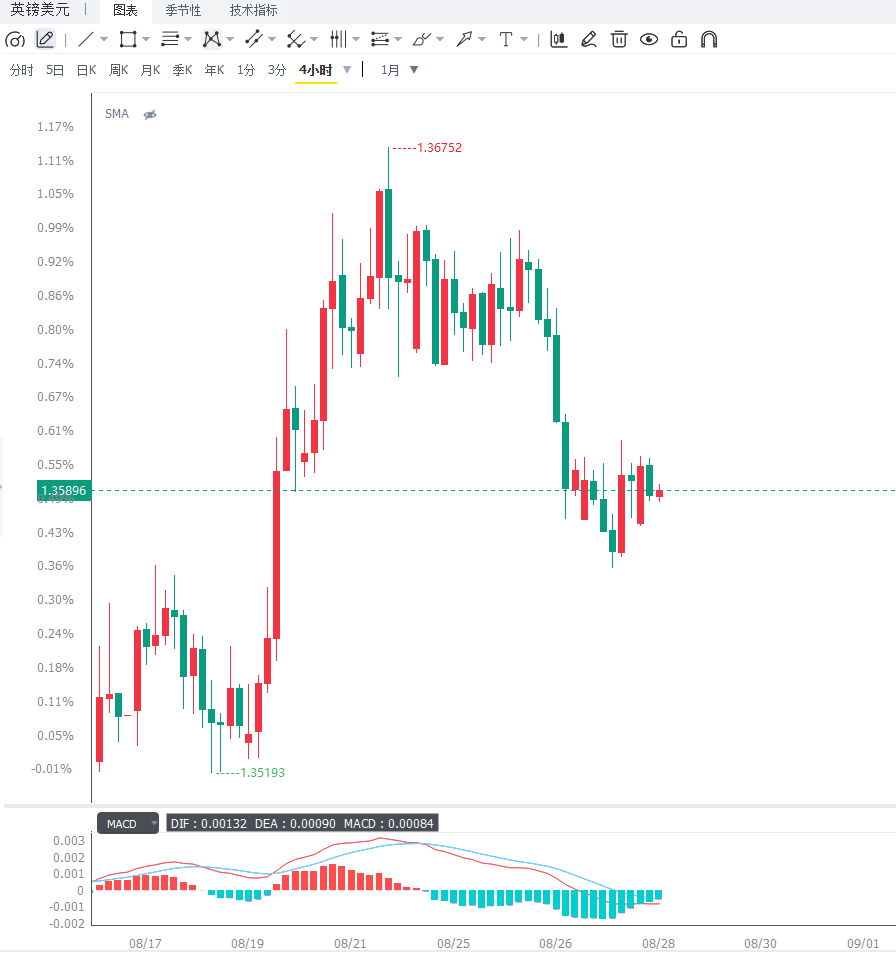 In summary, GBP/USD is currently in a tug-of-war between waning expectations of a UK interest rate hike and uncertainty surrounding US interest rate policy. The decline in Brent crude oil prices has reduced short-term inflationary pressures in the UK, causing the market to postpone expectations for the next Bank of England rate hike to early 2027, while a lack of UK economic data has further weakened short-term catalysts for the pound. In the short term, the Jackson Hole speech will be a crucial event determining the direction of GBP/USD. If Warsh delivers hawkish signals, a stronger dollar could push the exchange rate below 1.3580 and towards 1.3550 or even 1.34780; if the speech is dovish, a weaker dollar could push the pound to retest 1.3650 and 1.3700. In the medium term, UK inflation remains above target, so there is no single policy logic for a sustained and significant weakening of the pound. It is crucial to closely monitor UK inflation, wage, and employment data, as well as changes in the policy expectations between the Bank of England and the Federal Reserve. Overall, the daily chart structure for GBP/USD remains bullish, but the short-term trend has entered an event-driven phase. 1.3480 is a key support level for the medium-term bullish structure, while 1.3650-1.3700 is the area that the pound must break through to further open up upward space.
The recent decline in international oil prices is a significant factor influencing expectations for UK interest rates. Following the drop in Brent crude prices, the immediate impact of energy costs on UK consumer prices has weakened, leading the market to lower its expectations for further policy tightening by the Bank of England later this year. Market pricing indicates a cumulative tightening of approximately 24 basis points by December and approximately 36 basis points by February 2027, while the Bank of England's September meeting only factored in a rate hike of less than 4 basis points, corresponding to a probability of about 15%. This means the market is essentially no longer betting on action from the Bank of England in September. Previously, market concerns that regional tensions could push up energy prices and further stimulate UK inflation fueled expectations of a Bank of England rate hike, but this logic is gradually fading as energy price pressures have eased. The UK's domestic economic environment also limits the pound's upside potential. The UK's inflation rate rose to 2.9% in July, mainly driven by rising household energy costs, and the market expects inflation to continue rising slightly until the end of the year. However, the underlying performance of the UK labor market remains weak, and economic growth momentum is not robust. For the Bank of England, this presents a classic policy dilemma. On the one hand, inflation remains above the 2% target, especially as energy prices are likely to continue putting pressure on consumer prices; on the other hand, a weak labor market means that further increases in borrowing costs could exacerbate downside risks to the economy. Therefore, the Bank of England is more likely to continue monitoring data in the short term rather than rushing to resume its rate hike cycle. Recent UK economic data has been relatively limited, further weakening the pound's short-term momentum. Scotiabank strategists point out that the UK economic calendar is relatively light ahead of the next round of important Purchasing Managers' Index (PMI) data releases, and the Bank of England's policy information is also limited. In the absence of new economic data and policy guidance, investors are more inclined to adjust their pound positions based on the dollar's performance. Meanwhile, the market is turning its attention to the US. Federal Reserve Chairman Kevin Warsh will speak at the Jackson Hole Economic Policy Symposium. Recent US inflation data has remained high, with core PCE at 3.3% year-on-year, and market expectations for another Fed rate hike this year have increased. If Warsh emphasizes inflation risks in his speech and hints that policy rates may rise further, the dollar may find support, and GBP/USD will face greater downward pressure. Conversely, if Warsh doesn't deliver a clearly hawkish signal, but instead emphasizes factors like economic growth, productivity, or the labor market, the market may lower its expectations for further US interest rate hikes. A weaker dollar could give GBP/USD renewed upward momentum. The market currently doesn't seem to have adequately priced in the potential impact of the Jackson Hole speech. Scotiabank strategists point out that historical experience shows the Jackson Hole conference has the ability to significantly alter market pricing, but current one-week implied volatility is below recent averages, suggesting investors may be underestimating the market risks posed by the speech. This implies a significant event-driven risk for GBP/USD in the short term. With low market volatility, if Warsh's policy statements deviate significantly from market expectations, the dollar could experience a rapid correction, potentially driving GBP/USD out of its current technical range. From a dollar fundamentals perspective, US interest rate expectations remain the core variable determining the short-term direction of GBP/USD. High US core inflation means the Fed hasn't completely ruled out another rate hike, while Bank of England rate hike expectations have cooled significantly after declining energy prices. If this policy expectation gap widens further, GBP/USD will be under pressure. However, UK inflation remains above the policy target, meaning the Bank of England doesn't have the urgent conditions to quickly shift to easing. If UK service sector inflation, wage growth, and overall CPI continue to remain high, the market may reassess the Bank of England's policy path. At that time, the pound's interest rate advantage is expected to be somewhat restored. Therefore, the current fundamentals for GBP/USD do not form a clear one-sided direction. Cooling expectations of UK interest rate hikes limit the pound's rise, but uncertainty surrounding US interest rate policy makes it difficult for the dollar to maintain sustained strength. In the short term, the market is likely to continue oscillating around 1.3600, awaiting the Jackson Hole speech and subsequent UK economic data to provide new direction. From a market sentiment perspective, although the pound has recently experienced two days of decline, its technical structure remains relatively resilient. As long as the price doesn't significantly break below key moving average support, the current pullback is more likely a technical correction after the rise than a trend reversal. From a daily chart perspective, GBP/USD is currently trading around 1.3600, with the price still above the 9-period and 50-period exponential moving averages, maintaining an overall bullish technical structure. The 14-period RSI is around 61, above the 50 midline but not yet in overbought territory, indicating that bullish momentum still exists. However, after the recent rise, further upward movement requires a new fundamental catalyst. The first resistance level to watch is around 1.3650, followed by the psychological level of 1.3700. A decisive break above this level could lead to a further test of the 1.3750 area. On the downside, the first support level to watch is around 1.3580, near the 9-period EMA. A break below this level could lead to a test of the 1.3550 area. More significant support lies at around 1.3480, near the 50-period EMA. As long as the price remains above the 50-period EMA, the overall bullish structure on the daily chart will not be significantly disrupted in the short term. Looking at the 4-hour chart, GBP/USD has retreated for two consecutive days, indicating a cooling of short-term momentum, but the price remains within a relatively stable upward structure. The MACD bullish momentum has contracted, and short-term moving averages are gradually flattening, suggesting the market is awaiting a new directional catalyst. If the price breaks through 1.3650 again, the 4-hour chart is expected to regain upward momentum and advance towards 1.3700 and 1.3750. If the support around 1.3580 is breached, the short-term correction may extend to 1.3550, and a further break below this level would require monitoring the 50-period moving average support around 1.3480. Overall, the area around 1.3580 is a crucial level for the current short-term battle between bulls and bears, while 1.3650 is a key resistance level for the bulls to extend their gains. In summary, GBP/USD is currently in a tug-of-war between waning expectations of a UK interest rate hike and uncertainty surrounding US interest rate policy. The decline in Brent crude oil prices has reduced short-term inflationary pressures in the UK, causing the market to postpone expectations for the next Bank of England rate hike to early 2027, while a lack of UK economic data has further weakened short-term catalysts for the pound. In the short term, the Jackson Hole speech will be a crucial event determining the direction of GBP/USD. If Warsh delivers hawkish signals, a stronger dollar could push the exchange rate below 1.3580 and towards 1.3550 or even 1.34780; if the speech is dovish, a weaker dollar could push the pound to retest 1.3650 and 1.3700. In the medium term, UK inflation remains above target, so there is no single policy logic for a sustained and significant weakening of the pound. It is crucial to closely monitor UK inflation, wage, and employment data, as well as changes in the policy expectations between the Bank of England and the Federal Reserve. Overall, the daily chart structure for GBP/USD remains bullish, but the short-term trend has entered an event-driven phase. 1.3480 is a key support level for the medium-term bullish structure, while 1.3650-1.3700 is the area that the pound must break through to further open up upward space.
- Risk Warning and Disclaimer
- The market involves risk, and trading may not be suitable for all investors. This article is for reference only and does not constitute personal investment advice, nor does it take into account certain users’ specific investment objectives, financial situation, or other needs. Any investment decisions made based on this information are at your own risk.