The US dollar index is hovering around 99.20, and its medium-term downward trend remains unchanged, awaiting a stress test.
2026-08-28 14:15:01
The dollar index stabilized slightly in Asian trading on Friday, last trading at around 99.20, after a slight decline in the previous session. Markets remained cautious during the Jackson Hole economic policy symposium, with investors awaiting a speech from Federal Reserve Chairman Kevin Warsh for further assessment of the future path of US interest rates. While the dollar has recently received some fundamental support, it remains in a recovery phase following its previous decline.  The latest US inflation data has been a key driver of the recent dollar rebound. The US core personal consumption expenditures price index remained at 3.3% year-on-year, significantly higher than the Federal Reserve's 2% target. This has increased market bets on further interest rate hikes this year. Current interest rate futures pricing indicates a 74% probability of a December rate hike, compared to about 65% for maintaining the rate in September. This means that while there is no consensus in the market that the Fed will immediately shift to tightening policy, investors have clearly increased their risk of another rate hike this year. For the dollar, the renewed rise in interest rate expectations can provide short-term support, especially given the simultaneous rise in US Treasury yields, which could improve the relative attractiveness of dollar assets. However, this round of dollar rebound still faces a crucial question: whether the improved expectations for US monetary policy are sufficient to change the dollar's medium-term trend. The dollar index, after a prolonged period of adjustment, has returned above 99, but from a technical perspective, it has not yet completely escaped its medium-term weakness. Scotiabank strategists believe that the recent dollar rise is more of a correction to the previous deep downtrend than a new long-term uptrend. The institution is also watching whether the dollar index can retest the mid-range of 99, meaning the market currently tends to view the dollar's rebound as a technical correction. US fiscal issues are another pressure on the dollar's medium- to long-term performance. The recent expansion of the US Treasury's debt repurchase program, while improving bond market liquidity, has also reignited market attention to the size of US debt and future fiscal financing pressures. With US long-term debt levels remaining high, investor discussions about the dollar's long-term purchasing power and the risk premium of US assets are increasing. From a market logic perspective, if the US fiscal deficit continues to expand while long-term Treasury yields remain high, the dollar may receive short-term interest rate support, but in the medium to long term, it may be constrained by concerns about fiscal sustainability. Therefore, there is currently a clear time cycle divergence in the dollar market: short-term support from interest rate hike expectations, while in the medium to long term, it remains suppressed by fiscal and valuation factors. Recent policy signals from Federal Reserve officials have also shown some divergence. Cleveland Fed President Beth Hammark recently emphasized the persistence of inflation and believes now is the time to act. Her assessment of the neutral interest rate level is also biased towards a higher level, meaning that without a significant cooling of inflation, policy rates may need to remain at a higher level. Hammark's hawkish remarks have heightened market sensitivity to future Fed policy tightening. If other officials continue to emphasize inflation risks during Jackson Hole, the dollar could receive further support. In particular, if Warsh explicitly states that another rate hike is not ruled out unless inflation sustains a decline, the market may further revise its probability of a rate hike this year. However, if Warsh's speech does not release a stronger hawkish signal, or focuses on long-term factors such as US economic growth, productivity, and demographics, the dollar's recent rebound may be limited. The market has already partially priced in inflation risks, so a stronger policy catalyst is needed for the dollar to establish a new upward trend. US economic data also needs close monitoring. Currently, the job market is showing some resilience, while inflation is declining relatively slowly, providing a reason for the Fed to maintain a restrictive policy. However, if the job market cools significantly in the future, while inflation declines simultaneously, the necessity for another Fed rate hike will decrease, and the dollar may then face renewed downward pressure. From a global market perspective, the dollar index's movement will also affect gold, crude oil, and non-US currencies. A stronger dollar typically increases the cost of dollar-denominated commodities, putting pressure on gold and crude oil; conversely, a weaker dollar favors the re-flow of funds into precious metals and commodity markets. Therefore, the Jackson Hole speech will not only determine the short-term direction of the dollar but may also be a crucial juncture for global asset repricing this week. Currently, market sentiment remains cautious. While the dollar is supported by inflation and interest rate expectations, investors are not entirely convinced that this rebound can translate into a long-term trend. If the dollar index fails to effectively break through the medium-term technical resistance around 99.88, the market may still view the current rise as a technical correction after the previous decline. Conversely, if the dollar breaks through 99.88 and further stabilizes above the 100 mark, it signifies a potential change in the short-term market structure. At that point, the market will need to reassess the probability of a Fed rate hike this year and whether US Treasury yields have entered a new upward phase. Therefore, the core contradiction in the current dollar market is the interplay between improved short-term interest rate expectations and the medium-term downward trend of the dollar. Before the Jackson Hole speech, the dollar index is likely to continue its consolidation, with the direction of the breakout depending more on Warsh's statements regarding inflation and interest rate policy. From a daily chart perspective, the US dollar index is currently trading around 99.20, maintaining a generally weak trend. The price is below the 50-day exponential moving average, indicating that the medium-term rebound has not changed the previous downward structure; the area around the 9-day moving average is a key battleground between bulls and bears in the short term. The 14-day RSI is around 39.5, still below the 50 midline, suggesting that bearish momentum has not completely disappeared, but the indicator still has some room to move into oversold territory. The first resistance level to watch is around 99.50, followed by the 99.88 area where the 50-day EMA is located. A decisive break above 99.88 could see the dollar index further test the 100 level. On the downside, the first support level to watch is the 9-day moving average around 99.18. A significant break below this level on the daily chart could lead to a return to the 98.80 and 98.30 areas. From a 4-hour chart perspective, the dollar index experienced a technical rebound after its previous rapid decline, and short-term momentum has recovered somewhat, but a clear bullish trend has not yet formed. The MACD indicator shows signs of recovery at low levels, but a break above 99.50 and a firm hold above 99.88 are still needed to confirm a further short-term rebound. If 99.88 continues to act as resistance, the US dollar index may fall back to test 99.18; if 99.18 is breached, further downside potential may open up. Overall, 99.88 is a key resistance level for the US dollar index, representing a shift from a rebound to a trend correction, while 99.18 is a crucial level that short-term bulls must hold.
 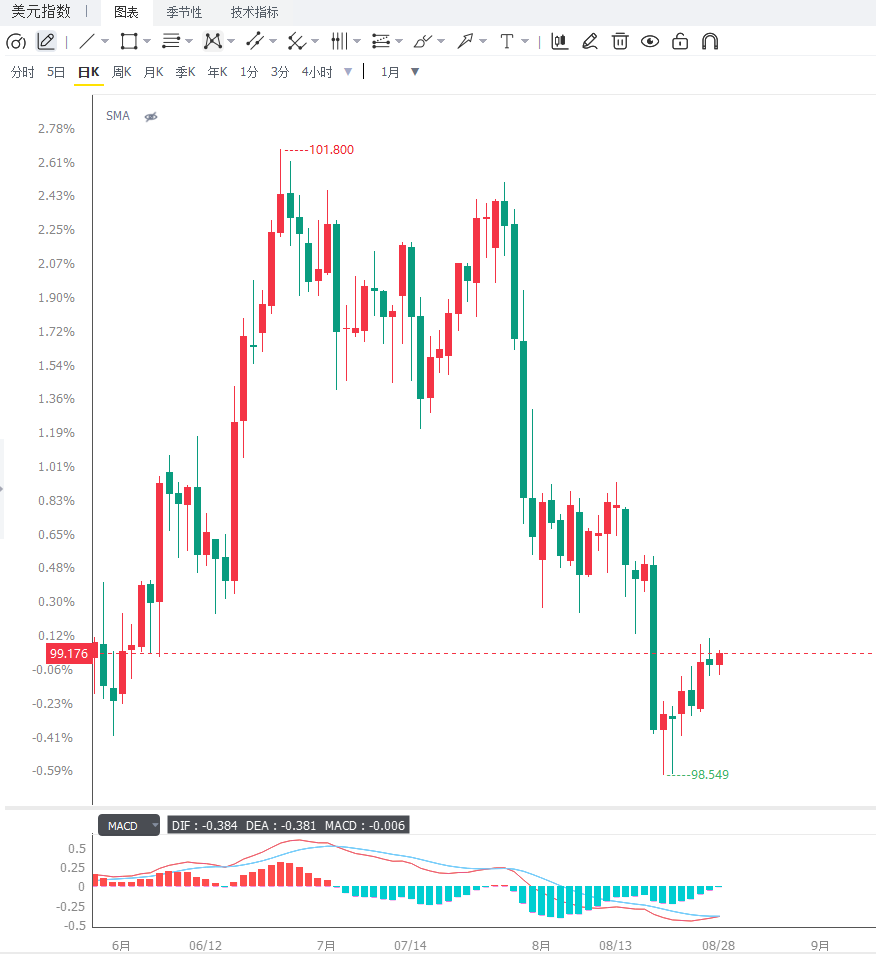 Editor's Summary: The US dollar index stabilized around 99.20, with core support coming from sticky US inflation and rising expectations of an interest rate hike this year. The market currently estimates a 74% probability of a December rate hike, indicating that the risk of the Fed tightening policy again has been re-priced in. However, the medium-term trend for the dollar remains weak, with US fiscal pressure and debt concerns limiting the sustainability of the dollar's rebound. The market currently tends to interpret the dollar's rise as a correction within a downtrend rather than a confirmed new upward trend. Going forward, key attention should be paid to the Fed's policy statements, US inflation and employment data, US Treasury yields, and changes in fiscal policy. Whether the dollar can break through 99.88 will be a crucial indicator of whether this rebound is a short-term correction or a trend reversal.
The latest US inflation data has been a key driver of the recent dollar rebound. The US core personal consumption expenditures price index remained at 3.3% year-on-year, significantly higher than the Federal Reserve's 2% target. This has increased market bets on further interest rate hikes this year. Current interest rate futures pricing indicates a 74% probability of a December rate hike, compared to about 65% for maintaining the rate in September. This means that while there is no consensus in the market that the Fed will immediately shift to tightening policy, investors have clearly increased their risk of another rate hike this year. For the dollar, the renewed rise in interest rate expectations can provide short-term support, especially given the simultaneous rise in US Treasury yields, which could improve the relative attractiveness of dollar assets. However, this round of dollar rebound still faces a crucial question: whether the improved expectations for US monetary policy are sufficient to change the dollar's medium-term trend. The dollar index, after a prolonged period of adjustment, has returned above 99, but from a technical perspective, it has not yet completely escaped its medium-term weakness. Scotiabank strategists believe that the recent dollar rise is more of a correction to the previous deep downtrend than a new long-term uptrend. The institution is also watching whether the dollar index can retest the mid-range of 99, meaning the market currently tends to view the dollar's rebound as a technical correction. US fiscal issues are another pressure on the dollar's medium- to long-term performance. The recent expansion of the US Treasury's debt repurchase program, while improving bond market liquidity, has also reignited market attention to the size of US debt and future fiscal financing pressures. With US long-term debt levels remaining high, investor discussions about the dollar's long-term purchasing power and the risk premium of US assets are increasing. From a market logic perspective, if the US fiscal deficit continues to expand while long-term Treasury yields remain high, the dollar may receive short-term interest rate support, but in the medium to long term, it may be constrained by concerns about fiscal sustainability. Therefore, there is currently a clear time cycle divergence in the dollar market: short-term support from interest rate hike expectations, while in the medium to long term, it remains suppressed by fiscal and valuation factors. Recent policy signals from Federal Reserve officials have also shown some divergence. Cleveland Fed President Beth Hammark recently emphasized the persistence of inflation and believes now is the time to act. Her assessment of the neutral interest rate level is also biased towards a higher level, meaning that without a significant cooling of inflation, policy rates may need to remain at a higher level. Hammark's hawkish remarks have heightened market sensitivity to future Fed policy tightening. If other officials continue to emphasize inflation risks during Jackson Hole, the dollar could receive further support. In particular, if Warsh explicitly states that another rate hike is not ruled out unless inflation sustains a decline, the market may further revise its probability of a rate hike this year. However, if Warsh's speech does not release a stronger hawkish signal, or focuses on long-term factors such as US economic growth, productivity, and demographics, the dollar's recent rebound may be limited. The market has already partially priced in inflation risks, so a stronger policy catalyst is needed for the dollar to establish a new upward trend. US economic data also needs close monitoring. Currently, the job market is showing some resilience, while inflation is declining relatively slowly, providing a reason for the Fed to maintain a restrictive policy. However, if the job market cools significantly in the future, while inflation declines simultaneously, the necessity for another Fed rate hike will decrease, and the dollar may then face renewed downward pressure. From a global market perspective, the dollar index's movement will also affect gold, crude oil, and non-US currencies. A stronger dollar typically increases the cost of dollar-denominated commodities, putting pressure on gold and crude oil; conversely, a weaker dollar favors the re-flow of funds into precious metals and commodity markets. Therefore, the Jackson Hole speech will not only determine the short-term direction of the dollar but may also be a crucial juncture for global asset repricing this week. Currently, market sentiment remains cautious. While the dollar is supported by inflation and interest rate expectations, investors are not entirely convinced that this rebound can translate into a long-term trend. If the dollar index fails to effectively break through the medium-term technical resistance around 99.88, the market may still view the current rise as a technical correction after the previous decline. Conversely, if the dollar breaks through 99.88 and further stabilizes above the 100 mark, it signifies a potential change in the short-term market structure. At that point, the market will need to reassess the probability of a Fed rate hike this year and whether US Treasury yields have entered a new upward phase. Therefore, the core contradiction in the current dollar market is the interplay between improved short-term interest rate expectations and the medium-term downward trend of the dollar. Before the Jackson Hole speech, the dollar index is likely to continue its consolidation, with the direction of the breakout depending more on Warsh's statements regarding inflation and interest rate policy. From a daily chart perspective, the US dollar index is currently trading around 99.20, maintaining a generally weak trend. The price is below the 50-day exponential moving average, indicating that the medium-term rebound has not changed the previous downward structure; the area around the 9-day moving average is a key battleground between bulls and bears in the short term. The 14-day RSI is around 39.5, still below the 50 midline, suggesting that bearish momentum has not completely disappeared, but the indicator still has some room to move into oversold territory. The first resistance level to watch is around 99.50, followed by the 99.88 area where the 50-day EMA is located. A decisive break above 99.88 could see the dollar index further test the 100 level. On the downside, the first support level to watch is the 9-day moving average around 99.18. A significant break below this level on the daily chart could lead to a return to the 98.80 and 98.30 areas. From a 4-hour chart perspective, the dollar index experienced a technical rebound after its previous rapid decline, and short-term momentum has recovered somewhat, but a clear bullish trend has not yet formed. The MACD indicator shows signs of recovery at low levels, but a break above 99.50 and a firm hold above 99.88 are still needed to confirm a further short-term rebound. If 99.88 continues to act as resistance, the US dollar index may fall back to test 99.18; if 99.18 is breached, further downside potential may open up. Overall, 99.88 is a key resistance level for the US dollar index, representing a shift from a rebound to a trend correction, while 99.18 is a crucial level that short-term bulls must hold. Editor's Summary: The US dollar index stabilized around 99.20, with core support coming from sticky US inflation and rising expectations of an interest rate hike this year. The market currently estimates a 74% probability of a December rate hike, indicating that the risk of the Fed tightening policy again has been re-priced in. However, the medium-term trend for the dollar remains weak, with US fiscal pressure and debt concerns limiting the sustainability of the dollar's rebound. The market currently tends to interpret the dollar's rise as a correction within a downtrend rather than a confirmed new upward trend. Going forward, key attention should be paid to the Fed's policy statements, US inflation and employment data, US Treasury yields, and changes in fiscal policy. Whether the dollar can break through 99.88 will be a crucial indicator of whether this rebound is a short-term correction or a trend reversal.
- Risk Warning and Disclaimer
- The market involves risk, and trading may not be suitable for all investors. This article is for reference only and does not constitute personal investment advice, nor does it take into account certain users’ specific investment objectives, financial situation, or other needs. Any investment decisions made based on this information are at your own risk.