Gold prices saw a slight pullback but the overall bullish trend remains unchanged; investors await the outcome of the Jackson Hole meeting.
2026-08-28 14:33:02
Spot gold continued its consolidation at higher levels on Friday, falling back to around $4,580 per ounce in early Asian trading, a significant drop from the high of around $4,696 reached this week. Gold had previously risen for several days, reaching a three-month high, but after the release of US inflation data, the market reassessed the Federal Reserve's interest rate path, and some profit-taking led to a significant correction in gold prices from their highs. Latest market data shows that gold fell by about 0.5% at one point on Friday, as the market awaited Federal Reserve Chairman Kevin Warsh's speech in Jackson Hole.  The US Personal Consumption Expenditures (PCE) price index rose 3.7% year-on-year in July, while the core PCE remained at 3.3% year-on-year, meeting market expectations. Although the data did not significantly exceed expectations, core inflation remains significantly higher than the Federal Reserve's 2% target, indicating that the decline in US inflation is still slow. For the Federal Reserve, if inflation continues to remain at a high level in the future, policy interest rates may need to remain at a restrictive level for a longer period, and the possibility of raising interest rates again cannot be ruled out. Market interest rate expectations have therefore changed. The latest market pricing shows that the probability of a Fed rate hike in September is about 35%, and the probability of a rate hike in December is close to 75%, indicating that although investors have not reached a clear consensus on a September rate hike, they remain highly vigilant about the risk of tightening policy again this year. High interest rate expectations usually push up the dollar and real interest rates, thereby increasing the cost of holding gold and putting pressure on gold, which does not generate interest income. However, this round of adjustment in gold has not evolved into a trend of decline. Gold prices previously touched $4,696.18 this week, a new high in more than three months, mainly driven by factors such as the temporary weakening of the dollar, fiscal risks, and changes in the US long-term bond market. Even with hawkish inflation data, gold has managed to stay above $4,500, indicating that medium- to long-term buying pressure remains resilient. The US fiscal and bond markets remain key variables to watch for gold. The US Treasury's recent expansion of long-term Treasury bond repurchase programs has fueled concerns about long-term debt financing, fiscal sustainability, and the repricing of dollar assets. These factors could provide additional structural support for gold should the Federal Reserve maintain a tighter policy stance. The US dollar has also not seen a sustained one-sided rise recently. The dollar index was around 99.13 on Friday, near a one-week high, but is still on track for its second consecutive monthly decline. The dollar's rebound and rising expectations of a Fed rate hike are somewhat bearish, but the dollar's medium-term performance remains influenced by US fiscal policy and market concerns about currency purchasing power. Meanwhile, geopolitical tensions remain a significant risk variable for the gold market. Recent diplomatic efforts regarding the Strait of Hormuz have shown signs of improvement, but a full resumption of shipping in the strait depends on the implementation of subsequent conditions. If energy transport recovers further, the geopolitical risk premium in oil prices may decrease, and global inflationary pressures may be somewhat alleviated, reducing the need for further tightening by the Federal Reserve. Conversely, if developments falter and energy supply risks resurface, oil prices could rise again, and market concerns about global inflation could intensify. In this scenario, gold could simultaneously receive support from both safe-haven demand and inflation hedging demand. Currently, the most important variable in the market remains Federal Reserve Chairman Kevin Warsh's Jackson Hole speech. The market hopes to glean insights from his remarks on how the Fed will handle the relationship between inflation, economic growth, and interest rate policy. If Warsh clearly emphasizes that inflation remains stubborn and signals further rate hikes if necessary, US Treasury yields and the dollar may strengthen, while gold may continue to face pressure. Conversely, if Warsh's speech does not significantly reinforce expectations of rate hikes, or emphasizes economic growth, productivity, and long-term structural factors, the market may reduce its bets on further Fed tightening. At that point, the dollar and US Treasury yields may fall, and gold could receive support from bargain hunters. From a market sentiment perspective, gold has now transitioned from a rapid upward phase to a high-level consolidation phase. This week's high near $4696 suggests significant short-term profit potential for bulls, while $4600 has become a crucial psychological level. The market is awaiting new fundamental catalysts to determine the next direction. Institutional views also suggest that if Warsh releases a clearly hawkish signal, it could catalyze a further pullback in gold, but the overall sentiment for precious metals remains relatively resilient. Market demand for medium- to long-term gold allocation, official gold purchases, and participation in ETFs and futures markets continue to provide some support. Therefore, the core contradiction in the current gold market has shifted to balancing high interest rate pressures with fiscal policy, safe-haven demand, and the repricing of the US dollar. In the short term, gold still faces the risk of further correction, but as long as key trend support levels are not effectively broken, the market cannot yet define this pullback as a trend reversal. From a daily chart perspective, gold is currently still in a medium-term bullish trend, with prices previously consistently trading above important trend lines. The rapid pullback after reaching $4696 this week indicates significant profit-taking around $4700. The RSI, which had previously entered a bullish zone, has cooled somewhat with the price pullback, suggesting that upward momentum is weakening. The first resistance level to watch is $4600. If it holds above this level, further resistance lies at $4650 and the $4696-$4700 area. A decisive break above $4700 could lead to a retest of the $4760 area. On the downside, the first support level to watch is around $4580. A break below this level could lead to a test of $4520, with stronger support at $4415 and the $4375 area. As long as $4375 holds, the medium-term bullish structure on the daily chart remains intact. Looking at the 4-hour chart, gold has transitioned from a rapid rise to a consolidation phase. After breaking below $4600, short-term upward momentum has weakened significantly, and the MACD bullish momentum has contracted, indicating a rebalancing phase between bulls and bears. If $4580 provides effective support and the price recovers above $4600, gold could rebound towards $4650, and a break above that could retest the previous high of $4696. However, if $4580 is decisively broken, the pullback could extend to $4520 or even $4415. The current level of $4,580 is a crucial point for short-term strength or weakness, while the $4,600-$4,650 range is the key area for the bulls to regain control.
 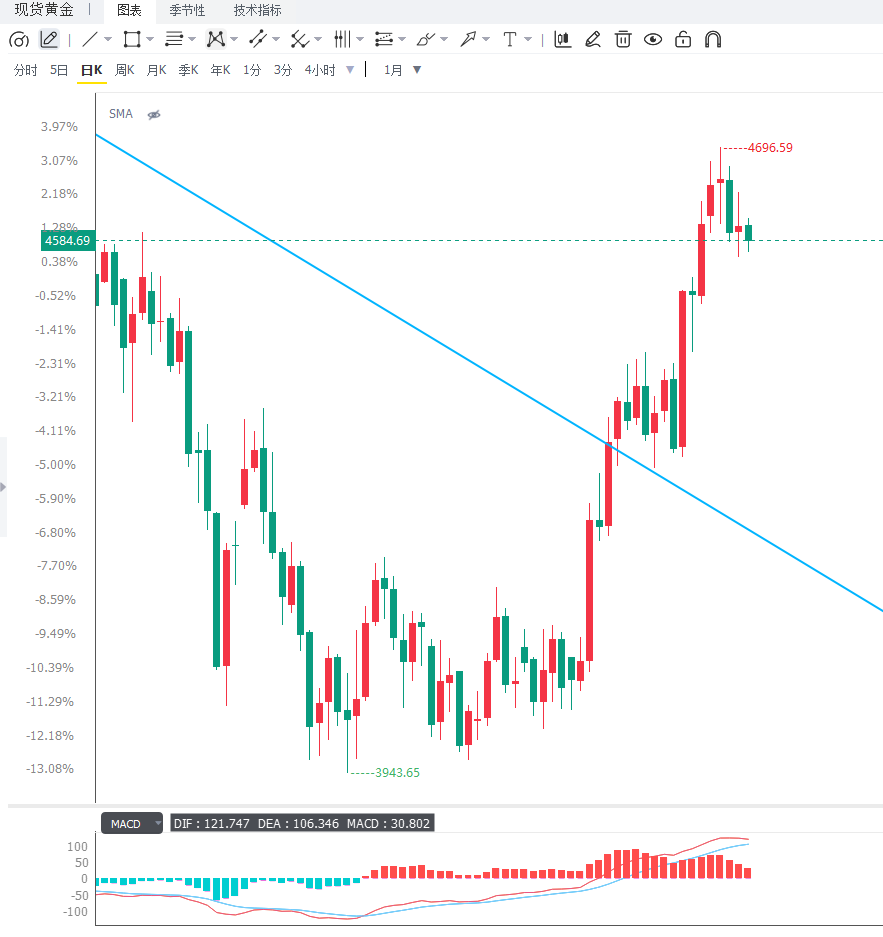 Editor's Summary: Gold retreated from a three-month high near $4,700, primarily due to renewed market expectations of further Federal Reserve rate hikes fueled by sticky US inflation. The US dollar and Treasury yields thus became significant short-term factors suppressing gold prices. However, fiscal risks, official gold purchases, safe-haven demand, and funds allocated to gold still provide structural support. Therefore, the current market movement is more accurately described as a high-level correction rather than a trend reversal. The Jackson Hole speech will be a key catalyst in determining the short-term direction. Close attention should be paid to Warsh's comments on inflation, interest rates, and the US economic outlook, as well as whether the US dollar index and Treasury yields react in tandem after his speech.
The US Personal Consumption Expenditures (PCE) price index rose 3.7% year-on-year in July, while the core PCE remained at 3.3% year-on-year, meeting market expectations. Although the data did not significantly exceed expectations, core inflation remains significantly higher than the Federal Reserve's 2% target, indicating that the decline in US inflation is still slow. For the Federal Reserve, if inflation continues to remain at a high level in the future, policy interest rates may need to remain at a restrictive level for a longer period, and the possibility of raising interest rates again cannot be ruled out. Market interest rate expectations have therefore changed. The latest market pricing shows that the probability of a Fed rate hike in September is about 35%, and the probability of a rate hike in December is close to 75%, indicating that although investors have not reached a clear consensus on a September rate hike, they remain highly vigilant about the risk of tightening policy again this year. High interest rate expectations usually push up the dollar and real interest rates, thereby increasing the cost of holding gold and putting pressure on gold, which does not generate interest income. However, this round of adjustment in gold has not evolved into a trend of decline. Gold prices previously touched $4,696.18 this week, a new high in more than three months, mainly driven by factors such as the temporary weakening of the dollar, fiscal risks, and changes in the US long-term bond market. Even with hawkish inflation data, gold has managed to stay above $4,500, indicating that medium- to long-term buying pressure remains resilient. The US fiscal and bond markets remain key variables to watch for gold. The US Treasury's recent expansion of long-term Treasury bond repurchase programs has fueled concerns about long-term debt financing, fiscal sustainability, and the repricing of dollar assets. These factors could provide additional structural support for gold should the Federal Reserve maintain a tighter policy stance. The US dollar has also not seen a sustained one-sided rise recently. The dollar index was around 99.13 on Friday, near a one-week high, but is still on track for its second consecutive monthly decline. The dollar's rebound and rising expectations of a Fed rate hike are somewhat bearish, but the dollar's medium-term performance remains influenced by US fiscal policy and market concerns about currency purchasing power. Meanwhile, geopolitical tensions remain a significant risk variable for the gold market. Recent diplomatic efforts regarding the Strait of Hormuz have shown signs of improvement, but a full resumption of shipping in the strait depends on the implementation of subsequent conditions. If energy transport recovers further, the geopolitical risk premium in oil prices may decrease, and global inflationary pressures may be somewhat alleviated, reducing the need for further tightening by the Federal Reserve. Conversely, if developments falter and energy supply risks resurface, oil prices could rise again, and market concerns about global inflation could intensify. In this scenario, gold could simultaneously receive support from both safe-haven demand and inflation hedging demand. Currently, the most important variable in the market remains Federal Reserve Chairman Kevin Warsh's Jackson Hole speech. The market hopes to glean insights from his remarks on how the Fed will handle the relationship between inflation, economic growth, and interest rate policy. If Warsh clearly emphasizes that inflation remains stubborn and signals further rate hikes if necessary, US Treasury yields and the dollar may strengthen, while gold may continue to face pressure. Conversely, if Warsh's speech does not significantly reinforce expectations of rate hikes, or emphasizes economic growth, productivity, and long-term structural factors, the market may reduce its bets on further Fed tightening. At that point, the dollar and US Treasury yields may fall, and gold could receive support from bargain hunters. From a market sentiment perspective, gold has now transitioned from a rapid upward phase to a high-level consolidation phase. This week's high near $4696 suggests significant short-term profit potential for bulls, while $4600 has become a crucial psychological level. The market is awaiting new fundamental catalysts to determine the next direction. Institutional views also suggest that if Warsh releases a clearly hawkish signal, it could catalyze a further pullback in gold, but the overall sentiment for precious metals remains relatively resilient. Market demand for medium- to long-term gold allocation, official gold purchases, and participation in ETFs and futures markets continue to provide some support. Therefore, the core contradiction in the current gold market has shifted to balancing high interest rate pressures with fiscal policy, safe-haven demand, and the repricing of the US dollar. In the short term, gold still faces the risk of further correction, but as long as key trend support levels are not effectively broken, the market cannot yet define this pullback as a trend reversal. From a daily chart perspective, gold is currently still in a medium-term bullish trend, with prices previously consistently trading above important trend lines. The rapid pullback after reaching $4696 this week indicates significant profit-taking around $4700. The RSI, which had previously entered a bullish zone, has cooled somewhat with the price pullback, suggesting that upward momentum is weakening. The first resistance level to watch is $4600. If it holds above this level, further resistance lies at $4650 and the $4696-$4700 area. A decisive break above $4700 could lead to a retest of the $4760 area. On the downside, the first support level to watch is around $4580. A break below this level could lead to a test of $4520, with stronger support at $4415 and the $4375 area. As long as $4375 holds, the medium-term bullish structure on the daily chart remains intact. Looking at the 4-hour chart, gold has transitioned from a rapid rise to a consolidation phase. After breaking below $4600, short-term upward momentum has weakened significantly, and the MACD bullish momentum has contracted, indicating a rebalancing phase between bulls and bears. If $4580 provides effective support and the price recovers above $4600, gold could rebound towards $4650, and a break above that could retest the previous high of $4696. However, if $4580 is decisively broken, the pullback could extend to $4520 or even $4415. The current level of $4,580 is a crucial point for short-term strength or weakness, while the $4,600-$4,650 range is the key area for the bulls to regain control. Editor's Summary: Gold retreated from a three-month high near $4,700, primarily due to renewed market expectations of further Federal Reserve rate hikes fueled by sticky US inflation. The US dollar and Treasury yields thus became significant short-term factors suppressing gold prices. However, fiscal risks, official gold purchases, safe-haven demand, and funds allocated to gold still provide structural support. Therefore, the current market movement is more accurately described as a high-level correction rather than a trend reversal. The Jackson Hole speech will be a key catalyst in determining the short-term direction. Close attention should be paid to Warsh's comments on inflation, interest rates, and the US economic outlook, as well as whether the US dollar index and Treasury yields react in tandem after his speech.
- Risk Warning and Disclaimer
- The market involves risk, and trading may not be suitable for all investors. This article is for reference only and does not constitute personal investment advice, nor does it take into account certain users’ specific investment objectives, financial situation, or other needs. Any investment decisions made based on this information are at your own risk.