One chart: Freight rates across all vessel types strengthened, with the Baltic Dry Index hitting a near three-month high and closing significantly higher on the weekly chart.
2026-08-28 23:36:04
Latest data shows that the Baltic Dry Index (BDI) reached 3186 points on August 28, 2026, a new high since June 2, 2026, up 2.54% month-on-month, the largest increase since August 26, 2026, and marking the 7th consecutive day of increase (including zero growth). Looking at the short-term charts, the recent 11 BDI data points show: 9 positive increases, 2 negative increases, and 0 zero increases. Specifically, the Panamax Freight Index (BPI) was 2315 points, up 1.00% from the previous value; the Capesize Freight Index (BCI) was 5336 points, up 3.85%; and the Supramax Freight Index (BSI) was 1647 points, up 0.12%. For detailed 720-day and 10-year trend charts of the Baltic Dry Index and its three sub-indices, please refer to the charts specially created by FX678. 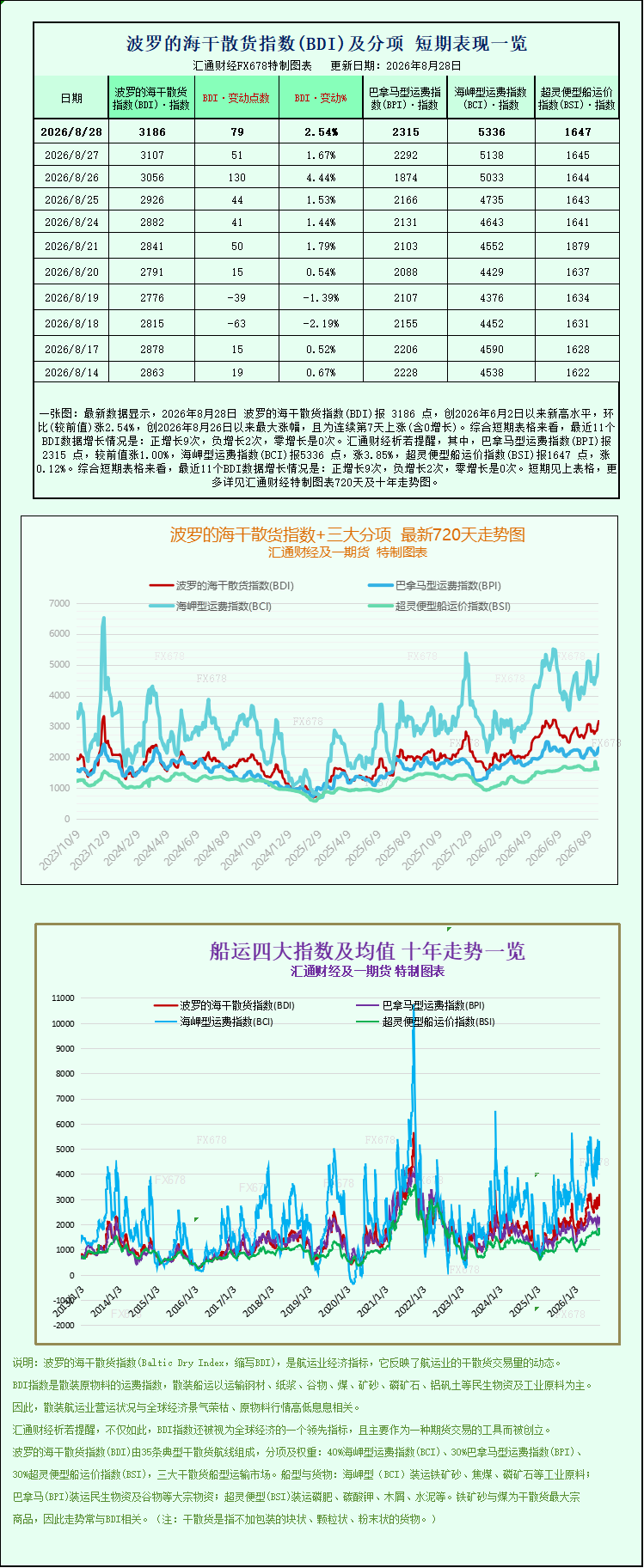 On August 28, 2026, the latest market data showed that the international dry bulk shipping market experienced a strong rebound. The core indicator, the Baltic Dry Index (BDI), steadily rose to a near three-month high, with a cumulative increase of 12.1% this week, completely reversing the previous weak and volatile trend. This round of index increase was not driven by a single vessel type, but rather by a strong pattern of simultaneous increases in freight rates across the entire vessel sector, including Capesize, Panamax, and Supramax. This demonstrates the continued recovery of global dry bulk shipping demand and the continuous optimization of the market supply and demand structure, sending a positive signal for the shipping market trend in the second half of the year. Specifically, the Baltic Dry Index, which tracks the freight rate performance of mainstream dry bulk vessel types, rose 79 points on the day, a single-day increase of 2.5%, finally closing at 3186 points, reaching the highest point since June 2. Looking at the trend this week, the index continued to fluctuate upwards, with a cumulative increase of 12.1%, a significant increase and the strongest single-week performance in recent times. As a core indicator of the global dry bulk shipping market, the significant rebound in the Baltic Dry Index (BDI) directly reflects the concentrated release of global demand for bulk dry bulk trade and transportation, such as iron ore, coal, and grain, as well as the marginal improvement in the supply and demand relationship of shipping capacity in the maritime market. Among the various vessel sub-segments, Capesize vessels, which transport bulk minerals, have become the core driver of this round of index increases, leading the entire market in terms of gains. Data shows that the Capesize index rose sharply by 198 points on the day, a single-day increase of 3.9%, closing at 5336 points, also hitting a new high since June 2nd. The cumulative increase this week was as high as 17.2%, far exceeding the performance of other vessel types. Capesize vessels mainly carry large cargoes of 150,000 tons or more, with core transport categories being industrial bulk raw materials such as iron ore and thermal coal, making them the core carriers of global industrial supply chain maritime transport. The freight profitability data is even more impressive, with the average daily revenue of Capesize vessels increasing by $1798 per day, reaching a latest average daily revenue of $44896, significantly expanding the profit margins for shipowners. The recent surge in Capesize vessel prices was primarily driven by the recovery of the Chinese port market. Major domestic ports continued their raw material destocking efforts, leading to a weekly rise in iron ore futures prices. Downstream steel industry restocking demand continued to be released, resulting in a significant increase in international iron ore seaborne orders. Simultaneously, increased global energy supply demand during the summer and accelerated international coal trade further boosted demand for large dry bulk vessels, driving up freight rates. The medium-sized vessel market also continued its upward trend, supporting the overall strength of the index. The Panamax index rose slightly by 23 points, or 1%, to close at 2315 points, also reaching a three-month high. Panamax vessels primarily transport 60,000 to 70,000-ton cargoes, mainly carrying bulk commodities such as thermal coal and grains, meeting the mainstream transportation needs of global energy supply and food trade. Correspondingly, the average daily revenue of Panamax vessels increased by $202, reaching a latest average daily revenue of $20,834, with shipowner operating profits steadily improving. However, compared to the strong surge in Capesize vessels, Panamax vessels saw a relatively moderate trend this week, with a slight weekly adjustment, reflecting the differentiated pace of trade demand across different product categories. The small dry bulk vessel sector maintained a steady upward trend, demonstrating strong market resilience. The Supramax index rose slightly by 2 points, or 0.1%, to close at 1647 points, with a cumulative weekly increase of 0.4%, showing a stable trend. Supramax vessels offer greater flexibility and are suitable for transporting small to medium-sized batches of dry bulk cargo, covering regional trade, short-haul industrial raw materials, and grains. Their stable performance confirms the continued stability of global demand for small to medium-sized dry bulk cargo, providing fundamental support for the overall shipping market. Considering the overall industry fundamentals, the recent surge in the BDI index is the result of a confluence of multiple positive factors. On the demand side, the domestic industrial chain is steadily recovering, with port destocking and downstream enterprises' restocking cycle overlapping, driving a concentrated release of demand for imported industrial raw materials such as iron ore and coal via sea freight. Globally, the peak summer energy demand season continues, and countries are accelerating their thermal coal reserves and grain trade, comprehensively activating the dry bulk shipping market. On the supply side, the International Maritime Organization's relevant shipping control policies continue to be implemented, slowing the pace of industry capacity release and effectively alleviating the previous pressure of excess capacity, thus promoting a continuous improvement in the supply and demand pattern. Looking ahead, industry analysts believe that with the steady recovery of global industrial production, the start of the autumn and winter energy stockpiling cycle, and the arrival of the peak season for grain harvest trade, dry bulk shipping demand is expected to remain high. However, the market still needs to pay attention to variables such as global macroeconomic trends, commodity price fluctuations, and adjustments to import and export policies of various countries, which may affect the sustainability of shipping demand. Overall, the current recovery in freight rates across all vessel types has laid the foundation for a stable and positive operating tone in the dry bulk shipping market in the second half of the year, and the industry's prosperity is expected to continue to recover.
On August 28, 2026, the latest market data showed that the international dry bulk shipping market experienced a strong rebound. The core indicator, the Baltic Dry Index (BDI), steadily rose to a near three-month high, with a cumulative increase of 12.1% this week, completely reversing the previous weak and volatile trend. This round of index increase was not driven by a single vessel type, but rather by a strong pattern of simultaneous increases in freight rates across the entire vessel sector, including Capesize, Panamax, and Supramax. This demonstrates the continued recovery of global dry bulk shipping demand and the continuous optimization of the market supply and demand structure, sending a positive signal for the shipping market trend in the second half of the year. Specifically, the Baltic Dry Index, which tracks the freight rate performance of mainstream dry bulk vessel types, rose 79 points on the day, a single-day increase of 2.5%, finally closing at 3186 points, reaching the highest point since June 2. Looking at the trend this week, the index continued to fluctuate upwards, with a cumulative increase of 12.1%, a significant increase and the strongest single-week performance in recent times. As a core indicator of the global dry bulk shipping market, the significant rebound in the Baltic Dry Index (BDI) directly reflects the concentrated release of global demand for bulk dry bulk trade and transportation, such as iron ore, coal, and grain, as well as the marginal improvement in the supply and demand relationship of shipping capacity in the maritime market. Among the various vessel sub-segments, Capesize vessels, which transport bulk minerals, have become the core driver of this round of index increases, leading the entire market in terms of gains. Data shows that the Capesize index rose sharply by 198 points on the day, a single-day increase of 3.9%, closing at 5336 points, also hitting a new high since June 2nd. The cumulative increase this week was as high as 17.2%, far exceeding the performance of other vessel types. Capesize vessels mainly carry large cargoes of 150,000 tons or more, with core transport categories being industrial bulk raw materials such as iron ore and thermal coal, making them the core carriers of global industrial supply chain maritime transport. The freight profitability data is even more impressive, with the average daily revenue of Capesize vessels increasing by $1798 per day, reaching a latest average daily revenue of $44896, significantly expanding the profit margins for shipowners. The recent surge in Capesize vessel prices was primarily driven by the recovery of the Chinese port market. Major domestic ports continued their raw material destocking efforts, leading to a weekly rise in iron ore futures prices. Downstream steel industry restocking demand continued to be released, resulting in a significant increase in international iron ore seaborne orders. Simultaneously, increased global energy supply demand during the summer and accelerated international coal trade further boosted demand for large dry bulk vessels, driving up freight rates. The medium-sized vessel market also continued its upward trend, supporting the overall strength of the index. The Panamax index rose slightly by 23 points, or 1%, to close at 2315 points, also reaching a three-month high. Panamax vessels primarily transport 60,000 to 70,000-ton cargoes, mainly carrying bulk commodities such as thermal coal and grains, meeting the mainstream transportation needs of global energy supply and food trade. Correspondingly, the average daily revenue of Panamax vessels increased by $202, reaching a latest average daily revenue of $20,834, with shipowner operating profits steadily improving. However, compared to the strong surge in Capesize vessels, Panamax vessels saw a relatively moderate trend this week, with a slight weekly adjustment, reflecting the differentiated pace of trade demand across different product categories. The small dry bulk vessel sector maintained a steady upward trend, demonstrating strong market resilience. The Supramax index rose slightly by 2 points, or 0.1%, to close at 1647 points, with a cumulative weekly increase of 0.4%, showing a stable trend. Supramax vessels offer greater flexibility and are suitable for transporting small to medium-sized batches of dry bulk cargo, covering regional trade, short-haul industrial raw materials, and grains. Their stable performance confirms the continued stability of global demand for small to medium-sized dry bulk cargo, providing fundamental support for the overall shipping market. Considering the overall industry fundamentals, the recent surge in the BDI index is the result of a confluence of multiple positive factors. On the demand side, the domestic industrial chain is steadily recovering, with port destocking and downstream enterprises' restocking cycle overlapping, driving a concentrated release of demand for imported industrial raw materials such as iron ore and coal via sea freight. Globally, the peak summer energy demand season continues, and countries are accelerating their thermal coal reserves and grain trade, comprehensively activating the dry bulk shipping market. On the supply side, the International Maritime Organization's relevant shipping control policies continue to be implemented, slowing the pace of industry capacity release and effectively alleviating the previous pressure of excess capacity, thus promoting a continuous improvement in the supply and demand pattern. Looking ahead, industry analysts believe that with the steady recovery of global industrial production, the start of the autumn and winter energy stockpiling cycle, and the arrival of the peak season for grain harvest trade, dry bulk shipping demand is expected to remain high. However, the market still needs to pay attention to variables such as global macroeconomic trends, commodity price fluctuations, and adjustments to import and export policies of various countries, which may affect the sustainability of shipping demand. Overall, the current recovery in freight rates across all vessel types has laid the foundation for a stable and positive operating tone in the dry bulk shipping market in the second half of the year, and the industry's prosperity is expected to continue to recover.
- Risk Warning and Disclaimer
- The market involves risk, and trading may not be suitable for all investors. This article is for reference only and does not constitute personal investment advice, nor does it take into account certain users’ specific investment objectives, financial situation, or other needs. Any investment decisions made based on this information are at your own risk.