The yen's drop below 160 is merely a symptom; the real market for dramatic repricing lies within bonds.
2026-08-31 17:00:02
On Monday, August 31, the Japanese financial market once again saw a structure where both the currency and bonds were under pressure. The yen fell below 160, and the yield on Japanese 2-year government bonds rose to approximately 1.72%, a high since 1995, while the 10-year yield briefly touched 2.95%, its highest level since 1996. Meanwhile, the yield on US 10-year Treasury bonds remained around 4.7%. On the surface, this reflects a repricing of interest rate expectations in Japan and the US; in reality, it reflects a recalculation of carry trade yields, term risks, and exchange rate hedging costs by global funds following the simultaneous rise of two tightening expectations. The Jackson Hole meeting became a significant catalyst for this latest pricing shift. Federal Reserve Chairman Kevin Warsh clearly stated that the current policy focus should be on price stability, noting that the personal consumption expenditure price index was still at 3.7% year-on-year, with an annualized growth rate of approximately 4.1% over the past six months, still significantly below the 2% policy target. Interest rate futures subsequently showed that the market's implied probability of a Fed rate hike in September had risen to approximately 57% to 60%. 
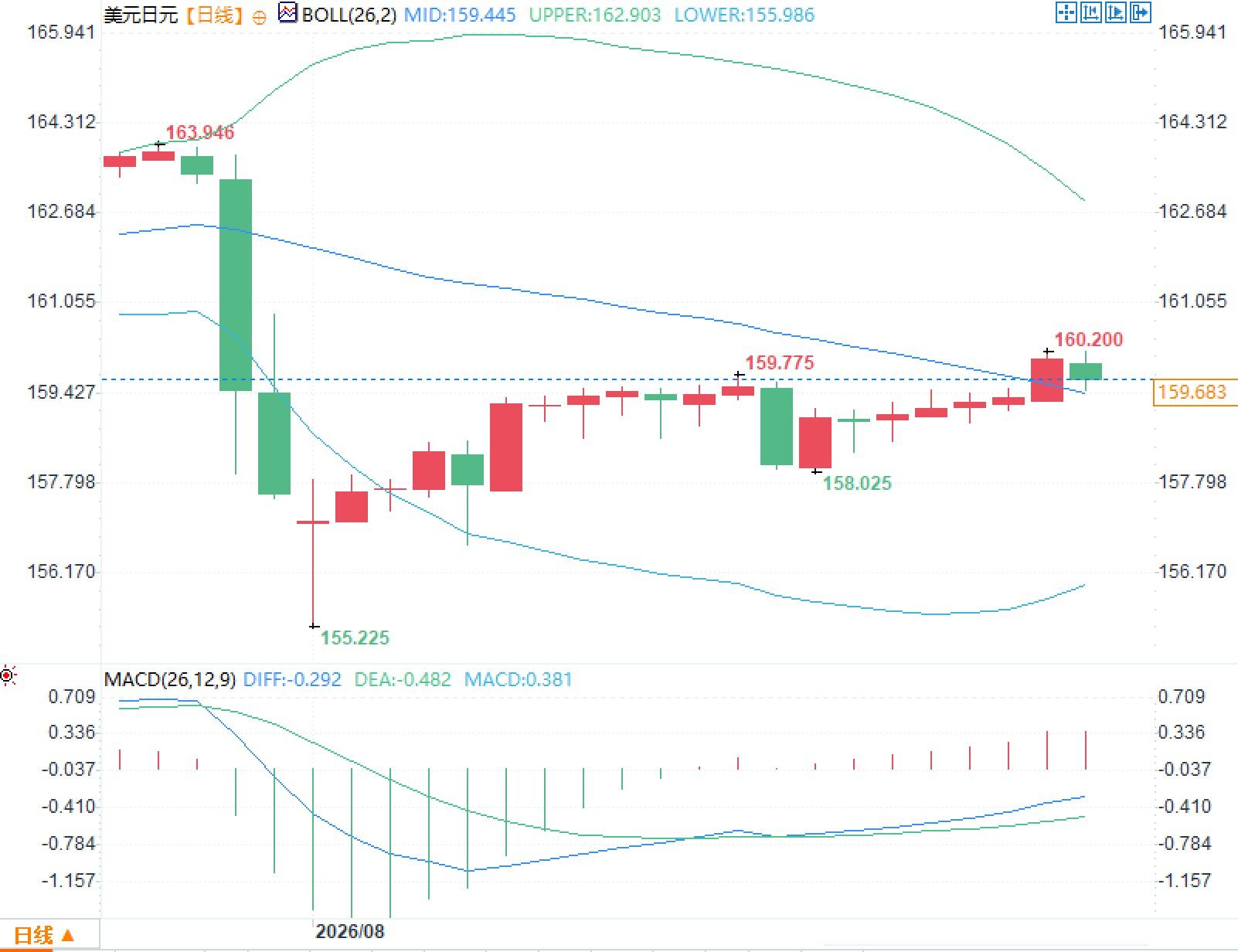 The rise in the Japanese 2-year yield reflects the repricing of policy rate expectations, while the 10-year yield is approaching 3%, indicating a widening term premium. When the short end is repriced faster than the long end, the yield curve flattens, typically indicating that the market is reinforcing its pricing of near-term policy tightening, rather than simply increasing long-term growth assumptions. Meanwhile, the US 2-year Treasury yield remains above approximately 4.3%, and the significant change in the Fed's policy expectations in September has kept the Japan-US short-term interest rate differential at a high level. For the currency market, what truly affects the cost of funds is the actual interest rate differential after adjusting for volatility, forward points, and hedging costs, not a simple subtraction of the two countries' policy rates. This is also the most important observation framework for the current yen market: the exchange rate is merely a price outcome, short-term interest rates reflect policy expectations, long-term yields reflect inflation and term risk, and the shape of the yield curve reveals which type of risk is being repriced.
Why did the yen not strengthen in line with rising Japanese yields?
Traditional interest rate logic posits that rising domestic bond yields enhance the attractiveness of domestic currency assets, thereby improving exchange rate performance. However, the current Japanese market exhibits a clear divergence, primarily due to the different nature of the yield increases. If rising yields stem from improved potential economic growth, higher real returns, and policy normalization, funds are more likely to interpret this as increased attractiveness of domestic currency assets. But if a rapid rise in yields is accompanied by inflation risk, fiscal risk premiums, and increased bond volatility, overseas investors must first consider duration losses and the real returns after currency hedging, rather than nominal coupon rates. Currently, the Bank of Japan's policy rate is 1%, while the 2-year government bond yield has reached approximately 1.72%, indicating that the short-term bond market has already priced in further tightening. Market expectations for a September rate adjustment by the Bank of Japan exceed 90%, with policy expectations clearly preceding official decisions. Bank of Japan Deputy Governor Ryozo Himino recently emphasized the need for timely adjustments to the still-loose financial conditions to address accumulating inflation risks. Therefore, the truly crucial issue now is not whether Japanese yields are high enough, but whether they can stabilize. When bond volatility is excessively high, higher yields alone may not be sufficient to attract long-term funds to establish sustained allocations.Behind the 160 is the repricing of the policy reaction function between Japan and the United States.
The yen has already undergone large-scale official intervention. Public data shows that between July 30 and August 26, Japan used 15.4 trillion yen to stabilize the exchange rate, a record high. However, the yen has given back most of its gains after the intervention, indicating that relying solely on spot market intervention cannot permanently change the interest rate differential-driven funding structure. Currently, the market is actually comparing the policy response speed of the two central banks. Regarding the Federal Reserve, Warsh deliberately downplayed traditional forward guidance, emphasizing that policy should be determined based on real-time data and trend changes. He also pointed out that the current personal consumption expenditure price index is still 3.7% year-on-year, the labor market is generally stable, and financial conditions cannot be described as significantly tight. This means that the marginal impact of subsequent employment, inflation, and energy price data on interest rate expectations may be further amplified. The Bank of Japan faces a more complex problem. On the one hand, it needs to deal with persistent imported price pressures, and on the other hand, it needs to consider bond market stability and financing conditions. If the speed of monetary policy adjustment lags behind inflation expectations, the exchange rate channel may continue to amplify import costs; but if the policy repricing speed is too fast, the bond term premium may widen significantly. Therefore, the current issue of the Japanese yen is no longer just a foreign exchange problem, but a result of the combined effects of monetary policy, inflation expectations, and government bond pricing.The core of the technical structure has shifted from exchange rates to interest rate differentials and yield curves.
From a market structure perspective, simply discussing technical patterns around the yen's key levels is insufficient to explain the current market trend. More noteworthy are the interplay between short-term interest rates, term structure, and cross-market volatility. The rise in the Japanese 2-year yield reflects the repricing of policy rate expectations, while the 10-year yield is approaching 3%, indicating a widening term premium. When the short end is repriced faster than the long end, the yield curve flattens, typically indicating that the market is reinforcing its pricing of near-term policy tightening, rather than simply increasing long-term growth assumptions. Meanwhile, the US 2-year Treasury yield remains above approximately 4.3%, and the significant change in the Fed's policy expectations in September has kept the Japan-US short-term interest rate differential at a high level. For the currency market, what truly affects the cost of funds is the actual interest rate differential after adjusting for volatility, forward points, and hedging costs, not a simple subtraction of the two countries' policy rates. This is also the most important observation framework for the current yen market: the exchange rate is merely a price outcome, short-term interest rates reflect policy expectations, long-term yields reflect inflation and term risk, and the shape of the yield curve reveals which type of risk is being repriced.
- Risk Warning and Disclaimer
- The market involves risk, and trading may not be suitable for all investors. This article is for reference only and does not constitute personal investment advice, nor does it take into account certain users’ specific investment objectives, financial situation, or other needs. Any investment decisions made based on this information are at your own risk.