Why did the Federal Reserve's September forecast suddenly undergo such a dramatic reassessment, from 35% to nearly 60%?
2026-08-31 17:52:03
On Monday, August 31, the foreign exchange market re-priced in whether the Federal Reserve would resume interest rate hikes in September. Following the Jackson Hole symposium, Fed Chairman Kevin Warsh's comments on inflation were noticeably cautious, causing the market's implied probability of a 25 basis point rate hike at the September 16 meeting to rise rapidly from about 35% before his speech to nearly 60%. The US dollar index consequently rose to a near two-week high, but has not yet experienced a sustained upward trend, remaining mainly trading around 99.5. Meanwhile, the conflict in the Gulf region has pushed up energy prices, and inflation risks have re-entered the interest rate pricing framework, significantly increasing the sensitivity of short-term interest rates and the US dollar to macroeconomic data. 
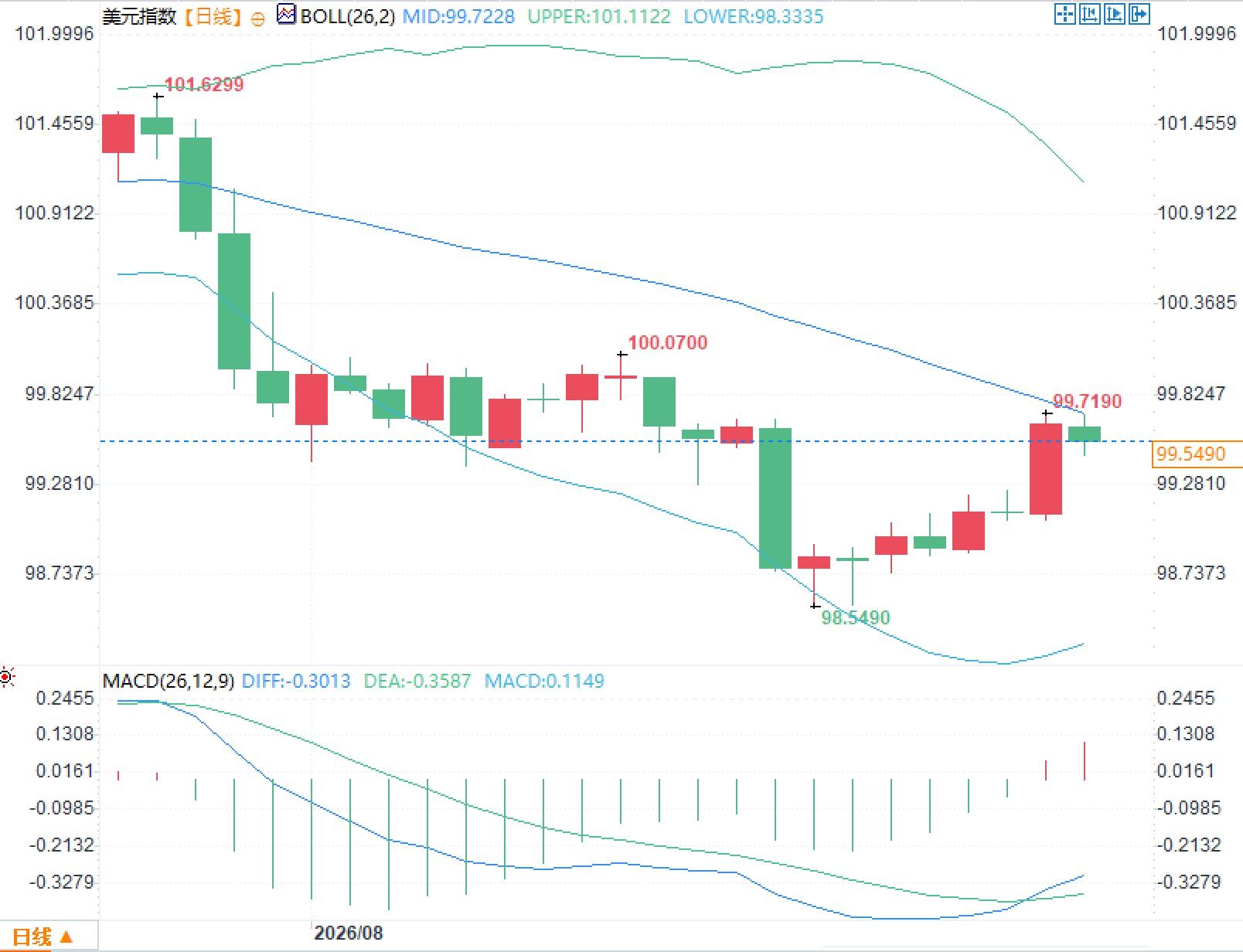 This structure suggests that recent price action is more accurately described as a volatility correction following a rapid decline, rather than a change in the original trend based solely on a few rebound candlesticks. The Bollinger Middle Band remains downward, and the Upper Band is converging downwards, indicating that the previously formed downward shift in the medium-term price center has not yet been fully digested. The MACD structure provides another layer of information. The DIFF is approximately -0.3013, the DEA is approximately -0.3587, and the histogram value is approximately 0.1149. The DIFF has risen above the DEA, but both remain below the zero line, which typically reflects a weakening of downward momentum, while the medium-term trend indicators have not yet completed their repricing.
Warsh didn't change interest rates, but rather the probability distribution of the September meeting.
The core reason for the renewed support for the US dollar is not the Fed's decision to raise interest rates, but the disruption of market certainty regarding the continued stability of interest rates. In his Jackson Hole speech, Warsh reiterated the 2% inflation target and questioned whether underlying inflation was approaching the target at a sufficiently clear and rapid pace. His policy logic was that with price pressures remaining high and the job market not yet showing significant signs of slowing, the Fed did not need to prematurely rule out further tightening. This change directly impacted the yield curve. Following the speech, the yield on the 2-year US Treasury note rose significantly in a single day, reflecting that traders were adjusting their near-term policy rate path rather than simply reassessing long-term economic growth. Currently, the market gives a probability of about 58% to 60% for a September rate hike, compared to only about 35% to 36% before the speech; some institutions have even adjusted their policy path for the year to 25 basis point rate hikes in September and December respectively. Therefore, the main support currently given to the dollar is actually a "policy probability premium." As long as the outcome of the September meeting remains highly uncertain, it will be difficult for short-term interest rate differentials to exit from exchange rate pricing. However, increased probability and final policy implementation are two different concepts.What will truly determine the policy path in September is whether employment and inflation can provide answers simultaneously.
The next two weeks will be packed with US data releases. The official schedule shows July job openings data on September 1st, August jobs report on September 4th, August producer price data on September 10th, and August consumer price data on September 11th, culminating in the Federal Reserve meeting on September 16th. This means that key variables from employment and wages to inflation will be largely updated before the meetings. Current market expectations for August non-farm payrolls remain low, with various surveys concluding an increase of around 50,000 to 60,000, and the unemployment rate expected to remain at 4.1%. July's non-farm payrolls decreased by 23,000, and previous months' data were significantly revised downwards, leading the market to focus more on the trend of job growth rather than the absolute figures for a single month. Official data also shows that May and June's employment figures were revised downwards by a combined 103,000. This presents a significant policy contradiction: job growth has slowed significantly, but layoffs remain relatively limited, and the unemployment rate has not risen rapidly. This "low hiring, low layoffs" situation means that a cooling job market does not equate to a stalled job market. Therefore, a low number of new jobs alone may not be enough to change the policy framework. The market is more likely to take into account the unemployment rate, labor participation, wages, and previous value revisions.The technical structure of the US dollar index indicates that a rebound and correction coexist with medium-term pressure.
Observing the daily chart, the US dollar index is currently around 99.5. The Bollinger Band middle line is around 99.72, the upper line is around 101.11, and the lower line is around 98.33. The index previously fell continuously from around 101.63, once dipping to around 98.55, before recovering, but it is currently still in the trading range near the Bollinger Band middle line. This structure suggests that recent price action is more accurately described as a volatility correction following a rapid decline, rather than a change in the original trend based solely on a few rebound candlesticks. The Bollinger Middle Band remains downward, and the Upper Band is converging downwards, indicating that the previously formed downward shift in the medium-term price center has not yet been fully digested. The MACD structure provides another layer of information. The DIFF is approximately -0.3013, the DEA is approximately -0.3587, and the histogram value is approximately 0.1149. The DIFF has risen above the DEA, but both remain below the zero line, which typically reflects a weakening of downward momentum, while the medium-term trend indicators have not yet completed their repricing.September dollar pricing will enter the "data-by-data clearing" phase.
The core issue for the US dollar in the future has shifted from "whether the Fed is prepared to tighten" to "whether economic data is sufficient to support further tightening." This distinction is crucial. The current approximately 60% probability of a rate hike means the market has already priced in a considerable degree of policy risk, yet still retains significant room for repricing. Meanwhile, energy prices have once again become an exogenous variable that cannot be ignored. On August 31, oil prices rose by about 2% due to escalating conflict in the Gulf region, with Brent crude regaining its position above $90 per barrel. If energy prices remain persistently high, they may influence policy discussions through transportation, production costs, and inflation expectations, but short-term oil price fluctuations will not mechanically translate into core inflation. Therefore, before the September meeting, the market is likely to continue to adjust around three key factors: whether employment will further cool, whether core inflation will truly approach 2%, and whether energy prices will alter the inflation path in the coming months. The current dollar index, near 99.5, merely reflects the combined pricing of these three variables at this stage, rather than indicating that any single macroeconomic narrative has gained a decisive advantage.- Risk Warning and Disclaimer
- The market involves risk, and trading may not be suitable for all investors. This article is for reference only and does not constitute personal investment advice, nor does it take into account certain users’ specific investment objectives, financial situation, or other needs. Any investment decisions made based on this information are at your own risk.