Prices in UK shops surge by 1.5%! With energy and AI as the "dual engines" igniting, what's next for the pound?
2026-09-01 10:09:04
Data released by the British Retail Consortium (BDC) on Tuesday (September 1) showed that the store price index rose 1.5% year-on-year in August, the highest since February 2024, a significant acceleration from 0.9% in July. Food inflation rose to a four-month high of 2.8%, while non-food inflation jumped from 0.2% to 0.9%. The BDC CEO pointed out that rising energy, input, and commodity costs are beginning to be passed on to shelf prices, and the AI boom has driven up the prices of memory chips and electronic components, thus pushing up the prices of consumer electronics. 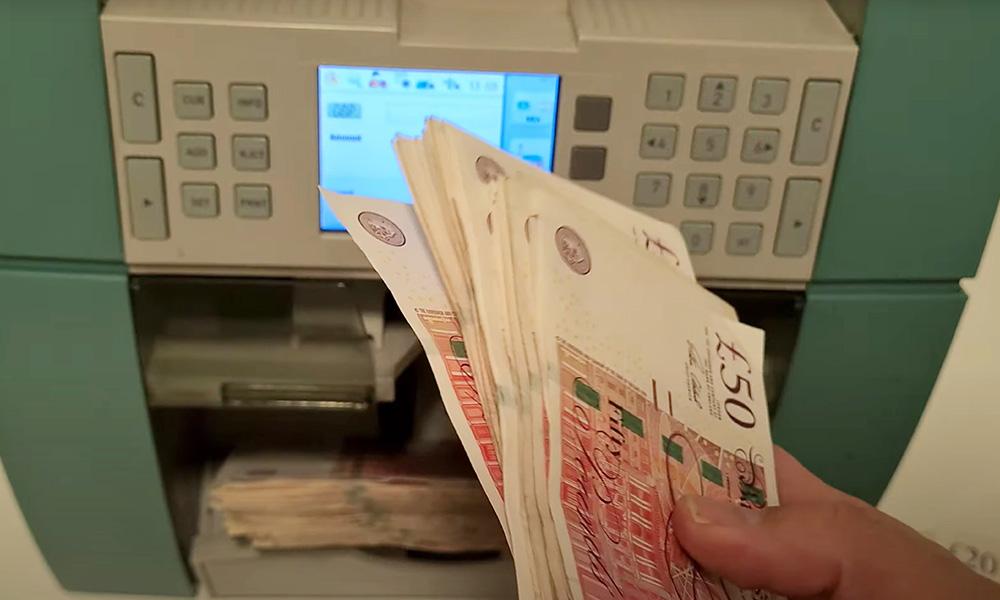
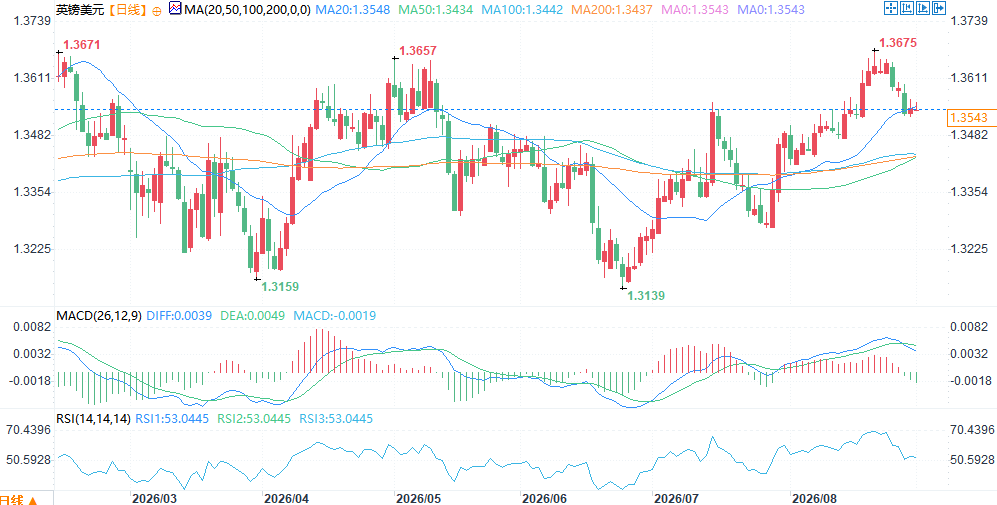 (GBP/USD daily chart, source: FX678) At 10:07 Beijing time, GBP/USD was trading at 1.3542/43.
Shop inflation accelerated to 1.5%, with both food and non-food inflation rising across the board.
The latest data from the British Retail Consortium (BRC) shows that the store price index rose 1.5% year-on-year in August, the highest level since February 2024, a significant acceleration from 0.9% in July. Food inflation rose to a four-month high of 2.8% (previous value 2.2%), while non-food inflation jumped from 0.2% to 0.9%, also the highest since February 2024. This broad-based rebound indicates that price pressures previously suppressed through promotions and competition are accelerating their transmission to the shelf. The BRC CEO pointed out that rising energy, input, and commodity costs have begun to be reflected, particularly impacting imported and processed room-temperature foods. Meanwhile, the global AI boom has driven up prices for memory chips and electronic components, directly increasing the cost of consumer electronics and becoming a significant driver of the rebound in non-food inflation. Although retailers continue to alleviate some pressure through promotions, the continued rise in costs makes an overall price acceleration inevitable. This data provides a leading indicator for the future trend of the official CPI, showing that retail inflation is rebounding from its low point.Supply-side factors are reshaping the inflation landscape, complicating the Bank of England's policy trade-offs.
This data echoes the UK Office for National Statistics' July CPI, which rose to a four-month high of 2.9%. The Bank of England had previously predicted that the CPI would peak at 3.2% in October and November, and that food inflation would reach 3.5% in December. Currently, rising energy costs and supply-side factors such as AI-driven chip demand are becoming the core forces reshaping the UK's inflation landscape. These factors are largely beyond the direct control of the Bank of England's traditional demand-side monetary policy tools, leading to a more complex trade-off when assessing the pace of further interest rate cuts. On the one hand, economic growth and the labor market still require easing support; on the other hand, the rising risk of sticky inflation from supply shocks may force a more cautious policy path. If subsequent shop prices and official CPI data continue to strengthen, market pricing of UK bond yields and interest rate cut expectations may be readjusted, increasing the difficulty of communication and decision-making for the central bank. Overall, inflation drivers are shifting from demand-driven to supply-driven, further narrowing policy space.GBP/USD: Shop price inflation accelerated to 1.5%, but Bank of England's "hold on" expectation limited gains.
The UK's August shop price inflation accelerated to 1.5%, providing short-term support for the pound, as the reading reinforced market expectations that the Bank of England might maintain a hawkish stance. Supply-side factors such as rising energy costs and AI-driven chip price increases are pushing up inflation, reminding the market that the Bank of England's policy path faces similar supply-side complexities to the Federal Reserve—inflation may be more sticky than expected. However, the pound is currently fluctuating against the dollar, trading around 1.3550, almost flat for the day. The pound's upside is limited by several factors. First, the market has pushed back its expectations for the Bank of England's next rate hike to early 2027, with only about a 15% probability of a rate hike at the September meeting, a stark contrast to the 60% probability of a Fed rate hike in September. Second, energy costs and AI-related price pressures are more supply-side shocks than demand-driven, leaving the Bank of England facing the dilemma of "whether to use demand-side tools to address supply-side inflation" when weighing rate hikes; the central bank may prefer to wait for more data. Third, the dollar's overall strength following Warsh's hawkish remarks has limited the pound's upside potential. The pound is likely to fluctuate between 1.3540 and 1.3650 against the dollar in the short term. If subsequent UK inflation data continues to exceed expectations (such as a sustained strengthening of the BRC data or a continued rise in official CPI), the market may reassess the Bank of England's policy path, providing further support for the pound. Conversely, if the Bank of England remains on hold while expectations of a Fed rate hike rise, the pound may face further downward pressure. (GBP/USD daily chart, source: FX678) At 10:07 Beijing time, GBP/USD was trading at 1.3542/43.
- Risk Warning and Disclaimer
- The market involves risk, and trading may not be suitable for all investors. This article is for reference only and does not constitute personal investment advice, nor does it take into account certain users’ specific investment objectives, financial situation, or other needs. Any investment decisions made based on this information are at your own risk.