The British pound continued its correction against the US dollar, awaiting a directional move near key support levels.
2026-09-01 14:04:05
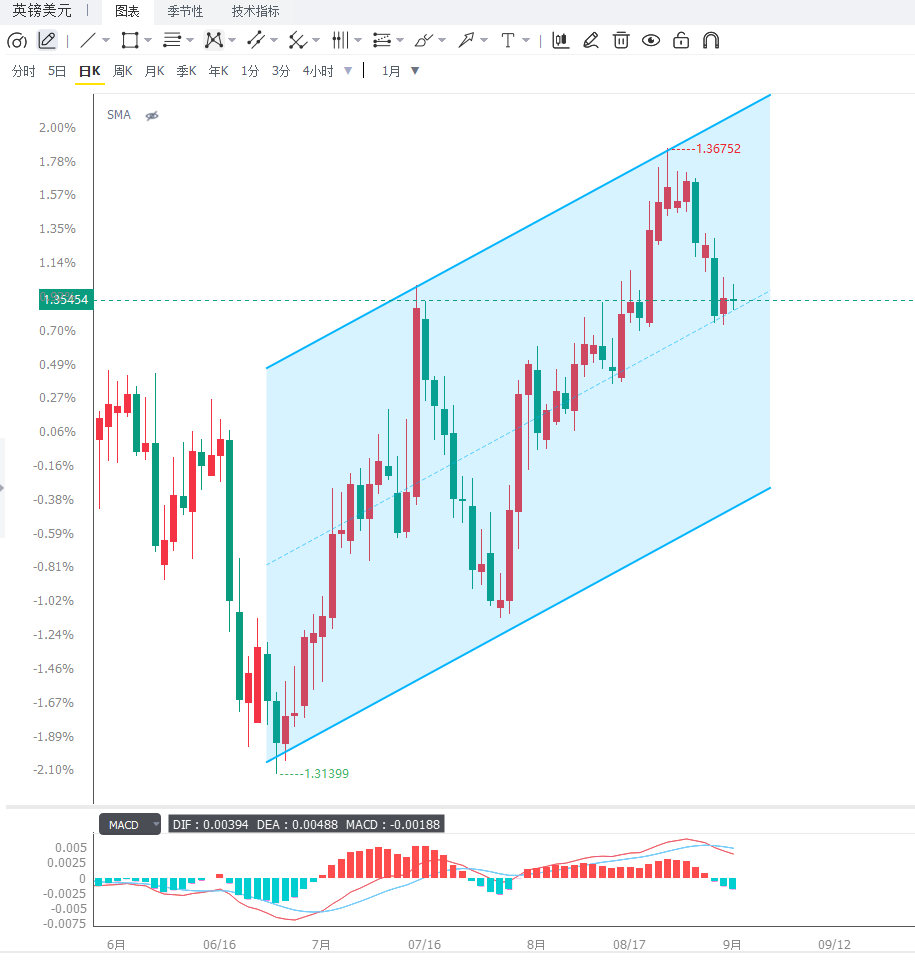
The pound/dollar pair remained weak in early Asian trading on Tuesday, hovering around 1.3550. The dollar received some safe-haven buying amid renewed tensions in the Middle East, while recent hawkish signals from Federal Reserve Chairman Kevin Warsh further strengthened the dollar, putting short-term pressure on the pound/dollar. However, expectations of further tightening by the Bank of England remain, limiting the pound's downside.  The situation in the Middle East has once again become a significant factor influencing the foreign exchange market. Recent clashes between the US and Iran have heightened market concerns about further escalation of the regional conflict. Meanwhile, the UK's Office for Maritime Trade Operations reported that an oil tanker was attacked by multiple projectiles while leaving the Strait of Hormuz. This increased security risk in energy transport not only pushes up risk premiums in the crude oil market but may also reinforce concerns about a resurgence of global inflation. For GBP/USD, the Middle East risks have a dual impact. On the one hand, risk aversion typically drives funds to traditional safe-haven assets like the US dollar, thus suppressing risk-sensitive currencies like the pound. On the other hand, if energy prices continue to rise, the UK may also face imported inflationary pressures, forcing the Bank of England to maintain a relatively tight monetary policy. Therefore, current oil price movements are both a support factor for the US dollar and a crucial variable for pound interest rate expectations. Expectations regarding US monetary policy further strengthen the short-term advantage of the US dollar. Federal Reserve Chairman Kevin Warsh's speech at the Jackson Hole conference was noticeably hawkish, emphasizing that if policymakers cannot confirm that underlying inflation is falling back towards the 2% target, the Fed still needs to take further action. This statement has led the market to readjust expectations for the September policy meeting and increased the US dollar's interest rate premium. The Federal Reserve's renewed hawkish stance is a key factor limiting the current rebound of the pound/dollar. If US inflation remains resilient while energy prices continue to rise, the Fed may need to maintain higher interest rates for an extended period, and further tightening cannot be ruled out. In this scenario, changes in the interest rate differential between the US and the UK would be more favorable to the dollar. However, the pound is not entirely without fundamental support. The market maintains a relatively positive expectation for the Bank of England's future policy. Traders currently believe there is about a 60% probability that the Bank of England will implement a 25 basis point adjustment at its September 16 meeting, and expect there may still be room for a cumulative tightening of about 36 basis points for the remainder of the year. If this expectation continues to rise, UK government bond yields may remain relatively high, thereby increasing the attractiveness of pound assets. In addition, the UK government's fiscal budget to be released at the end of October is also a key focus for the market. Fiscal spending, taxation, and government debt management methods may all affect UK inflation and economic growth expectations, thereby changing market judgments on the Bank of England's policy path. Judging from recent market performance, the pound is still supported by expectations of UK monetary policy, but the safe-haven advantage of the dollar and the Fed's hawkish stance are exerting significant downward pressure. Therefore, GBP/USD is not currently in a clear one-sided downtrend, but rather in a consolidation phase driven by both policy expectations and risk sentiment. US economic data will be a crucial variable determining the dollar's direction in the near term. The market is awaiting the US ISM Manufacturing Purchasing Managers' Index (PMI), followed by the August employment data. If US manufacturing activity and the job market continue to show resilience, it could further strengthen expectations that the Federal Reserve will maintain high interest rates, thus pushing the dollar higher; conversely, if manufacturing and employment data are significantly weaker than expected, the dollar may fall back, providing room for a rebound in GBP/USD. Particular attention needs to be paid to the job market. The market has already significantly increased its bets on a Fed policy adjustment in September, thus further increasing the importance of the August US employment data. If job growth slows significantly while wage pressures decline simultaneously, the market may lower its expectations for further Fed tightening, weakening the dollar's interest rate advantage. From a daily chart perspective, GBP/USD is currently trading around 1.3546, maintaining a generally mildly bullish medium-term structure. The exchange rate is above the 100-day simple moving average at 1.3444 and the lower Bollinger Band at 1.3433, indicating some support below. However, the price is currently approaching the middle Bollinger Band at 1.3550, which is a significant short-term resistance level. The RSI is around 53.3, in neutral territory, indicating stable market momentum but no clear strong breakout signal yet. If the exchange rate can effectively break through 1.3550 and hold above it, it will test the upper Bollinger Band near 1.3668; a successful breakout could lead to a further move towards the 1.3700 area. Conversely, if 1.3550 continues to act as resistance and GBP/USD weakens again, the first support level to watch is 1.3444-1.3433. A break below this area could lead to a further test of the 1.3350 area. On the 4-hour chart, GBP/USD is showing a slightly weak consolidation pattern in the short term, with the price fluctuating around 1.3550. While the bulls haven't completely lost their advantage, there's a lack of clear upward momentum. If the price reclaims the 1.3570-1.3600 area, the short-term trend will improve, and a test of the 1.3660 level is possible. However, a break below 1.3500 could increase downward pressure, with the next support level around 1.3440. Short-term technical indicators are currently neutral, and the direction remains highly dependent on the US dollar index and US economic data. The market will need to pay close attention to policy expectations from both the Federal Reserve and the Bank of England. If US data is weak and the Bank of England maintains a hawkish stance, GBP/USD could regain upward momentum. Conversely, if US data remains strong, demand for the dollar as a safe haven increases, and the Federal Reserve releases further hawkish signals, the exchange rate may continue to face downward pressure.
  Editor's Summary: The biggest contradiction in the GBP/USD pair right now lies in the struggle between the Bank of England's potential tightening policy and the Federal Reserve's hawkish expectations. UK interest rate expectations provide fundamental support for the pound, but the safe-haven demand for the dollar due to escalating tensions in the Middle East, and the potential for rising energy prices to strengthen US inflationary pressures, keep the dollar in a relatively favorable position. Therefore, in the near term, close attention should be paid to the US ISM Manufacturing PMI, August employment data, the US dollar index, and Fed policy signals, while also noting the potential impact of the UK fiscal budget on inflation and the Bank of England's policy path. The GBP/USD pair is expected to remain range-bound in the short term, with a breakout of key technical levels needed to confirm the next trend.
The situation in the Middle East has once again become a significant factor influencing the foreign exchange market. Recent clashes between the US and Iran have heightened market concerns about further escalation of the regional conflict. Meanwhile, the UK's Office for Maritime Trade Operations reported that an oil tanker was attacked by multiple projectiles while leaving the Strait of Hormuz. This increased security risk in energy transport not only pushes up risk premiums in the crude oil market but may also reinforce concerns about a resurgence of global inflation. For GBP/USD, the Middle East risks have a dual impact. On the one hand, risk aversion typically drives funds to traditional safe-haven assets like the US dollar, thus suppressing risk-sensitive currencies like the pound. On the other hand, if energy prices continue to rise, the UK may also face imported inflationary pressures, forcing the Bank of England to maintain a relatively tight monetary policy. Therefore, current oil price movements are both a support factor for the US dollar and a crucial variable for pound interest rate expectations. Expectations regarding US monetary policy further strengthen the short-term advantage of the US dollar. Federal Reserve Chairman Kevin Warsh's speech at the Jackson Hole conference was noticeably hawkish, emphasizing that if policymakers cannot confirm that underlying inflation is falling back towards the 2% target, the Fed still needs to take further action. This statement has led the market to readjust expectations for the September policy meeting and increased the US dollar's interest rate premium. The Federal Reserve's renewed hawkish stance is a key factor limiting the current rebound of the pound/dollar. If US inflation remains resilient while energy prices continue to rise, the Fed may need to maintain higher interest rates for an extended period, and further tightening cannot be ruled out. In this scenario, changes in the interest rate differential between the US and the UK would be more favorable to the dollar. However, the pound is not entirely without fundamental support. The market maintains a relatively positive expectation for the Bank of England's future policy. Traders currently believe there is about a 60% probability that the Bank of England will implement a 25 basis point adjustment at its September 16 meeting, and expect there may still be room for a cumulative tightening of about 36 basis points for the remainder of the year. If this expectation continues to rise, UK government bond yields may remain relatively high, thereby increasing the attractiveness of pound assets. In addition, the UK government's fiscal budget to be released at the end of October is also a key focus for the market. Fiscal spending, taxation, and government debt management methods may all affect UK inflation and economic growth expectations, thereby changing market judgments on the Bank of England's policy path. Judging from recent market performance, the pound is still supported by expectations of UK monetary policy, but the safe-haven advantage of the dollar and the Fed's hawkish stance are exerting significant downward pressure. Therefore, GBP/USD is not currently in a clear one-sided downtrend, but rather in a consolidation phase driven by both policy expectations and risk sentiment. US economic data will be a crucial variable determining the dollar's direction in the near term. The market is awaiting the US ISM Manufacturing Purchasing Managers' Index (PMI), followed by the August employment data. If US manufacturing activity and the job market continue to show resilience, it could further strengthen expectations that the Federal Reserve will maintain high interest rates, thus pushing the dollar higher; conversely, if manufacturing and employment data are significantly weaker than expected, the dollar may fall back, providing room for a rebound in GBP/USD. Particular attention needs to be paid to the job market. The market has already significantly increased its bets on a Fed policy adjustment in September, thus further increasing the importance of the August US employment data. If job growth slows significantly while wage pressures decline simultaneously, the market may lower its expectations for further Fed tightening, weakening the dollar's interest rate advantage. From a daily chart perspective, GBP/USD is currently trading around 1.3546, maintaining a generally mildly bullish medium-term structure. The exchange rate is above the 100-day simple moving average at 1.3444 and the lower Bollinger Band at 1.3433, indicating some support below. However, the price is currently approaching the middle Bollinger Band at 1.3550, which is a significant short-term resistance level. The RSI is around 53.3, in neutral territory, indicating stable market momentum but no clear strong breakout signal yet. If the exchange rate can effectively break through 1.3550 and hold above it, it will test the upper Bollinger Band near 1.3668; a successful breakout could lead to a further move towards the 1.3700 area. Conversely, if 1.3550 continues to act as resistance and GBP/USD weakens again, the first support level to watch is 1.3444-1.3433. A break below this area could lead to a further test of the 1.3350 area. On the 4-hour chart, GBP/USD is showing a slightly weak consolidation pattern in the short term, with the price fluctuating around 1.3550. While the bulls haven't completely lost their advantage, there's a lack of clear upward momentum. If the price reclaims the 1.3570-1.3600 area, the short-term trend will improve, and a test of the 1.3660 level is possible. However, a break below 1.3500 could increase downward pressure, with the next support level around 1.3440. Short-term technical indicators are currently neutral, and the direction remains highly dependent on the US dollar index and US economic data. The market will need to pay close attention to policy expectations from both the Federal Reserve and the Bank of England. If US data is weak and the Bank of England maintains a hawkish stance, GBP/USD could regain upward momentum. Conversely, if US data remains strong, demand for the dollar as a safe haven increases, and the Federal Reserve releases further hawkish signals, the exchange rate may continue to face downward pressure. Editor's Summary: The biggest contradiction in the GBP/USD pair right now lies in the struggle between the Bank of England's potential tightening policy and the Federal Reserve's hawkish expectations. UK interest rate expectations provide fundamental support for the pound, but the safe-haven demand for the dollar due to escalating tensions in the Middle East, and the potential for rising energy prices to strengthen US inflationary pressures, keep the dollar in a relatively favorable position. Therefore, in the near term, close attention should be paid to the US ISM Manufacturing PMI, August employment data, the US dollar index, and Fed policy signals, while also noting the potential impact of the UK fiscal budget on inflation and the Bank of England's policy path. The GBP/USD pair is expected to remain range-bound in the short term, with a breakout of key technical levels needed to confirm the next trend.
- Risk Warning and Disclaimer
- The market involves risk, and trading may not be suitable for all investors. This article is for reference only and does not constitute personal investment advice, nor does it take into account certain users’ specific investment objectives, financial situation, or other needs. Any investment decisions made based on this information are at your own risk.