Rising expectations of a Federal Reserve rate hike are supporting the dollar, with the USD/JPY pair hovering around the 160 level.
2026-09-01 14:09:02
The USD/JPY pair remained range-bound in early Asian trading on Tuesday, trading below the 160.00 level and not far from the one-month high retested in the previous session. Market confidence in the yen remains weak, with concerns about Japan's high government debt, rising long-term financing costs, and expansionary fiscal policies continuing to diminish the yen's appeal.  Japanese government bond yields have been a focus of attention recently. Rising long-term borrowing costs mean a further increase in the Japanese government's fiscal burden, and market concerns about the sustainability of fiscal policy can easily be transmitted to the yen through the bond and foreign exchange markets. Meanwhile, although Japan's monetary policy has gradually normalized, its interest rates remain relatively low compared to major economies like the US, and the large interest rate differential continues to reduce the attractiveness of yen-denominated assets. Regarding the US dollar, the market is re- pricing in the possibility of a hawkish stance from the Federal Reserve. Fed Chairman Kevin Warsh emphasized at the Jackson Hole symposium that if underlying inflation does not sufficiently decline towards the 2% policy target, the Fed will need to continue taking action. This statement has boosted investor expectations for further policy tightening and has also led to renewed buying interest in the dollar after its previous correction. Fed interest rate expectations and the US-Japan interest rate differential remain the core fundamental support for the USD/JPY exchange rate's upward movement. If US inflation remains resilient, while energy prices continue to rise and increase inflationary pressures, the market may further postpone expectations of easing, strengthening the yield advantage of dollar-denominated assets. Escalating tensions in the Middle East have further increased the safe-haven appeal of the dollar. Recent renewed military conflict between the US and Iran has simultaneously increased the risks to energy transportation near the Strait of Hormuz. Rising oil prices could exacerbate global inflation concerns, while geopolitical risks themselves could drive increased allocations to safe-haven assets like the US dollar. However, the policy risks facing USD/JPY around 160 are clearly increasing. Japan has repeatedly emphasized the importance of exchange rate stability, and when the exchange rate rapidly approaches or breaks through key psychological levels, the market often raises expectations for measures taken by Japan. Therefore, the area around 160 USD/JPY is not only a technical resistance level but also a significant watershed between market sentiment and policy expectations. Furthermore, this week's US economic data will provide new directional clues for the dollar. The US ISM Manufacturing PMI will be released first, followed by the August non-farm payroll report. If US economic activity and the job market continue to be resilient, the Fed's hawkish expectations may be strengthened, giving USD/JPY further upward momentum; if the data is significantly weaker than expected, it could trigger a dollar pullback and alleviate upward pressure on the exchange rate. Regarding Japan, the Bank of Japan's subsequent policy signals also need to be monitored. If Japanese inflation continues to be resilient, and wage growth and service prices remain strong, expectations for further policy adjustments by the Bank of Japan may rise, partially offsetting the adverse effects of the Japan-US interest rate differential on the yen. Therefore, the fundamentals for USD/JPY remain bullish, but the upside is not without limits. US interest rate expectations, energy prices, and safe-haven demand provide upward momentum, while Japanese policy responses and the high-level risks around 160 pose significant constraints. Whether the exchange rate can truly break through this level depends on whether US data continues to support a stronger dollar and whether Japan releases clearer policy signals. On the daily chart, USD/JPY maintains a clear high-level bullish pattern, and the price remains in a recent uptrend. In the short term, the first focus is on the equilibrium zone around 159.60, with 160.00 being a key psychological resistance level. A successful break and hold above this level could lead to further targets around 160.60 and 162.10; stronger resistance lies around 164.00. Key support lies at 159.20, followed by 158.55 and 157.30. A break below 157.30 would significantly weaken the short-term upward structure. From a 4-hour chart perspective, the exchange rate is in a high-level consolidation phase, with the price above the 100-period moving average at 159.19, indicating that the bulls still hold a certain advantage. However, the 200-period moving average around 160.26 is providing significant resistance. 159.59 is currently a crucial technical level; a break above 160.26 could lead to a short-term move towards 160.62 or even 162.09; conversely, a break below 159.19 could extend the pullback to around 158.56. Overall, the 4-hour technical structure is slightly neutral to bullish, but the validity of a breakout around 160 will determine the direction in the next phase.
 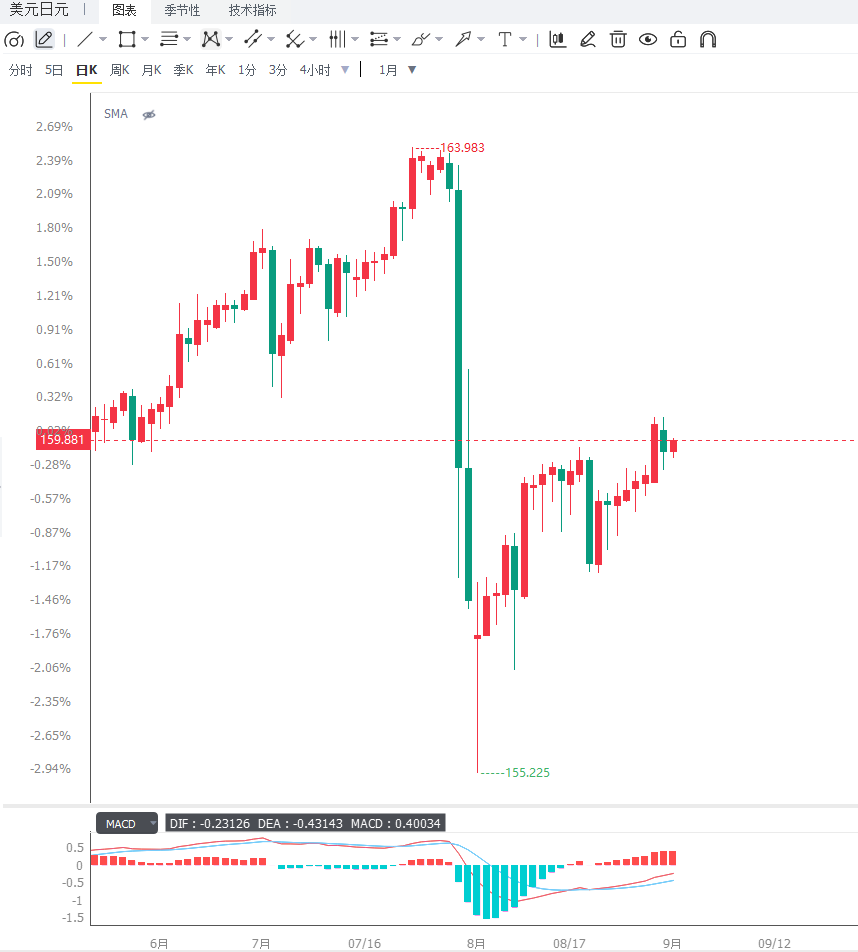 Editor's Summary: The USD/JPY pair is currently supported by the US-Japan interest rate differential, expectations of US monetary policy, and safe-haven inflows, while Japanese fiscal pressures are further weakening the yen's performance. However, as the exchange rate approaches the 160 level, the market's sensitivity to Japanese policy intervention has significantly increased. In the short term, 160.00-160.60 is a key area for whether the bulls can open up further upside potential, while 159.20 is currently an important defensive level. If US economic data is strong and the Federal Reserve continues to release hawkish signals, USD/JPY may break through 160 and extend to higher levels; if US data weakens or expectations of Japanese policy increase, the exchange rate may experience a significant pullback from its highs. Going forward, close attention should be paid to the US ISM Manufacturing PMI, August non-farm payroll data, Federal Reserve policy signals, and relevant statements from the Bank of Japan, while also being wary of sharp fluctuations caused by a sudden escalation of policy risks after a rapid rise in the exchange rate.
Japanese government bond yields have been a focus of attention recently. Rising long-term borrowing costs mean a further increase in the Japanese government's fiscal burden, and market concerns about the sustainability of fiscal policy can easily be transmitted to the yen through the bond and foreign exchange markets. Meanwhile, although Japan's monetary policy has gradually normalized, its interest rates remain relatively low compared to major economies like the US, and the large interest rate differential continues to reduce the attractiveness of yen-denominated assets. Regarding the US dollar, the market is re- pricing in the possibility of a hawkish stance from the Federal Reserve. Fed Chairman Kevin Warsh emphasized at the Jackson Hole symposium that if underlying inflation does not sufficiently decline towards the 2% policy target, the Fed will need to continue taking action. This statement has boosted investor expectations for further policy tightening and has also led to renewed buying interest in the dollar after its previous correction. Fed interest rate expectations and the US-Japan interest rate differential remain the core fundamental support for the USD/JPY exchange rate's upward movement. If US inflation remains resilient, while energy prices continue to rise and increase inflationary pressures, the market may further postpone expectations of easing, strengthening the yield advantage of dollar-denominated assets. Escalating tensions in the Middle East have further increased the safe-haven appeal of the dollar. Recent renewed military conflict between the US and Iran has simultaneously increased the risks to energy transportation near the Strait of Hormuz. Rising oil prices could exacerbate global inflation concerns, while geopolitical risks themselves could drive increased allocations to safe-haven assets like the US dollar. However, the policy risks facing USD/JPY around 160 are clearly increasing. Japan has repeatedly emphasized the importance of exchange rate stability, and when the exchange rate rapidly approaches or breaks through key psychological levels, the market often raises expectations for measures taken by Japan. Therefore, the area around 160 USD/JPY is not only a technical resistance level but also a significant watershed between market sentiment and policy expectations. Furthermore, this week's US economic data will provide new directional clues for the dollar. The US ISM Manufacturing PMI will be released first, followed by the August non-farm payroll report. If US economic activity and the job market continue to be resilient, the Fed's hawkish expectations may be strengthened, giving USD/JPY further upward momentum; if the data is significantly weaker than expected, it could trigger a dollar pullback and alleviate upward pressure on the exchange rate. Regarding Japan, the Bank of Japan's subsequent policy signals also need to be monitored. If Japanese inflation continues to be resilient, and wage growth and service prices remain strong, expectations for further policy adjustments by the Bank of Japan may rise, partially offsetting the adverse effects of the Japan-US interest rate differential on the yen. Therefore, the fundamentals for USD/JPY remain bullish, but the upside is not without limits. US interest rate expectations, energy prices, and safe-haven demand provide upward momentum, while Japanese policy responses and the high-level risks around 160 pose significant constraints. Whether the exchange rate can truly break through this level depends on whether US data continues to support a stronger dollar and whether Japan releases clearer policy signals. On the daily chart, USD/JPY maintains a clear high-level bullish pattern, and the price remains in a recent uptrend. In the short term, the first focus is on the equilibrium zone around 159.60, with 160.00 being a key psychological resistance level. A successful break and hold above this level could lead to further targets around 160.60 and 162.10; stronger resistance lies around 164.00. Key support lies at 159.20, followed by 158.55 and 157.30. A break below 157.30 would significantly weaken the short-term upward structure. From a 4-hour chart perspective, the exchange rate is in a high-level consolidation phase, with the price above the 100-period moving average at 159.19, indicating that the bulls still hold a certain advantage. However, the 200-period moving average around 160.26 is providing significant resistance. 159.59 is currently a crucial technical level; a break above 160.26 could lead to a short-term move towards 160.62 or even 162.09; conversely, a break below 159.19 could extend the pullback to around 158.56. Overall, the 4-hour technical structure is slightly neutral to bullish, but the validity of a breakout around 160 will determine the direction in the next phase. Editor's Summary: The USD/JPY pair is currently supported by the US-Japan interest rate differential, expectations of US monetary policy, and safe-haven inflows, while Japanese fiscal pressures are further weakening the yen's performance. However, as the exchange rate approaches the 160 level, the market's sensitivity to Japanese policy intervention has significantly increased. In the short term, 160.00-160.60 is a key area for whether the bulls can open up further upside potential, while 159.20 is currently an important defensive level. If US economic data is strong and the Federal Reserve continues to release hawkish signals, USD/JPY may break through 160 and extend to higher levels; if US data weakens or expectations of Japanese policy increase, the exchange rate may experience a significant pullback from its highs. Going forward, close attention should be paid to the US ISM Manufacturing PMI, August non-farm payroll data, Federal Reserve policy signals, and relevant statements from the Bank of Japan, while also being wary of sharp fluctuations caused by a sudden escalation of policy risks after a rapid rise in the exchange rate.
- Risk Warning and Disclaimer
- The market involves risk, and trading may not be suitable for all investors. This article is for reference only and does not constitute personal investment advice, nor does it take into account certain users’ specific investment objectives, financial situation, or other needs. Any investment decisions made based on this information are at your own risk.