Safe-haven demand supports the US dollar; can Australia's better-than-expected GDP growth save the Australian dollar?
2026-09-02 08:10:04
On Wednesday (September 2nd) during the Asian session, the Australian dollar traded in a narrow range against the US dollar, currently hovering around 0.7145. Escalating geopolitical tensions between the US and Iran continued to provide safe-haven support for the US dollar, while stronger energy prices pushed up US Treasury yields. The market's pricing in a September rate hike has risen to approximately 72%, and these multiple factors have significantly limited the upside potential of the Australian dollar. US July JOLTS job openings were 7.27 million (lower than expected), and the ISM Manufacturing PMI fell from 55.6 to 54.6 (still in expansion territory). Federal Reserve Governor Barr stated that he is prepared to raise interest rates if inflation does not slow down soon. The market is focused on Wednesday's Australian Q2 GDP data (expected to be 0.3% quarter-on-quarter, and down 1.8% year-on-year from 2.5%) and Friday's US non-farm payroll report. 
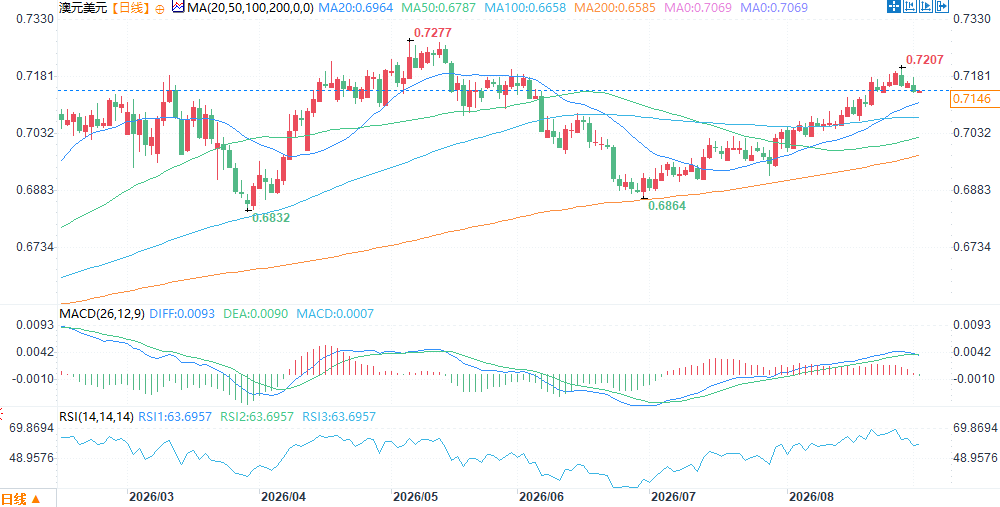 (Australian dollar to US dollar daily chart, source: EasyForex) At 8:04 Beijing time, the Australian dollar to US dollar exchange rate was 0.7145/46.
The US-Iran conflict boosted the US dollar and expectations of interest rate hikes, putting downward pressure on the Australian dollar.
The Australian dollar fell about 0.3% against the US dollar overnight, closing near 0.7145, after briefly dipping below 0.7140 during the session. The core driver of this decline was risk aversion triggered by the escalating conflict between the US and Iran. Geopolitical tensions significantly boosted demand for the US dollar as the world's primary safe-haven currency, causing funds to flow back from risk assets to dollar assets, directly suppressing commodity currencies including the Australian dollar. Simultaneously, the conflict pushed up international oil and natural gas prices, and rising energy costs further intensified market concerns about sticky US inflation. US Treasury yields subsequently rose, with the 10-year yield climbing to 4.796%, and the increase in real interest rates also put additional pressure on the Australian dollar. Regarding interest rate expectations, the market's pricing in a September rate hike by the Federal Reserve quickly rose to approximately 72%. Federal Reserve Governor Barr's public statement that policymakers are prepared to raise rates again if inflation data does not show a significant slowdown in the short term significantly reinforced hawkish expectations. Although the US July JOLTS job openings totaled 7.27 million, below market expectations, and the ISM Manufacturing PMI fell from 55.6 to 54.6, it remained in expansion territory. Overall, employment and manufacturing data were not yet sufficient to reverse the interest rate hike path. Multiple factors combined to support the US dollar index, while the Australian dollar, due to its commodity export attributes and relative interest rate disadvantage, came under pressure and declined, with its short-term technical chart also showing a bearish pattern.The market awaits Australian GDP and US non-farm payroll data.
Looking ahead, market focus has quickly shifted to two key data releases this week: Australia's Q2 GDP figures released on Wednesday and the US non-farm payrolls report on Friday. The market consensus for Australian GDP is a 0.3% quarter-on-quarter increase, with year-on-year growth potentially slowing to around 1.8% from 2.5% in the previous quarter. If the actual data is significantly stronger than expected, indicating continued resilience in the Australian economy and robust domestic demand and exports, it could provide a temporary boost to the Australian dollar, triggering short covering and pushing the exchange rate towards the 0.7180-0.7200 range. Conversely, if the data is weak, confirming a further slowdown in growth momentum, it will exacerbate market concerns about the Reserve Bank of Australia's limited policy space, thus increasing downward pressure on the Australian dollar and potentially testing the key support level of 0.7100. Meanwhile, Friday's US non-farm payrolls data will directly verify the strength of the job market, thereby influencing the Fed's subsequent interest rate hike path. Strong non-farm payrolls and wage data could further increase the probability of a September rate hike, strengthening the US dollar; weak data could ease rate hike expectations, providing breathing room for the Australian dollar. In the short term, the Australian dollar is likely to remain range-bound between 0.7100 and 0.7200 against the US dollar ahead of the data release. Traders need to closely monitor the latest developments in the US-Iran conflict, energy price fluctuations, and statements from Reserve Bank of Australia officials. If geopolitical risks continue to escalate or US data is strong, the Australian dollar still faces the risk of further decline; conversely, better-than-expected data and easing risk sentiment may open a window for a short-term rebound. Overall, the direction will be highly dependent on the development of this week's economic data and geopolitical events.Institutional Views
The UOB FX strategy team, led by Quek Ser Leang and Lee Sue Ann, recently noted that the Australian dollar has rebounded from its high of 0.7208 against the US dollar and is expected to trade around 0.7150 today. They believe the nearly month-long strong rally in the Australian dollar has largely ended, with overbought conditions and negative divergence opening up room for a deeper correction. The short-term target is 0.7120, but it's uncertain whether it can effectively break below that level. A break above the strong resistance level of 0.7200 would likely lead to range-bound trading rather than a continued decline. The medium-term technical outlook remains bullish, and a sustained move above 0.7200 could potentially challenge the year's high near 0.7280. However, given the current US-Iran conflict driving safe-haven demand for the US dollar, rising expectations of a Fed rate hike, and the approaching release of Australian GDP and US non-farm payroll data, short-term volatility is expected to increase, but the medium-term support for the Australian dollar as a high-yield commodity currency remains intact. In its September Monthly FX Outlook, MUFG provided a clear quarterly path: the spot rate is approximately 0.7166, projected to reach 0.7100 by the end of Q3 2026, 0.7200 by the end of Q4 2026, 0.7300 in Q1 2027, and 0.7400 in Q2 2027. The bank believes that the divergence in policies between the Federal Reserve and the Reserve Bank of Australia, Middle East risks pushing up energy prices, and global risk sentiment will dominate short-term trends. The probability of an RBA rate hike at its September 29th meeting is approximately 50%, and the data will determine the final outcome. Although the Australian dollar may fall back to around 0.71 in the short term due to the safe-haven appeal of the US dollar and expectations of a rate hike, it still has room for steady appreciation as the US dollar weakens in the medium to long term (DXY forecasts are gradually declining), Australia's high interest rate advantage, and commodity price support provide support.Summarize
The Australian dollar is currently trading around 0.7145 against the US dollar, with the US-Iran conflict boosting the US dollar and expectations of interest rate hikes. US Treasury yields have risen to 4.796%, with a roughly 72% probability of a September rate hike. The market is awaiting Australian GDP and US non-farm payroll data. The Australian dollar may fluctuate between 0.7100 and 0.7200 in the short term, awaiting data and geopolitical developments to provide new direction. (Australian dollar to US dollar daily chart, source: EasyForex) At 8:04 Beijing time, the Australian dollar to US dollar exchange rate was 0.7145/46.
- Risk Warning and Disclaimer
- The market involves risk, and trading may not be suitable for all investors. This article is for reference only and does not constitute personal investment advice, nor does it take into account certain users’ specific investment objectives, financial situation, or other needs. Any investment decisions made based on this information are at your own risk.