Hawkish comments from Bank of Japan board members signaled further interest rate hikes, causing the USD/JPY exchange rate to fluctuate and decline.
2026-09-02 15:36:04
The yen strengthened significantly on Wednesday, with the USD/JPY pair briefly touching 160.39 before quickly retreating. The yen rose as much as 0.5% against the dollar, reaching around 159.44. The main driver of the yen's rebound was a noticeably stronger hawkish signal from the Bank of Japan (BOJ). BOJ policy board member Hajime Takada stated that the possibility of a larger-than-expected interest rate hike could not be ruled out, and that consecutive rate hikes were also a policy option. This prompted the market to reassess the BOJ's future tightening pace.  Hajime Takada's remarks garnered significant market attention due to his distinctly hawkish policy stance. He not only argued that future interest rate hikes should not be limited by a fixed pace but also emphasized that the Bank of Japan needs to flexibly adjust its policy based on changes in the economy, inflation, and financial markets. This means that market expectations previously built on a limited number of annual rate hikes may need to be repriced. Particularly noteworthy is Takada's statement that a 25 basis point rate hike is not a certainty, and he did not rule out the possibility of consecutive rate hikes. Compared to the market's previous understanding of a gradual and slow exit from the Bank of Japan's easing policy, this statement is significantly more aggressive. If other policymakers follow suit with similar views, the Bank of Japan's policy normalization may proceed faster than currently expected by the market. Bank of Japan Governor Kazuo Ueda also released hawkish signals that day, stating that the central bank will focus on assessing the economic and price outlook at its September meeting and determining whether inflation risks are further expanding. This further increased market expectations for a rate hike at the Bank of Japan's September 17-18 meeting. Currently, the biggest change facing the Bank of Japan's policy is the mutually reinforcing relationship between inflation risks and yen depreciation. The previous weakening of the yen had already pushed up import costs, and recently, international oil prices have risen rapidly due to the escalating situation in the Middle East. As an economy heavily reliant on energy imports, Japan faces even greater imported inflationary pressures. If the yen continues to depreciate while energy prices remain high, domestic price pressures in Japan may further intensify. This is one of the key reasons why the Bank of Japan is accelerating policy normalization. Unlike the low-inflation environment that has long plagued the Japanese economy in the past, policymakers are increasingly concerned about prolonged inflation. If the central bank continues to maintain a relatively loose real interest rate environment, the weak yen may further increase import costs and create new inflationary pressures. Meanwhile, the Japanese bond market has begun pricing in faster interest rate hikes. The yield on 10-year Japanese government bonds recently rose to 3.00%, the highest level since 1996. Short- and medium-term bond yields are also at multi-year highs, indicating that investors are reassessing the Bank of Japan's future interest rate path. The rapid rise in Japanese government bond yields has a dual impact. On the one hand, rising yields mean a narrowing of the interest rate differential between Japanese assets and overseas assets, which is conducive to attracting some funds back to Japan, thus supporting the yen. On the other hand, Japan's high level of government debt and a rapid rise in long-term interest rates will also increase fiscal financing costs. If the bond market continues to be under pressure, the Bank of Japan will need to be more cautious in handling financial stability risks during interest rate hikes. However, from an exchange rate perspective, a single hawkish speech is insufficient for the yen to form a sustained appreciation trend. The yield on 10-year US Treasury bonds is also currently high, and a significant interest rate differential still exists between the US and Japan. At the same time, the US has recently been affected by rising oil prices and inflationary pressures, and the Fed's policy expectations have also shifted towards a hawkish stance. The US dollar index is approaching the 100 mark again, meaning that the dollar itself still has strong interest rate and safe-haven support. Therefore, USD/JPY is currently in a direct collision between two policy forces: on one hand, high US yields and expectations of Fed rate hikes; on the other hand, the Bank of Japan's accelerated rate hikes and the rapid rise in Japanese government bond yields. If the Bank of Japan does indeed adopt a strategy of continuous rate hikes in the future, the US-Japan interest rate differential may narrow further, and the medium-term downward pressure on USD/JPY will increase significantly. Previously, the main concern regarding the Bank of Japan was that its policy normalization pace might not keep up with the yen's depreciation and changes in domestic inflation. Hajime Takada's recent remarks have changed this expectation. Market strategists believe his statements on the magnitude and pace of interest rate hikes were more aggressive than the recent comments from the Bank of Japan governor and deputy governor, hence the yen's swift reaction. Furthermore, the yen has recently been supported by the Japanese authorities' stance on stabilizing the exchange rate. The US Treasury has previously publicly supported Japan taking more explicit monetary policy measures to mitigate inflation and financial market risks caused by an excessively weak yen. Meanwhile, Japan continues to monitor exchange rate fluctuations. This increased focus on policy has made the market more sensitive to the risk of USD/JPY continuing to rise around 160. From a market pricing perspective, 160 has become a significant psychological level for USD/JPY. Recent significant fluctuations after the exchange rate approached this level multiple times indicate a strong battle between bulls and bears in this area. If the Bank of Japan (BOJ) signals further consecutive interest rate hikes while US employment and inflation data show signs of cooling, the USD/JPY pair may experience a more pronounced downward trend. Conversely, if US yields continue to rise while the BOJ only implements a single, small rate hike, the yen's appreciation potential may remain limited. Therefore, the key to the future of USD/JPY is not whether the BOJ raises interest rates, but rather whether the magnitude, continuity, and speed of policy normalization can exceed current market pricing. Takata Hajime has already opened up this possibility for the market, and subsequent statements from other central bank officials and the September policy meeting will determine whether this expectation can truly translate into sustained yen buying. From a daily chart perspective, USD/JPY has recently been fluctuating around 160, with 160.00 becoming the most important psychological level. The exchange rate previously rose to 160.39 before quickly falling back, indicating strong selling pressure above this area. If the pair subsequently re-establishes itself above 160.00 and breaks through 160.40, further resistance levels to watch are 161.00 and 162.10. If the bulls break through 163.00, they may retest the previous high of 163.96. On the downside, the first support level to watch is around 159.60; a break below this level could lead to a pullback towards 158.60 and 157.30. Overall, the daily chart remains in a high-level consolidation pattern, but hawkish expectations from the Bank of Japan are increasing downward pressure on the exchange rate. Looking at the 4-hour chart, USD/JPY rose sharply near 160.39 before quickly falling back, showing clear signs of a short-term reversal. The area around 159.60 is a key level for the bulls to defend; a breach of this area could extend the short-term correction to 158.60. If 158.60 is also broken, then the area around 157.30 will become the next important support level. Only after breaking through 160.40 again can the exchange rate regain its short-term strength and retest the vicinity of 161.00. The current 4-hour chart suggests a pullback from higher levels, and the market needs to closely observe the 159.60 level.
 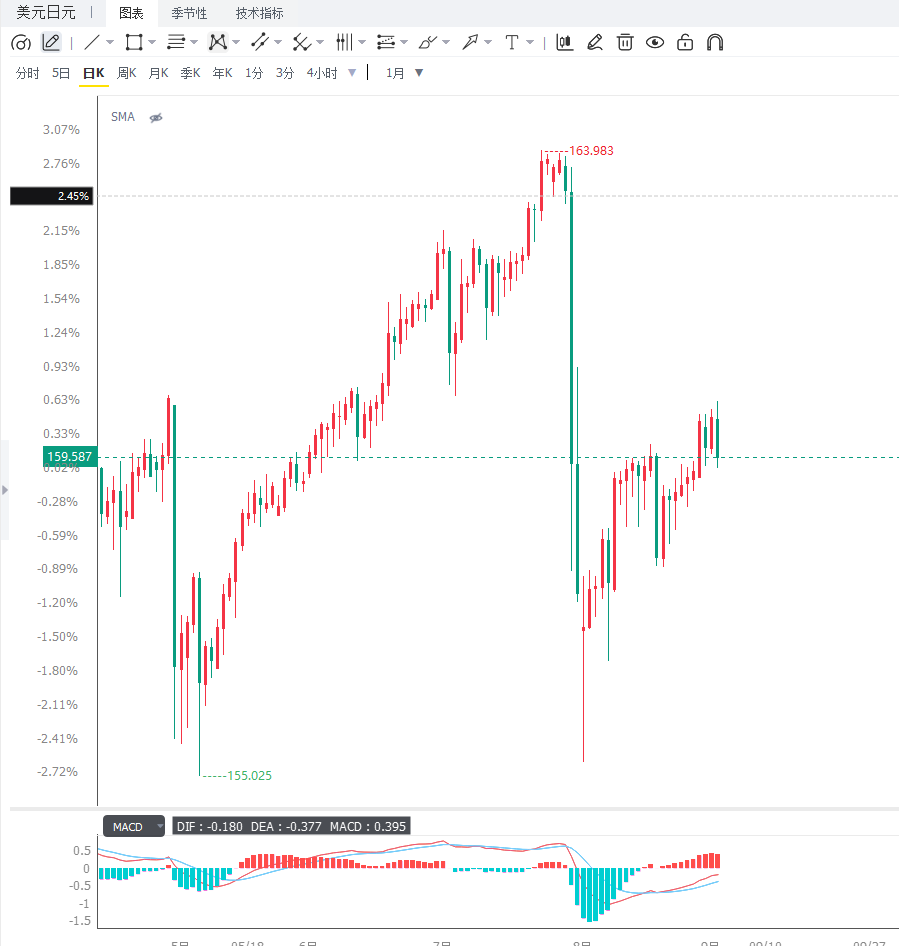 Editor's Summary: The recent remarks by hawkish Bank of Japan (BOJ) board member Hajime Takada significantly increased market expectations for consecutive interest rate hikes and faster policy normalization, leading to a rapid rebound in the yen. Especially given the backdrop of the 10-year Japanese government bond yield rising to 3% and the yen's continued depreciation pushing up import inflation, the necessity for the BOJ to accelerate policy tightening is increasing. In the short term, 160.00 remains the most crucial dividing line between bullish and bearish sentiment for USD/JPY. If the BOJ further strengthens its hawkish stance and confirms that it may continue to act after the September rate hike, while US economic data begins to cool, USD/JPY could fall back to 158.60 or even 157.30. Conversely, if US yields continue to rise, and the BOJ ultimately only raises rates slightly and remains cautious about subsequent policy, USD/JPY may retest 160.40 and higher levels. Overall, the pace of the BOJ's policy is becoming a core variable influencing the yen's trajectory. Hajime Takada's remarks mean that the market can no longer simply interpret the Bank of Japan's policy as "slow, quarterly rate hikes." If the pace of policy normalization accelerates significantly in the future, the narrowing of the US-Japan interest rate differential may become an important force driving a medium-term reversal in the yen's performance.
Hajime Takada's remarks garnered significant market attention due to his distinctly hawkish policy stance. He not only argued that future interest rate hikes should not be limited by a fixed pace but also emphasized that the Bank of Japan needs to flexibly adjust its policy based on changes in the economy, inflation, and financial markets. This means that market expectations previously built on a limited number of annual rate hikes may need to be repriced. Particularly noteworthy is Takada's statement that a 25 basis point rate hike is not a certainty, and he did not rule out the possibility of consecutive rate hikes. Compared to the market's previous understanding of a gradual and slow exit from the Bank of Japan's easing policy, this statement is significantly more aggressive. If other policymakers follow suit with similar views, the Bank of Japan's policy normalization may proceed faster than currently expected by the market. Bank of Japan Governor Kazuo Ueda also released hawkish signals that day, stating that the central bank will focus on assessing the economic and price outlook at its September meeting and determining whether inflation risks are further expanding. This further increased market expectations for a rate hike at the Bank of Japan's September 17-18 meeting. Currently, the biggest change facing the Bank of Japan's policy is the mutually reinforcing relationship between inflation risks and yen depreciation. The previous weakening of the yen had already pushed up import costs, and recently, international oil prices have risen rapidly due to the escalating situation in the Middle East. As an economy heavily reliant on energy imports, Japan faces even greater imported inflationary pressures. If the yen continues to depreciate while energy prices remain high, domestic price pressures in Japan may further intensify. This is one of the key reasons why the Bank of Japan is accelerating policy normalization. Unlike the low-inflation environment that has long plagued the Japanese economy in the past, policymakers are increasingly concerned about prolonged inflation. If the central bank continues to maintain a relatively loose real interest rate environment, the weak yen may further increase import costs and create new inflationary pressures. Meanwhile, the Japanese bond market has begun pricing in faster interest rate hikes. The yield on 10-year Japanese government bonds recently rose to 3.00%, the highest level since 1996. Short- and medium-term bond yields are also at multi-year highs, indicating that investors are reassessing the Bank of Japan's future interest rate path. The rapid rise in Japanese government bond yields has a dual impact. On the one hand, rising yields mean a narrowing of the interest rate differential between Japanese assets and overseas assets, which is conducive to attracting some funds back to Japan, thus supporting the yen. On the other hand, Japan's high level of government debt and a rapid rise in long-term interest rates will also increase fiscal financing costs. If the bond market continues to be under pressure, the Bank of Japan will need to be more cautious in handling financial stability risks during interest rate hikes. However, from an exchange rate perspective, a single hawkish speech is insufficient for the yen to form a sustained appreciation trend. The yield on 10-year US Treasury bonds is also currently high, and a significant interest rate differential still exists between the US and Japan. At the same time, the US has recently been affected by rising oil prices and inflationary pressures, and the Fed's policy expectations have also shifted towards a hawkish stance. The US dollar index is approaching the 100 mark again, meaning that the dollar itself still has strong interest rate and safe-haven support. Therefore, USD/JPY is currently in a direct collision between two policy forces: on one hand, high US yields and expectations of Fed rate hikes; on the other hand, the Bank of Japan's accelerated rate hikes and the rapid rise in Japanese government bond yields. If the Bank of Japan does indeed adopt a strategy of continuous rate hikes in the future, the US-Japan interest rate differential may narrow further, and the medium-term downward pressure on USD/JPY will increase significantly. Previously, the main concern regarding the Bank of Japan was that its policy normalization pace might not keep up with the yen's depreciation and changes in domestic inflation. Hajime Takada's recent remarks have changed this expectation. Market strategists believe his statements on the magnitude and pace of interest rate hikes were more aggressive than the recent comments from the Bank of Japan governor and deputy governor, hence the yen's swift reaction. Furthermore, the yen has recently been supported by the Japanese authorities' stance on stabilizing the exchange rate. The US Treasury has previously publicly supported Japan taking more explicit monetary policy measures to mitigate inflation and financial market risks caused by an excessively weak yen. Meanwhile, Japan continues to monitor exchange rate fluctuations. This increased focus on policy has made the market more sensitive to the risk of USD/JPY continuing to rise around 160. From a market pricing perspective, 160 has become a significant psychological level for USD/JPY. Recent significant fluctuations after the exchange rate approached this level multiple times indicate a strong battle between bulls and bears in this area. If the Bank of Japan (BOJ) signals further consecutive interest rate hikes while US employment and inflation data show signs of cooling, the USD/JPY pair may experience a more pronounced downward trend. Conversely, if US yields continue to rise while the BOJ only implements a single, small rate hike, the yen's appreciation potential may remain limited. Therefore, the key to the future of USD/JPY is not whether the BOJ raises interest rates, but rather whether the magnitude, continuity, and speed of policy normalization can exceed current market pricing. Takata Hajime has already opened up this possibility for the market, and subsequent statements from other central bank officials and the September policy meeting will determine whether this expectation can truly translate into sustained yen buying. From a daily chart perspective, USD/JPY has recently been fluctuating around 160, with 160.00 becoming the most important psychological level. The exchange rate previously rose to 160.39 before quickly falling back, indicating strong selling pressure above this area. If the pair subsequently re-establishes itself above 160.00 and breaks through 160.40, further resistance levels to watch are 161.00 and 162.10. If the bulls break through 163.00, they may retest the previous high of 163.96. On the downside, the first support level to watch is around 159.60; a break below this level could lead to a pullback towards 158.60 and 157.30. Overall, the daily chart remains in a high-level consolidation pattern, but hawkish expectations from the Bank of Japan are increasing downward pressure on the exchange rate. Looking at the 4-hour chart, USD/JPY rose sharply near 160.39 before quickly falling back, showing clear signs of a short-term reversal. The area around 159.60 is a key level for the bulls to defend; a breach of this area could extend the short-term correction to 158.60. If 158.60 is also broken, then the area around 157.30 will become the next important support level. Only after breaking through 160.40 again can the exchange rate regain its short-term strength and retest the vicinity of 161.00. The current 4-hour chart suggests a pullback from higher levels, and the market needs to closely observe the 159.60 level. Editor's Summary: The recent remarks by hawkish Bank of Japan (BOJ) board member Hajime Takada significantly increased market expectations for consecutive interest rate hikes and faster policy normalization, leading to a rapid rebound in the yen. Especially given the backdrop of the 10-year Japanese government bond yield rising to 3% and the yen's continued depreciation pushing up import inflation, the necessity for the BOJ to accelerate policy tightening is increasing. In the short term, 160.00 remains the most crucial dividing line between bullish and bearish sentiment for USD/JPY. If the BOJ further strengthens its hawkish stance and confirms that it may continue to act after the September rate hike, while US economic data begins to cool, USD/JPY could fall back to 158.60 or even 157.30. Conversely, if US yields continue to rise, and the BOJ ultimately only raises rates slightly and remains cautious about subsequent policy, USD/JPY may retest 160.40 and higher levels. Overall, the pace of the BOJ's policy is becoming a core variable influencing the yen's trajectory. Hajime Takada's remarks mean that the market can no longer simply interpret the Bank of Japan's policy as "slow, quarterly rate hikes." If the pace of policy normalization accelerates significantly in the future, the narrowing of the US-Japan interest rate differential may become an important force driving a medium-term reversal in the yen's performance.
- Risk Warning and Disclaimer
- The market involves risk, and trading may not be suitable for all investors. This article is for reference only and does not constitute personal investment advice, nor does it take into account certain users’ specific investment objectives, financial situation, or other needs. Any investment decisions made based on this information are at your own risk.