Oil prices surged due to sentiment, but this actually conceals a deadly short-selling threat.
2026-09-02 15:56:04
On Wednesday (September 2nd) during the Asian and European sessions, international oil prices surged and then retreated. Following the US's resumption of military strikes against Iran on Tuesday, oil prices in New York surged by over 5% due to the unexpected event. On Wednesday, WTI oil prices continued to rise to $92.90, but have since fallen sharply to around $90, down 0.02%. The seven-month-long US-Iran standoff has recently escalated dramatically again, with military confrontations fully resumed. Coupled with the US's new policy targeting Iranian oil tankers, shipping efficiency in the Strait of Hormuz, a key global oil transport route, has significantly declined. This has led to a concentrated outbreak of geopolitical risk premiums, directly driving a violent surge in international oil prices. This round of market activity exhibits typical market differentiation characteristics: short-term geopolitical sentiment completely overwhelms the bearish fundamentals, dominating oil price movements. However, medium- and long-term supply and demand and macroeconomic constraints have not disappeared. This round of gains is not a trend-driven bull market, but rather a typical geopolitical impulsive market, with the overall market structure being "strong short-term sentiment and weak long-term fundamentals." 
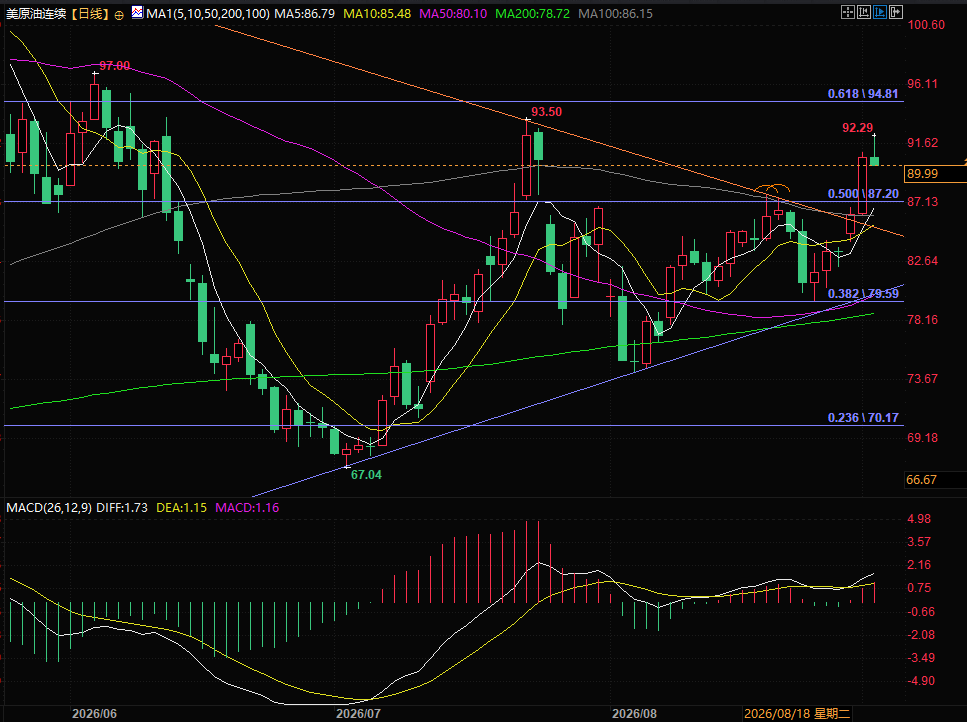 (WTI crude oil futures daily chart, source: EasyTrade) At 15:52 Beijing time, WTI crude oil futures were trading at $90.23 per barrel.
Key catalyst: The US implements new "tanker-to-tanker" policy, escalating the confrontation.
The core variable in this round of turmoil is the newly implemented US policy of attacking Iran. According to Axios, the US military launched a new round of military strikes against Iran on Tuesday, targeting two Iranian government oil tankers anchored in Iranian waters north of the US blockade line. This marks the first time the US has used retaliation for Iranian attacks on merchant ships in the Strait of Hormuz as the primary reason for striking Iranian oil tankers, completely overturning the previous logic of targeting only vessels illegally navigating the Strait. This operation relies on the new "tanker-to-tanker" policy approved by Trump, with the core objective of strongly deterring Iranian attacks on ships and ensuring commercial shipping order in the Strait of Hormuz. In addition to oil tankers, this round of US strikes also precisely targeted key military facilities of the Iranian Revolutionary Guard, including air defense positions, radar detection equipment, mine-laying facilities at sea, communication systems, anti-ship missiles, and attack drone launchers, comprehensively weakening Iran's maritime deterrent capabilities.Situation Recap: Multiple Clashes Between the US and Iran Escalate the Gulf Standoff
This round of escalation began after the military standoff ended at the end of the month. Following more than a month of relative calm, the US recently resumed military strikes against Iran, precisely targeting rocket launchers on Iranian islands in the Strait of Hormuz, breaking the deadlock. In response, Iran launched a multi-regional counterattack, launching missiles at US bases in Jordan, dropping drones into Kuwaiti airspace, and launching an airstrike on Bahrain early Wednesday morning. Bahrain, the UAE, and other US allies in the Gulf activated their air defense systems, successfully intercepting all incoming targets, plunging the Gulf region into a tense situation of multi-point standoffs. Simultaneously with the escalation of military strikes, the US intensified economic sanctions, forming a dual containment pattern of "military pressure + financial blockade." During the month-long standoff, the US continued to strengthen its maximum economic pressure on Iran, introducing several sanctions, including new regulations targeting the UAE branch of Misr Bank, Egypt's second-largest bank, aiming to cut off its dollar financial channels and foreshadowing a new round of sanctions against foreign banks, comprehensively blocking Iran's overseas trade and capital flows. Currently, Iran is experiencing high inflation, negative economic growth, and continuous currency devaluation, bringing its economic system to the brink of collapse. As its core economic pillar, crude oil exports are facing increasing pressure on its survival.Impact on the spot market: Traffic flow on core shipping routes has decreased sharply, leading to lower efficiency in spot market circulation.
The ongoing military conflict is directly impacting the global crude oil supply chain and trading market. As a core hub for global energy trade, the Strait of Hormuz handles one-fifth of the world's maritime crude oil trade. Since the joint US-Israeli military action against Iran in February, the strait has been in a semi-closed state, posing significant safety risks to shipping. Despite repeated claims by the US that the strait is open, actual traffic has shrunk dramatically. Data from ship tracking agency Kpler shows that only four merchant ships successfully passed through the Strait of Hormuz on Tuesday, far fewer than the 10 ships of the previous day and significantly lower than the ten-day average of 13, indicating continued low activity. The vessels passing through included mainstream oil tankers such as Very Large Crude Carriers (VLCCs) and Panamax tankers. This sharp reduction in strait capacity has directly led to a decrease in the efficiency of global crude oil spot market circulation.Market fundamentals analysis: Short-term geopolitical gains, medium- to long-term macroeconomic fundamentals cap the rally.
Fueled by extreme geopolitical tensions, risk aversion in the oil market has surged across the board, with WTI crude oil prices breaking through $90 per barrel, an increase of over 30% since the initial outbreak of the conflict, demonstrating significant short-term strength. However, it's important to clarify that this round of oil price increases lacks fundamental support; the core driving force comes entirely from the risk premium resulting from the disruption of shipping in the Strait of Hormuz. From a core macroeconomic perspective, high oil prices raise inflation expectations, which will force US Treasury yields upward, increasing the pressure on the Treasury to issue more US Treasury bonds, exacerbating the risk of stagflation, and negatively impacting the election. Therefore, the US has an incentive to avoid a sustained and significant rise in oil prices. Coupled with the current global economic slowdown and overall weak end-user demand for crude oil, there is no fundamental demand basis for sustained price increases, making the upward trend inherently unsustainable.Market Outlook: Short-term sentiment provides support, but medium- to long-term upside potential is limited.
The fundamental shift in the US's negotiating stance has further amplified short-term market uncertainty. Trump publicly denied market rumors of pressuring Iran to negotiate, stating that he had no intention of forcing Iran to sign an agreement and was more pleased with the current situation where the US controls the Strait and Iran's economy continues to collapse. He also issued a strong warning of more intense retaliatory strikes against Iran. The US's attitude of "refusing reconciliation and continuing to exert pressure" means that the US-Iran standoff is likely to continue for a long time, and short-term shipping risks in the Strait will persist, providing temporary support for oil prices. However, from the supply side, there has been no substantial supply disruption in the Strait. Sellers can still ship crude oil overseas via small vessels and smuggling. Global crude oil reserves are ample, with no rigid supply-demand gap, fundamentally locking in the long-term bullish potential for oil prices. Technical Analysis: As analyzed in previous articles, oil prices did not experience a significant pullback after breaking through the descending triangle resistance line, and subsequently broke through strongly. Current support is around 88.50, which is a recent key level for determining whether the market is bullish or bearish. (WTI crude oil futures daily chart, source: EasyTrade) At 15:52 Beijing time, WTI crude oil futures were trading at $90.23 per barrel.
- Risk Warning and Disclaimer
- The market involves risk, and trading may not be suitable for all investors. This article is for reference only and does not constitute personal investment advice, nor does it take into account certain users’ specific investment objectives, financial situation, or other needs. Any investment decisions made based on this information are at your own risk.